
.webp)
Post Summary
It's 11am on a Tuesday. No warning. The health inspector walks in.
The dining room looks fine. Tables wiped, floors swept, host stand clean. Then they head to the back.
Floor drains with grease buildup. An ice machine that hasn't been descaled in three months. A hood filter that's past its cleaning window by two weeks. And a paper cleaning log sitting on the shelf with entries that clearly weren't filled in daily. Some dates are missing entirely. A few look like they were written in the same pen at the same time.
This is not a story about a dirty restaurant. It's a story about a restaurant with no cleaning system.
Most restaurants clean. Very few have a documented, scheduled, verifiable cleaning program. And across multiple locations, that gap gets wider every week.
This guide gives you a complete restaurant daily cleaning checklist, a kitchen cleaning checklist for BOH, and weekly and monthly schedules for both FOH and BOH. Plus a framework for making them stick across every location.
.webp)
Related Resources
- The Complete Restaurant Operations Management Guide
- Restaurant Opening and Closing Checklists: The Complete FOH & BOH Guide
- Restaurant Food Safety Standards: What Every Operator Needs to Know
- How to Run Consistent Restaurant Audits and Inspections
- How to Pass a Restaurant Health Inspection: Prep Guide and Checklist
.svg)

Priced on per user or per location basis
Available on iOS, Android and Web


Why a cleaning schedule matters more than cleaning effort
First, three terms worth knowing. They're not interchangeable, and health departments treat them differently.
- Cleaning removes visible dirt and food debris.
- Sanitizing reduces pathogens to safe levels on a surface that's already been cleaned.
- Disinfecting eliminates pathogens entirely.
Different areas of a restaurant require different standards. A dining room table gets cleaned and sanitized. A prep surface that touched raw protein gets cleaned, sanitized, and sometimes disinfected.
Knowing the difference matters for health code compliance. An inspector doesn't just look at surfaces. They look at whether you're cleaning, sanitizing surfaces, or disinfecting them, and whether you can show a record that proves it.
But the bigger point is this: frequency and documentation matter as much as method.
A cleaning system isn't "clean when it looks dirty." It's a documented schedule that tells your team what gets cleaned, how often, by which role, and what it looks like when it's done.
Health departments don't just inspect surfaces. They inspect records. If your log is empty or backdated, the clean surface doesn't save you.
The multi-unit version of this problem is worse. At one location, a meticulous GM enforces a cleaning standard through presence and habit. At fifteen locations, that standard degrades the moment the GM changes.
Without a centrally defined, documented schedule, multi-location accountability breaks down. Every location runs a slightly different cleaning program, and most operators don't find out until an inspection.
**
What "cleaning when it looks dirty" creates, What a scheduled system creates
Reactive response to visible problems, Preventive compliance before problems appear
No documentation for health inspectors, Dated log showing what was cleaned and by whom
GM-dependent standards, Location-independent standards
Unknown equipment maintenance windows, Scheduled descaling-filter changes and deep cleans
Violations that surprise you, Violations that were already on your radar
**
What goes on a restaurant daily cleaning checklist?
Daily cleaning isn't about appearances. These are the tasks that directly affect food safety and health code compliance every single service period. Miss them and you're not just dirty. You're non-compliant.
Front of house daily cleaning checklist
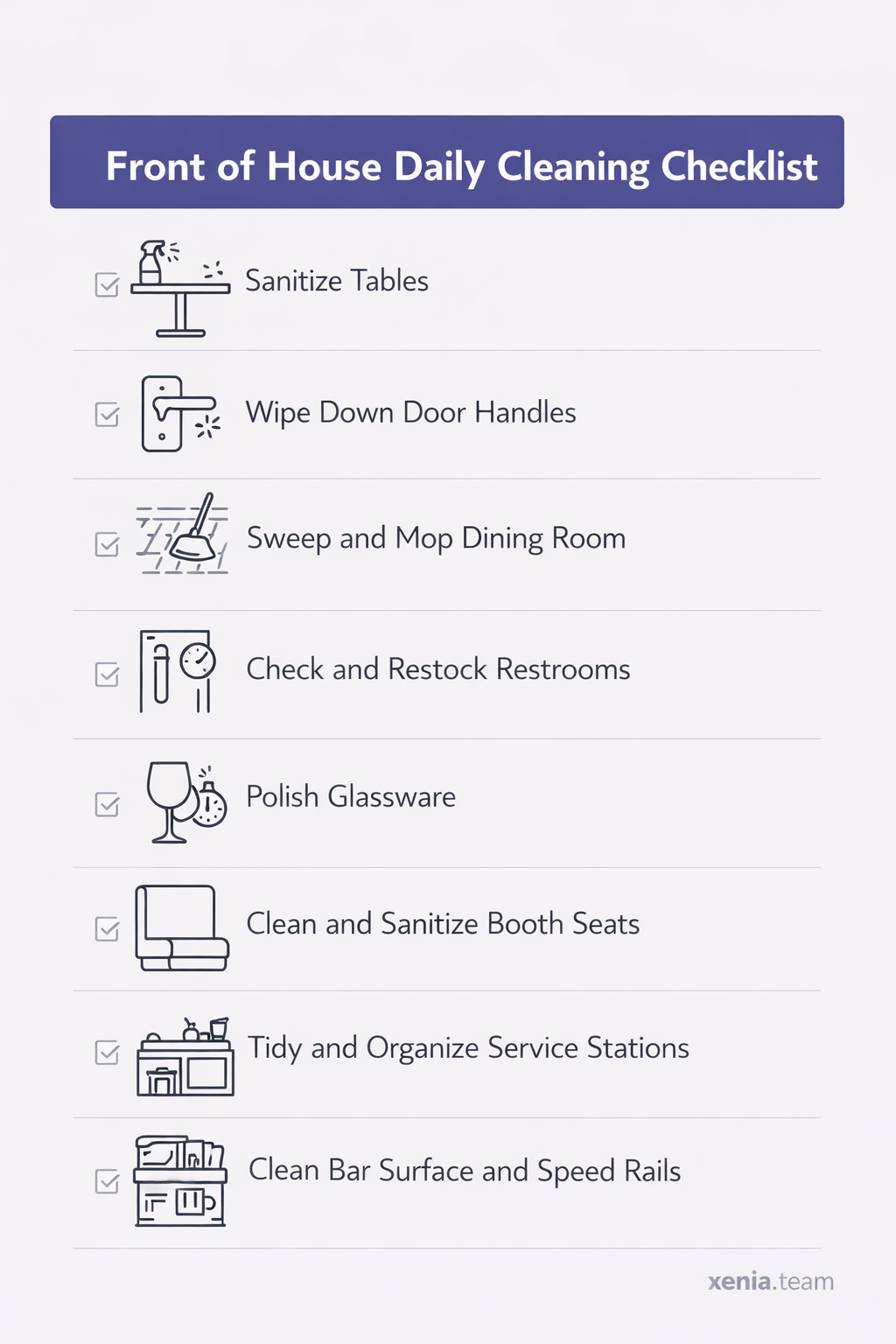
- Wipe all table surfaces with sanitizing solution between every cover and at shift end
- Clean and sanitize all high-touch surfaces: door handles, menus, menu holders, host stand, POS touchscreens
- Sweep and mop the dining room floor at opening and closing
- Clean and restock restrooms every two hours during service and at closing
- Polish glassware and silverware before service
- Wipe down upholstered chairs and booth seating
- Clean all service stations and waitstations
- Wipe down bar surfaces, speed rails, and drink dispensers
A restaurant sanitation checklist covers these tasks specifically, the ones that need sanitizing solution, not just a wipe-down.
The restroom check every two hours is the one most restaurants let slide during a busy lunch. It's also the one guests notice most. A dirty restroom mid-service is a review waiting to happen.
Download the template here: Restaurant Kitchen Cleaning Daily Checklist
Back of house daily cleaning checklist
.webp)
- Wipe all prep surfaces and cutting boards with sanitizer after every use and at the end of shift
- Degrease the grill, flat-top, and fryers after service
- Sweep and mop kitchen floors after prep and after service
- Clean floor drains: pull out debris, flush with hot water, sanitize the covers
- Wipe cooler handles and shelves
- Clean the dish machine: wipe inside, check sanitizer levels, clean the traps
- Empty, sanitize, and reline all trash cans
- Clear all food debris off cooking equipment
The floor drain is the one that surprises operators during inspections. It doesn't look dangerous. It smells before it looks wrong. By the time it's visible, it's already a citation. Daily flushing prevents the buildup that weekly cleaning alone can't fix.
What goes on a restaurant weekly cleaning checklist?
A weekly restaurant cleaning schedule catches what daily cleaning can't. It's also where most of the serious health code violations come from, because weekly tasks get deprioritized during busy weeks and skipped entirely during short-staffed ones.
BOH weekly deep cleaning checklist
.webp)
- Deep clean and descale the ice machine: drain, scrub interior, sanitize, refill
- Pull out all kitchen equipment and clean underneath and behind
- Clean grease trap, or schedule service if using an external contractor
- Deep scrub floor tiles and grout with degreaser
- Clean and degrease hood filters, or replace per schedule
- Sanitize and reorganize the walk-in cooler: check temperatures, FIFO organize, wipe all shelving
- Clean dish machine interior: delime, check spray arms, replace gaskets if worn
- Wipe down walls around all cooking equipment
Ice machine cleaning is consistently the most cited gap in restaurant health inspections and the most commonly missed item on cleaning schedules. It looks clean inside. It isn't. Biofilm and mold grow in the moisture and darkness. Most operators only think about it when they smell something. By then it's already a problem.
Download the template here: Restaurant Kitchen Cleaning Weekly Checklist
FOH weekly cleaning checklist
.webp)
- Dust and wipe light fixtures, ceiling fans, and vents
- Clean windows and glass inside and out
- Wipe down wall decor, artwork, and shelving
- Deep clean the bar: speed rails, ice bins, taps, and drain mats
- Spot clean booths, chair cushions, and banquettes
- Sanitize condiment holders, salt and pepper shakers, and table caddies
What goes on a restaurant monthly cleaning checklist?
Monthly tasks are where restaurant deep cleaning lives. These are the jobs that daily and weekly schedules can't reach. Hood exhaust systems. Condenser coils. Walk-in freezer walls. Skip them long enough and they quietly accumulate into health code violations and equipment failures.
Monthly restaurant cleaning schedule
.webp)
- Deep clean the hood exhaust system, or book a certified contractor to do it
- Descale coffee machines, steamers, and combi ovens
- Clean and check refrigerator condenser coils and door gaskets
- Test the fire suppression system and log the result
- Clean and check all grease interceptors
- Wash and sanitize all floor mats and anti-fatigue mats
- Deep clean the walk-in freezer: defrost if needed, wipe walls and ceiling
- Run pest control and document it
- Review the cleaning schedule and update anything that has changed
A note on the hood exhaust system: in most jurisdictions, this requires a certified contractor, not in-house staff.
The cleaning frequency depends on your cooking volume and fuel type. High-volume fryer operations may need quarterly professional cleaning. Document every service visit and keep the contractor's certificate on file. Inspectors ask for it
Looking for a cleaning schedule template you can customize for your locations?.
Download the template here: Restaurant Kitchen Cleaning Monthly Checklist
How multi-unit operators enforce cleaning standards consistently
A cleaning schedule is only as consistent as the system around it. Food safety compliance and multi-location accountability don't happen because GMs care. They happen because the system is built to make it impossible to skip.
Here's what actually works:
Assign ownership, not "everyone." Every task has a named role. AM opener cleans restrooms at open. Closing line cook degreasers the fryers. Closing manager runs the floor drain flush. "The team" cleans it means no one cleans it.
Build time blocks into the schedule. "Clean the fryers" at an unspecified time gets skipped during a rush. "Fryer breakdown: 10:30pm to 11:00pm, assigned to closing line cook" gets done because it's a named task with a named owner and a named window.
Document completion, don't assume it. Cleaning logs create a record for health inspectors and for internal accountability. If it's not logged, it wasn't done, at least not provably. This distinction matters when an inspector asks you to produce documentation.
Audit for cleaning drift quarterly. Cleaning standards degrade over time without regular manager walkthroughs against the documented schedule. A quarterly walkthrough specifically comparing actual practice to the written standard catches drift before it becomes a citation.
Update the schedule when operations change. New equipment, a different menu, a layout change, a new vendor. Any of these can make your existing cleaning schedule incomplete. Assign one person to own the cleaning schedule and review it after any operational change.
One operations manager at a 36-store chain described the problem clearly. She asked every location to send her their cleaning checklist. They all covered the same general areas. None of them were in the same format. None had the same frequencies. None assigned specific roles to specific tasks. Every location was running a different cleaning program under the same brand name.
Why restaurant cleaning programs fail
Most restaurants have cleaning checklists. Most of them break down somewhere in execution. Here's exactly where.
**
Failure point, What's actually happening, The fix
No schedule-just habits, Cleaning happens when things look dirty-not on a defined cadence, Build a documented daily-weekly and monthly schedule with named ownership
The ice machine blind spot, It looks clean-so it gets skipped until the inspection, Put it on the weekly schedule explicitly with a named owner and a completion log
Turnover wipes out institutional knowledge, The cook who cleaned the floor drain every Friday left-nobody told the new hire, Written schedule-not verbal handoffs. If it's only in someone's head it leaves with them
Paper cleaning logs, Backdated-pre-filled or simply absent, A paper log nobody enforces creates false compliance confidence-worse than no log
No verification step, Checked off doesn't mean done, Require photo evidence on critical cleaning items: ice machine interior-floor drains-hood filters
**
The paper log problem deserves its own call-out. We've heard from operators who walked into a location during an unannounced internal audit and found a cleaning log that was clearly filled in all at once, in the same handwriting, with the same pen, covering two weeks of entries.
The location looked clean. The log was worthless. And if a health inspector had asked for that documentation, the conversation would have gone badly.
How Xenia helps
Everything covered in this article, the daily tasks, the weekly deep cleans, the monthly contractor schedules, the documentation that health inspectors ask for, only works consistently if there's a system behind it that doesn't depend on any single GM's habits or memory.
That's the gap most multi-unit operators are trying to close. Not a cleaning problem. A visibility and accountability problem.
Platforms like Xenia let operators assign cleaning tasks by shift and role, so the right person gets the right task at the right time.
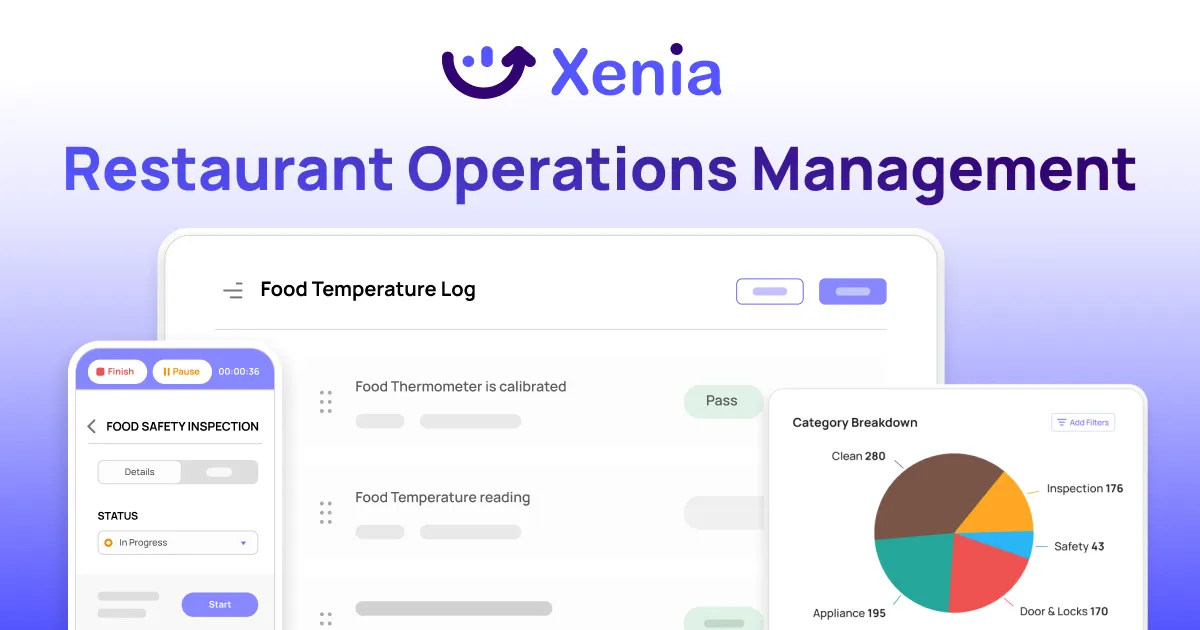
Critical items like ice machines, hood filters, and floor drains require photo verification before the task closes, which means "checked off" actually means done.
Every completed task is logged with a time stamp and a name, giving managers a digital cleaning record that satisfies health department documentation requirements without a single paper clipboard.
For a district manager covering 10 or 15 locations, that means you stop finding out about cleaning gaps at inspections. You see them the same shift they happen.
See how Xenia works for multi-unit restaurants.
Conclusion
A cleaning schedule isn't extra work. It's the work.
The restaurants that fail inspections aren't always the dirty ones. They're the ones that couldn't prove what got cleaned, when, and by whom. A clean surface without a record is just a surface.
Daily tasks keep you compliant. Weekly tasks keep you safe. Monthly tasks keep your equipment running and your inspectors satisfied.
And a system that enforces all three the same way across every location is what separates a brand from a collection of individually-run restaurants.
Frequently Asked Questions
Got a question? Find our FAQs here. If your question hasn't been answered here, contact us.
Do digital cleaning logs work for health inspections?

Generally yes. A digital log with time stamps and photos is usually more credible than a paper log. Requirements vary by location, so check with your local health department before going fully paperless.
What happens when someone skips a cleaning task?
On paper, nothing happens until an inspector visits. On a digital platform, an incomplete task sends an alert to the manager before the shift ends. You catch it the same day, not weeks later.
Can cleaning tasks be assigned to specific people?
Yes. Instead of sending a list to "the team," tasks get assigned to specific roles, closing line cook, AM opener, FOH lead, tied to specific shift windows. The right person gets the right task at the right time.
What is a digital cleaning log?
It's a record of completed cleaning tasks in an app instead of on paper. Each task is logged by a named user with a time stamp. You can pull it up during a health inspection without digging through a binder.
Can you track cleaning tasks on a spreadsheet?
You can store the schedule in a spreadsheet. But it can't tell you if the task was actually done, who did it, or when. For one location with a hands-on manager, it works. For multiple locations, it breaks down fast.


A Modern, AI-Powered Platform Built for Restaurant Operations
Xenia brings kitchen operations, food safety, audits, and team communication into one mobile-first platform. Restaurant teams execute daily work consistently, maintain compliance, and resolve issues faster, while leadership gets real-time visibility across all locations.
.webp)
Why Restaurant Operators Choose Xenia:
🤖 AI-Powered Operations, Convert paper logs instantly and verify food presentation and kitchen cleanliness automatically. Get instant answers about food safety trends without building reports.
🍽️ Food Safety & Compliance, Track line checks and temperature logs with automated alerts. Trigger corrective actions when readings exceed safe ranges. Maintain audit-ready records for health inspections.
📊 Multi-Location Control, Monitor food safety compliance and task completion across regions. Benchmark locations to identify training needs. Export reports for operational reviews.
One platform for kitchen operations, food safety, and compliance across all locations.

.svg)
.webp)
%201%20(1).webp)

.svg)
%201%20(2).webp)