
Post Summary
Here is a number that should bother you: roughly 80% of the global workforce does not sit at a desk. No corporate email. No Slack. No intranet. Just a shift, a manager, and whatever information happens to trickle down before the doors open.
Most internal communication frameworks were built for the other 20%. They assume everyone has a laptop, checks email, and has time to read a 14-slide deck from HR. For frontline businesses running restaurants, retail stores, or convenience locations across dozens of sites, those frameworks break down fast.
This guide is not about picking a messaging app. It is about building the actual communication system behind your frontline operation. You will get a clear breakdown of the four types of internal communication, a practical channel mix, eight real examples, and a five-step framework for a frontline communication plan that holds up at scale.
.svg)

Priced on per user or per location basis
Available on iOS, Android and Web


Related resources
- Strategies for effective frontline employee communication
- Deskless worker team communication
- Best restaurant communication apps
- Retail store communication software
- Streamline communication between HQ and retail branches
What is internal communication and why it fails on the frontline
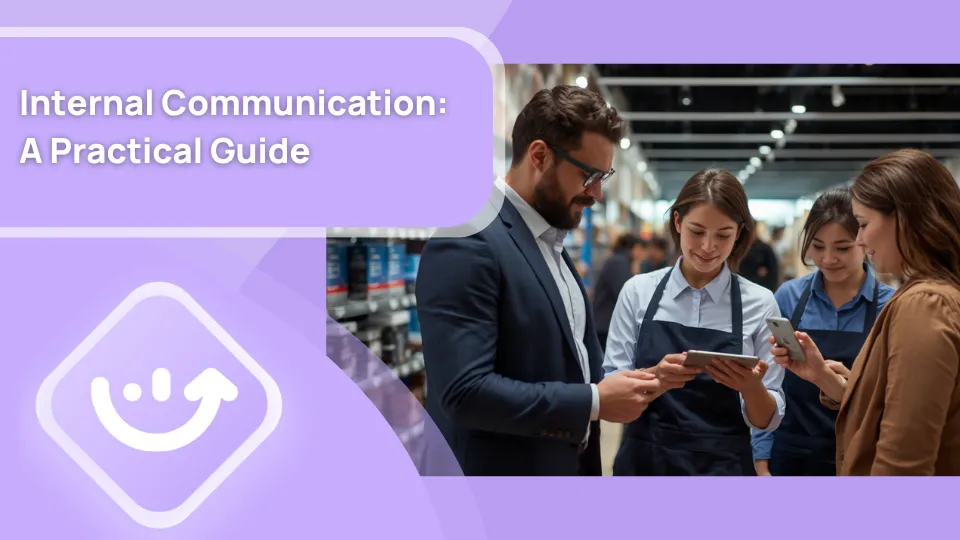
Internal communication is any exchange of information within an organization. That covers everything from a general manager briefing the morning crew to a regional director sharing audit results with store leads.
The challenge for multi-site operators is that the standard model assumes shared digital infrastructure. Most internal communication frameworks lean on email threads, intranet announcements, and calendar invites. Frontline staff rarely have access to any of those.
What frontline internal communication actually looks like in practice:
- A new food safety policy gets emailed to the GM. The GM tells the shift leads verbally. The shift leads tell staff during a 3-minute huddle. By the fourth location, the message has changed.
- A product launch brief gets posted in a Slack channel that half your staff cannot access because they do not have company phones.
- An HR update goes out company-wide. Three weeks later, a store associate has never heard of it.
This telephone-game dynamic is not a people problem. It is a systems problem. When there is no channel designed for frontline realities, information gets filtered, delayed, or dropped entirely. Building the right system starts with understanding what types of communication you are actually dealing with.
4 types of internal communication every multi-site operator must master
What are the 4 types of internal communication? They are vertical, horizontal, diagonal, and external-facing internal communication. Here is what each one means and how they play out across a frontline operation.
**
Type, Direction, Example
Vertical (top-down), HQ to store, SOP updates-policy rollouts-brand standards
Vertical (bottom-up), Store to HQ, Compliance flags-feedback-incident reports
Horizontal, Peer to peer, Store manager to store manager-team to team
Diagonal, Across hierarchy and departments, HR to a frontline associate-ops to a kitchen lead
External-facing internal, Staff to customer, Scripts-talking points-FAQ responses
**
Vertical communication is the one most operators focus on. HQ to store is obvious. But bottom-up vertical communication is what most miss. If your store teams have no reliable way to surface problems upward, you are flying blind on what is actually breaking down in the field.
Horizontal communication is underrated. When two store managers share a best practice about a product substitution that worked, that is organizational learning happening without any formal process. Most frontline setups have no structure for it at all.
Diagonal communication is trickiest to manage. When HR needs to communicate directly with a frontline employee, bypassing their immediate manager creates tension if done wrong. Done right, it builds trust and reduces manager filtering. The key is transparency: the manager should know the communication happened.
External-facing internal communication is often overlooked entirely. What your staff say to customers is a direct output of what you told them internally. If your product launch brief does not include a customer FAQ, your frontline team will improvise. Sometimes well. Often not.
Internal communication channels: a multi-site channel mix reference
The right internal communication channels depend on who you are trying to reach, what you are trying to say, and how fast you need it to land.
**
Channel, Best for, Frontline fit
Push notification app, Urgent-role-based messages, High
Shift huddle, Daily alignment-in-person, High
Manager-to-staff 1:1 chat, Private feedback-HR matters, High
Digital bulletin board / signage, Passive awareness-reminders, Medium
Newsletter or email, HQ-only announcements, Low (for frontline)
Document library, SOPs-brand standards-training, High
Town hall / all-hands, Quarterly culture-strategy, Medium
**
A few things worth calling out here.
Email is a low-fit channel for frontline staff. If your primary distribution method for critical updates is email, you are already behind. Most hourly staff check personal email infrequently and almost never during a shift.
Digital communication tools built for frontline realities fix this. A mobile-first push notification that lands on someone's phone before their shift starts is a fundamentally different experience than an email that sits unopened for four days.
The document library channel is underused. A centralized, searchable library of SOPs and brand standards is not just a storage system. It is a channel. When a new hire can pull up the correct procedure on their phone mid-task, that is internal communication happening at the point of need.
For a closer look at how communication apps stack up across restaurant operations specifically, see Xenia's best restaurant communication apps guide. For retail contexts, the retail store communication software breakdown covers channel options by use case.
8 internal communication examples for multi-site operators
These are not hypothetical. Each one covers a real communication scenario and the channel mix that actually works.
1. New SOP rollout
Send a pre-read via your operations platform 48 hours before the effective date. Follow with a 30-second video from the ops lead explaining the why. Have managers run a 5-minute Q&A during the next shift huddle. Require acknowledgment in the system so you know who has and has not seen it.
2. Product launch
Distribute a staff script plus a customer FAQ to all store leads three days before launch. Run a role-play during the pre-shift huddle on day one. Spot-check execution with a quick photo submission from the floor.
3. Food safety recall or crisis communication
Push an urgent notification to all affected locations immediately. Include a scripted manager talking-points document. Follow up with a checklist to confirm product removal and staff briefing.
4. Manager-to-DM weekly performance summary
A structured weekly summary from each GM to their district manager. This does not need to be a long report. A consistent format covering task completion rate, open issues, and one observation is enough. Diagonal communication at its most useful.
5. Frontline-to-HQ feedback loop
Build a standing channel for store teams to surface what is broken. A simple weekly prompt such as "what slowed your team down this week?" routed to an ops lead creates a bottom-up feedback loop that most operators do not have.
6. Brand standard reinforcement
Send a photo of the correct standard alongside the current audit expectation. Attach it to the recurring inspection checklist so it appears at point of use rather than buried in a training folder.
7. Schedule change communication
Push notifications to affected staff only. Not a broadcast to everyone. Targeted, role-based digital communication reduces noise and makes the message more likely to be read.
8. Recognition and shout-outs
A manager calling out a team win in the group chat before shift takes 90 seconds. The effect on morale lasts longer than any formal program. This is horizontal communication doing real work.
You can also explore Xenia's guide on strategies for effective frontline employee communication for a deeper look at the tactical side of this.
A 5-step frontline communication plan framework
What is an example of an internal communication plan? A practical frontline communication plan has five components: audience map, message map, channel mix, cadence, and feedback loop. Here is how to build each one.
Step 1: Audience map
Before you write a single message, document who actually needs it. Break this down by role and location, not just by "all staff." A food safety policy update matters to kitchen staff at every location. It does not need to go to your corporate finance team in the same format.
Step 2: Message map
For each major communication type, define the message, the required frequency, and the medium. A simple table works well here.
**
Message type, Audience, Frequency, Medium
SOP updates, All frontline staff, As needed, Document library + acknowledgment
Brand standards, Store managers, Monthly, Audit checklist + visual reference
Recognition, Team level, Weekly, In-app shout-out
Safety alerts, All staff, Immediate, Push notification
Feedback collection, All frontline, Weekly, Structured prompt
**
Step 3: Channel mix
Match the channel to the audience and the urgency. Push notifications for urgent and role-based messages. Shift huddles for context-heavy updates that need two-way discussion. Document library for reference material people need during work, not before it.
Step 4: Cadence
Set a communication rhythm and stick to it. Daily shift huddles. Weekly manager summaries. Monthly brand standards review. Quarterly all-hands or town hall. Ad-hoc for safety and crisis situations. The cadence reduces noise and builds trust. Staff know when to expect information and where to find it.
Step 5: Feedback and measurement
One-way communication is not communication. It is broadcasting. Build in read receipts or acknowledgment tracking so you know who has and has not received critical updates. Run a short quarterly staff survey to identify where the system is breaking down. Track metrics like message acknowledgment rate, response time on flagged issues, and manager comms effectiveness scores.
Communication skills training for frontline managers: what actually works
How frontline managers communicate directly determines how information moves through your organization. Most of what they learned about communication was informal. That is fine for some things and not fine for others.
Four skills matter most at the frontline manager level.
Active listening is the one most overlooks. A manager who asks "what slowed you down today?" and actually acts on the answer sends a very different signal than one who asks the same question without follow-through.
Clear escalation is about giving managers a defined path for surfacing problems upward. Without it, managers either hold issues locally until they compound, or escalate everything and create noise.
Recognition is a communication skill. Calling out good work specifically, with context, builds a team culture where people feel accountable. Vague praise does nothing.
Feedback delivery is the hardest one to train. Managers who can deliver corrective feedback in a way that feels helpful rather than punitive keep good staff longer.
Training format matters too. A two-hour classroom session on communication skills has a low retention rate in a frontline environment. Microlearning, role-play during shift huddles, and manager scorecards that track communication effectiveness all outperform formal training in retention and behavior change.
For more on how training builds long-term operational alignment, see frontline employee training.
Common frontline internal communication mistakes
These come up often enough to be worth naming directly.
Treating frontline staff as a single audience is the most common. A kitchen lead and a front-of-house associate have different responsibilities, different schedules, and different information needs. Sending the same message in the same format to everyone ensures it is relevant to no one.
Using email as a primary channel. Already covered above but worth repeating. Email does not reach hourly staff on shift. It just creates the illusion that communication happened.
No feedback loop. When information only flows one direction, you build a culture where problems get hidden rather than surfaced. Frontline staff stop telling managers things because nothing ever changes when they do.
Manager filtering. When a district manager tells a general manager who tells a shift lead who tells staff, four layers of interpretation happen. By the end, the message may be technically accurate but practically useless. Some information needs to go directly to the people who need it, with the manager in the loop but not as the relay.
Conclusion
Internal communication across a frontline workforce is not complicated in theory. Get the right information to the right people at the right time, and build a path for information to flow back up. The execution is where it breaks down.
The channel mix matters. The cadence matters. And none of it works if your tools were built for desk workers while your team is running a shift.
Xenia's frontline communication module ties messages directly to operational tasks so the right people get the right update at the right moment and you can see who acknowledged it across every location. See it in action.
Frequently Asked Questions
Got a question? Find our FAQs here. If your question hasn't been answered here, contact us.
How is frontline internal communication different from corporate?

Channel access. Corporate frameworks assume email, intranet, and a laptop. Most frontline staff have none of that during a shift. A frontline communication plan has to be mobile-first, shift-aware, and role-specific. It also has to account for manager mediation, where one person becomes the human relay for a whole team, something corporate frameworks rarely think about.
What is an example of an internal communication plan?
Figure out who needs what, pick the right channel, set a schedule, and confirm people actually saw it.
Safety alert? Push notification, right now, to everyone affected. New SOP? Post it in the document library and require staff to acknowledge it. Manager updates? A short weekly summary from the GM to the district manager, every week, same day.
If there is no way for staff to respond or push back, it is not a communication plan. It is just a one-way announcement system.
What is horizontal vs vertical vs diagonal communication?
Vertical is up and down. HQ sends a policy update to stores, that is top-down. A store manager flags a problem to the regional director, that is bottom-up.
Horizontal is side to side. Two store managers texting each other about what worked on a busy Friday. Same level, no hierarchy involved.
Diagonal is the odd one. HR talks directly to a cashier without going through the store manager first. Different departments, different levels, direct line.
What are the 4 types of internal communication?
Vertical is HQ talking to stores and stores talking back to HQ. Horizontal is teammates talking to each other. Diagonal is, say, HR reaching out directly to a floor associate. And external-facing internal communication is simply what you train your staff to say to customers.
Four directions. Each one needs its own channel to actually work.


A Modern, AI-Powered Platform Built Specifically for Frontline Operations
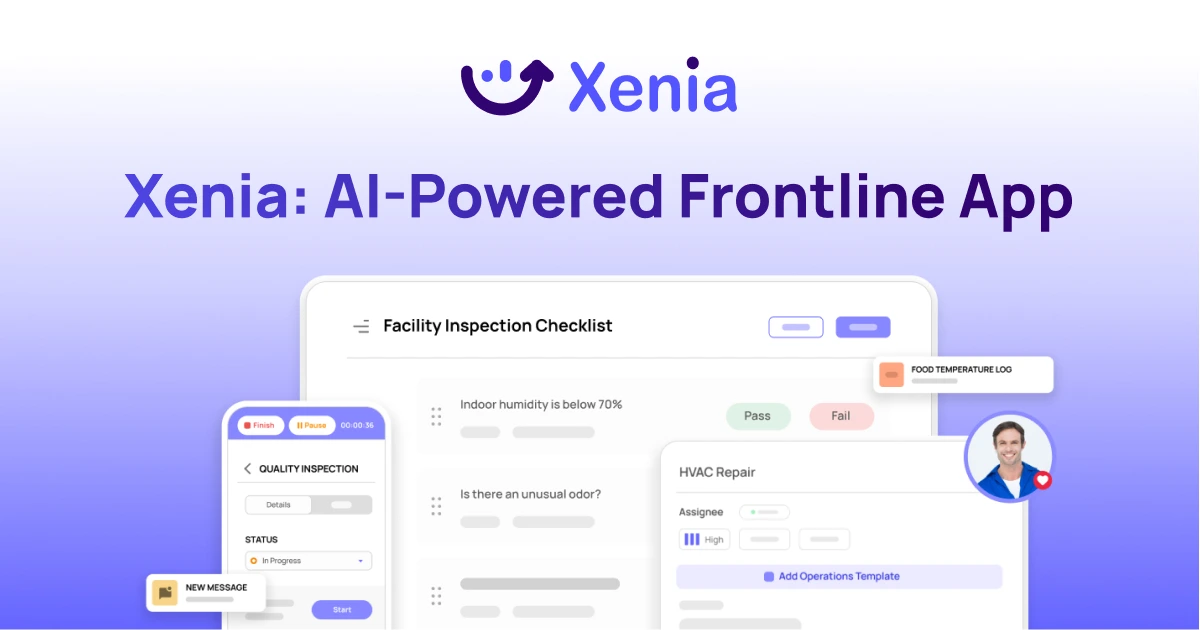
Xenia brings daily operations, maintenance, audits, and compliance into one mobile-first platform. Frontline teams execute work consistently across locations while leadership gets real-time visibility.
Why Multi-Location Operators Choose Xenia:
🤖 AI-Powered Operations, Create digital checklists instantly or convert paper forms with AI. Verify compliance automatically with photo analysis and get instant answers from your operational data.
✅ Daily Operations & Maintenance, Assign work across hundreds of locations in minutes. Report and route issues instantly. Schedule preventive maintenance to catch problems before downtime.
📊 Real-Time Visibility, Track completion, work orders, and performance across all locations through dashboards. Filter by site or asset to spot trends and take action.
Manage operations, maintenance, and compliance across all your locations from one platform

.svg)
.webp)
%201%20(1).webp)

.svg)
%201%20(2).webp)