
.png)
Post Summary
It's Wednesday morning. You manage HR across 18 locations.
An audit notice just landed in your inbox. The auditor wants training records for every employee across six states. Your coordinator is chasing paper I-9s. A manager is texting a new hire for the third time to sign a policy.
Nobody messed up. The process did.
Manual HR wasn't built for 50 locations. It was built for one. Most operators never updated it.
HR automation fixes that. It handles the repetitive work so your team doesn't have to.
Quick check: is your HR still fully manual?
- Does onboarding paperwork go out by email or print?
- Do managers track training in spreadsheets or by memory?
- Are compliance reminders sent by whoever remembers?
- Does offboarding mean someone walking through a checklist manually?
Two or more yes answers mean you have real automation opportunities right now.
.webp)
.svg)

Priced on per user or per location basis
Available on iOS, Android and Web


What is HR automation?
HR automation is software that handles repetitive HR tasks on its own. No one has to manually trigger anything.
A few things to clear up:
- It does not replace HR. It handles admin, not decisions.
- It is not AI. It runs on simple logic: if this happens, do that.
- It is not your HRIS. Your HRIS stores data. Automation does something with it.
HRIS vs HR automation: what's the difference?
**
Aspect, HRIS, HR Automation
What it does, Stores records-tracks status, Triggers workflows-sends assignments-escalates gaps
Examples, Workday-ADP-UKG-Paylocity, Onboarding sequences-training assignments-offboarding workflows
Role, The filing cabinet, The action layer
**
Most operators need both. The HRIS is the data source. Automation is what happens when something in that data changes.
Why frontline operations are different
In a corporate office, managers have time to follow up. Schedules are predictable. Everyone has a desk.
Frontline is different. Your managers are running the floor, covering call-outs, and dealing with customers all at once. Half your team will turn over within the year.
A process that depends on someone remembering to follow up will break. Not because people don't care. Because there's just too much going on.
Which HR processes are best suited for automation?
The sweet spot is anything high-volume and rule-based. Steps where the right outcome is always the same, regardless of who's doing them.
1. Hiring and applicant workflows
From application to offer letter, there are a dozen small handoffs: screening confirmation, interview scheduling, offer generation, background check initiation, pre-start paperwork.
Most of these don't need human judgment. They just need to happen on time, in the right order. Automation handles the handoffs and flags the hiring manager only when a real decision is needed.
2. New hire onboarding and document collection
This is the biggest automation win for most frontline operators and the area with the most compliance exposure when done manually.
Here's what automated onboarding looks like step by step:
**
Step, What happens automatically
New hire added to HRIS, Welcome message sent to employee's phone
Day 1, I-9 instructions-direct deposit form-handbook acknowledgment-role-specific compliance modules all assigned
Ongoing, Deadline reminders fire for incomplete steps
Manager view, Real-time completion status-no follow up required
**
The process runs the same at a busy QSR location during a holiday weekend as it does at a quiet retail site on a Tuesday. That's the point. A well-structured onboarding process should never depend on which manager is on shift.
For a comprehensive breakdown of what effective onboarding looks like step-by-step, see our complete employee onboarding checklist.
3. Scheduling and shift notifications
When a shift opens, the system identifies eligible employees and notifies them directly. No manager texting six people from their personal phone hoping someone responds.
When shift communication runs through automation instead of personal texts, there's an auditable trail, which matters when scheduling disputes come up.
4. Training assignment and completion tracking
Set the role. The training assigns itself. Right modules, right order, right deadline.
A new front-of-house hire gets food safety, allergen awareness, POS, and harassment prevention on day one. No one lifted a finger. Completions track automatically. Miss a deadline and the system alerts the manager.
For restaurant operators specifically, our guide on restaurant staff training topics covers the essential modules that should be part of your automated training sequences.
5. Policy acknowledgment and compliance sign-offs
When a policy update goes out manually, documentation is inconsistent. Emails get missed. Verbal confirmations leave no record.
Automated policy acknowledgment:
- Sends the update to every affected employee
- Collects a timestamped digital signature
- Tracks completion against the full roster
- Escalates non-completions automatically
When a health inspector asks for proof your team completed allergen training, you pull a report. You don't dig through old email threads.
6. Offboarding and account deprovisioning
Offboarding is the most underbuilt process in most frontline operations. When someone leaves, the required steps include:
- Final pay documentation
- System access termination
- Equipment return verification
- Benefits offboarding and COBRA notification
- Exit interview scheduling
- State-specific termination notice requirements
At a 100-location retail operator with high turnover, manually managing that list for every departure isn't realistic. Automated offboarding fires the moment a departure is recorded and closes out every step systematically.
We've created a complete employee exit interview checklist that shows what a thorough offboarding process should cover and how to structure exit interviews that capture valuable feedback before employees leave.
The ROI case for HR automation in frontline operations
The numbers are harder to ignore than most people expect.
Time cost of manual onboarding per hire
Brandon Hall Group research puts the fully-loaded onboarding cost per employee at over $4,100, accounting for HR time, manager time, and ramp-up productivity loss. A large portion is pure administration: documents going back and forth, follow-up reminders, steps getting missed and redone.
When onboarding is automated, that overhead drops significantly. HR only steps in when something is incomplete or needs a judgment call.
Turnover amplification in high-churn environments
**
Industry segment, Typical annual turnover
QSR / fast food, 75 to 100%+
Convenience stores, 50 to 75%
Hotel housekeeping, 60 to 80%
Casual dining, 50 to 70%
Amusement parks, Seasonal + 60%+
**
In a manual system, every new hire is another round of emails, printed forms, reminders, and follow-ups. The administrative load scales directly with turnover.
Automation breaks that relationship. The process runs the same whether you onboard five people this month or fifty. The time cost per hire drops as volume increases instead of multiplying.
Compliance cost of documentation gaps
An incomplete I-9. A food handler's certification that lapsed. A harassment prevention module that was assigned but never completed because a manager got slammed during a busy weekend.
These gaps happen in manual systems. Not because people don't care, but because the process depends on human memory across dozens of locations. The cost ranges from audit findings and regulatory fines to OSHA violations and EEOC exposure. Automation produces the documentation automatically. The audit trail exists without anyone building it after the fact.
Manager time recaptured per location
A store manager spends 3 to 5 hours a week chasing paperwork, following up on training, and sending compliance reminders.
Doesn't sound like much. But across 20 locations, that's up to 100 hours a week on tasks a system could just handle automatically.
Automate it, and that time goes back where it belongs. On the floor, with the team, running the store.
Consistency at scale
**
Locations, What breaks without automation
1 to 5, One strong manager can hold it together
10 to 15, Different onboarding packets-training tracked inconsistently
25+, Compliance exposure that's hard to see from the top
50+, Structural inconsistency across every HR process
**
Automation makes every location run the same way. Same onboarding. Same training. Same offboarding. Every time, no matter who's managing that week.
For retail operators specifically dealing with consistency challenges, our retail operations management guide explores how to standardize processes across distributed locations.
Common barriers to HR automation (and how to clear them)
You know automation makes sense. Here's what's stopping you, and how to fix it.
"We don't have the budget."
Run the actual math first. Manager hourly rate x hours per week on HR admin x number of locations. That's your current cost of not automating, and it's almost always larger than the tooling cost. It's just spread across time and headcount instead of appearing as a line item. Once you have that number, take it to whoever controls the budget conversation. A $40,000 tooling cost lands very differently when the alternative is $90,000 in manager time.
"Our team isn't technical enough."
Today's HR automation tools don't need an IT team. If your team can fill out a scheduling template, they can set up an onboarding workflow. Most platforms are up and running in days.
"We already have an HRIS. Isn't that enough?"
No. Your HRIS records that a new hire was added. That's it. Automation is what actually does something about it, sends the documents, assigns the training, triggers the sign-offs. One stores the data. The other acts on it.
"We're too small / too complex."
These cancel each other out. If you're small, limited HR bandwidth is exactly why automation matters. If you're complex, manual processes are already creating inconsistency across your locations. Neither is a reason to wait.
How to build an HR automation strategy that actually sticks
.webp)
Step 1: Start with onboarding
Almost every frontline operator should start here. It happens constantly, it's compliance-heavy, and it eats up manager time. Don't try to automate everything at once. Pick onboarding, prove it works, then move to the next thing.
Step 2: Map your current process first
Most operators skip this step. That's exactly why automation projects fail.
Automation doesn't fix a broken process. It just makes it faster. A step that gets skipped today will get skipped automatically tomorrow.
Write down what actually happens right now. Find the gaps. Fix them. Then automate.
If you're managing retail stores and need to see what a complete operational process looks like before automation, our daily store checklist shows the tasks that need to happen consistently across every location.
Step 3: Make it work on a phone
Think about your average team member. They're mid-shift, five minutes free, phone in hand.
That's your window. If your automation doesn't work smoothly in that moment, it won't work at all.
Pick a tool that's built for mobile from day one. Easy to tap, few steps, done fast. For deskless workers, a smooth phone experience is what separates a process people actually follow from one that gets ignored.
Step 4: Connect it to what you already use
Your automation should talk to your existing HR system. New hire added means onboarding fires. Role change means training updates. Departure means offboarding starts. Without that connection, you're running two separate systems and someone is manually keeping them in sync. That's the opposite of automation.
Step 5: Measure what changes
Before you automate anything, write down your numbers:
**
Metric, Measure before, Measure after (60 to 90 days)
Onboarding completion time, Days from hire to full completion, Same
Training completion rate, % completed by deadline, Same
Compliance gaps, Issues found in last audit, Same
Manager time on HR admin, Hours per week per location, Same
**
Then check the same numbers after 60 to 90 days. That's how you know it's working, and how you make the case to expand it further.
What to look for in HR automation software
**
Criteria, What good looks like, Why it matters
Mobile experience, Built mobile-first-not retrofitted from desktop, Frontline workers complete tasks on phones. Clunky means it won't get used.
Pre-built templates, Onboarding-offboarding-compliance workflows ready to configure, Weeks of setup time vs. days
HRIS integration, Bidirectional sync with Workday-ADP-UKG-Paylocity-Paycom, New hire triggers fire automatically; completions sync back without manual entry
Role-based access, Store-district and corporate levels each see what's relevant, Right visibility without overexposing sensitive data
Audit trails, Timestamped record of every completion-sign-off and escalation, Pull a report for regulators-don't reconstruct from memory
Location-level reporting, Completion rates by location-role and time period, Aggregate numbers hide problem locations. Location-level reporting doesn't.
**
One practical tip: grab your phone and try it yourself. If you struggle, your team will too.
Related Resources
- Employee Onboarding Checklist Template
- Employee Hiring Checklist
- Employee Exit Interview Checklist
- Staff Management Checklist App
- Store Operations Training Software
Conclusion
HR automation doesn't change what HR does. It changes how much of it has to be done by hand.
That matters most in frontline operations, where turnover means onboarding never stops, management bandwidth is thin, and every manual inconsistency compounds across locations.
The operators getting this right aren't doing anything complicated. They pick the process that runs most often, map it clearly, replace the manual triggers with automated ones, and measure what changes.
The goal isn't a smaller HR team. It's a team spending time on work that actually needs them, and a manager at every location who isn't buried in paperwork when they should be running their floor.
That's what automation actually buys you. Not less HR. More of the right kind.
Frequently Asked Questions
Got a question? Find our FAQs here. If your question hasn't been answered here, contact us.
What should I look for in HR automation software for frontline teams?

Start with the phone experience. If it's hard to use on mobile, your team won't touch it. Then verify that it integrates with your existing HR system, includes ready-made templates, maintains complete records, and displays location-level completion data.
Does HR automation eliminate compliance gaps entirely?
Not 100%. But it makes sure nothing gets forgotten. No more "oops, I forgot to assign that training." The system does it automatically, every time.
What HR processes should I automate first?
Onboarding. It happens the most, has the highest compliance risk, and takes up the most manager time. Get that running smoothly first, then expand.
How is HR automation different from an HRIS?
Your HRIS holds the data. HR automation does something with it. When a new hire is added, automation fires the onboarding sequence. Your HRIS just records it happened.

A Modern, AI-Powered Platform Built Specifically for Frontline Operations
Xenia brings daily operations, maintenance, audits, and compliance into one mobile-first platform. Frontline teams execute work consistently across locations while leadership gets real-time visibility.
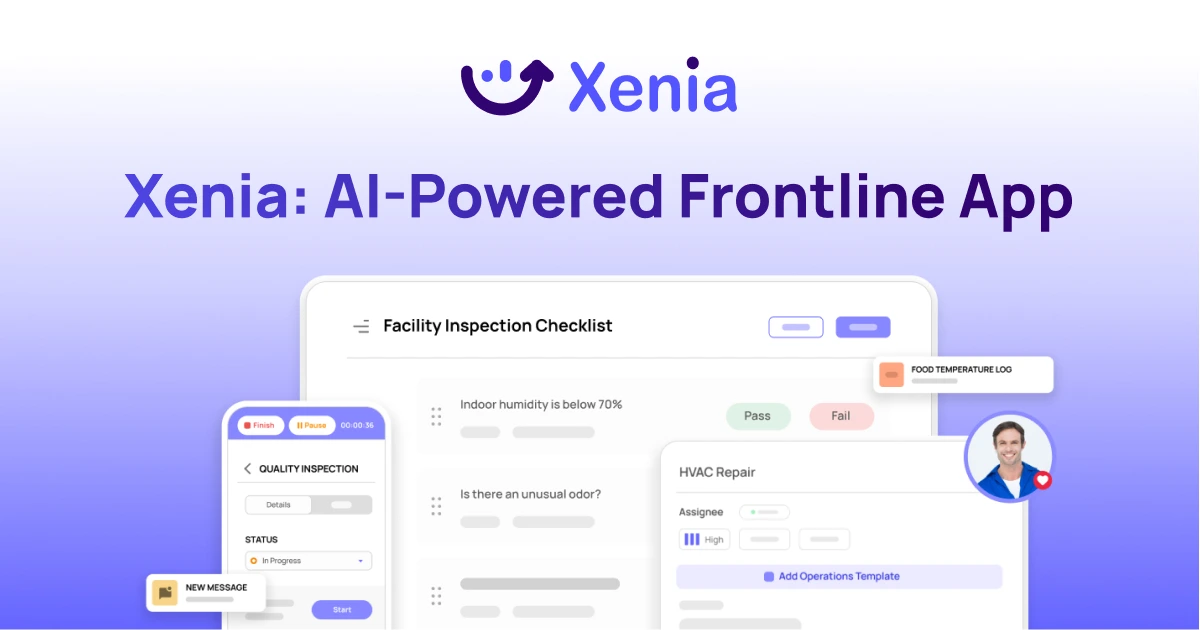
Why Multi-Location Operators Choose Xenia:
🤖 AI-Powered Operations, Create digital checklists instantly or convert paper forms with AI. Verify compliance automatically with photo analysis and get instant answers from your operational data.
✅ Daily Operations & Maintenance, Assign work across hundreds of locations in minutes. Report and route issues instantly. Schedule preventive maintenance to catch problems before downtime.
📊 Real-Time Visibility, Track completion, work orders, and performance across all locations through dashboards. Filter by site or asset to spot trends and take action.
Manage operations, maintenance, and compliance across all your locations from one platform

.svg)
.webp)
%201%20(1).webp)

.svg)
%201%20(2).webp)