
.webp)
Post Summary
Running one restaurant is hard. Running 10 of them consistently is a completely different problem.
Every location has its own team. Its own blind spots. Its own version of the closing checklist that is half-done by someone who was already clocking out. What a district manager needs is not another POS feature or a better scheduling tool.
They need to know, right now, whether the morning prep at location 6 actually happened, whether the walk-in at location 3 is holding temperature, and whether the corrective action from last Tuesday's inspection got resolved or just logged and forgotten.
That is what restaurant operations apps are for.
Not payroll. Not reservations. Not order processing. The daily operational work that happens between transactions and decides whether your locations run consistently or slowly drift apart.
This article covers 10 of the best restaurant operations software for multi-location teams in 2026. Every tool here was chosen because it helps managers run locations. Not just process orders.
For a broader look at running consistent multi-location operations, the restaurant operations management guide is a good place to start.
Restaurant Operations Apps vs Restaurant Management Software: What Is the Difference?
Most people use these terms like they mean the same thing. They do not.
Restaurant management software is your POS, your accounting platform, your inventory system. It handles transactions and business data. Restaurant operations apps handle what your team actually does between those transactions.
Here is the clearest way to think about it:
**
Category, What it handles, Examples
Restaurant operations apps, Daily checklists-food safety-inspections-task management-corrective actions-multi-site accountability, Xenia-MeazureUp-Lumiform-Bindy-Trail
Restaurant management software, POS-inventory-accounting-reservations-payroll, Toast-MarketMan-Restaurant365-OpenTable
**
Most multi-location restaurant operators need both running side by side. The problem is when teams buy a POS upgrade to fix an operational consistency problem. Those are not the same problem. And a new POS feature will not fix inconsistent opening procedures across 15 locations.
What to Actually Look for in a Restaurant Operations App
Before you look at a single tool, get clear on what your operation actually needs. Most buyers evaluate features. What you should evaluate is workflows.
Can your district manager see what happened at every location last night from one screen?
If not, you have not solved the visibility problem. You have just moved it online. Real cross-location visibility means one dashboard, real-time data, no phone calls required.
Does a flagged issue automatically become someone's responsibility?
A log entry that sits unread is identical to a paper note nobody acted on. The app needs to create an assigned task with a due date when something gets flagged. Logging a problem is not the same as fixing it.
Does it actually work on a phone in a loud kitchen with spotty Wi-Fi?
This sounds basic. But more tools fail this test than you would expect. If offline capability is weak, your team will take photos of the paper clipboard instead of using the app.
Does food safety live in the workflow, not in a separate binder?
HACCP logs, temperature monitoring, and food safety documentation need to be built into the daily checklist process. Not managed in a separate system that nobody opens.
Does it connect to your existing stack?
The right restaurant operations app works alongside your POS, not instead of it. Look for tools that integrate with what you already have.
The 10 Best Restaurant Operations Apps for Multi-Location Teams
.svg)

.webp)
**
Tool, Best for, Multi-site dashboard, Corrective actions, Food safety, Free plan
Xenia, Multi-location ops execution, Yes, Yes, Yes, Yes-5 users
MeazureUp, Multi-location audits and compliance, Yes, Yes, Yes, No
Lumiform, Inspections and digital checklists, Yes, Yes, Yes, Yes
Bindy, Brand standards and audit management, Yes, Yes, Basic, No
MarketMan, Inventory and food cost control, Yes, No, Basic, No
UpKeep, Equipment and facility maintenance, Yes, Maintenance only, No, Yes
FoodDocs, HACCP and food safety compliance, Limited, Basic, Yes, No
Trail, Daily ops and shift compliance, Yes, Yes, Yes, No
HotSchedules / Fourth, Workforce and back-office management, Yes, No, No, No
When I Work, Scheduling and team communication, Limited, No, No, Yes
**
1. Xenia: Best Overall Restaurant Operations App for Multi-Location Teams
.webp)
Best for: Multi-location restaurant operators who need daily checklists, food safety compliance, corrective action workflows, and above-store visibility across every location in one AI-powered platform.
Xenia is an AI-powered frontline operations execution platform built for multi-unit operators across restaurants, retail, c-stores, and hospitality.
Restaurant managers use it to replace paper binders, disconnected checklists, and reactive chaos with one connected system that handles daily operational tasks, food safety, inspections, corrective actions, and above-store visibility from a single mobile-first platform.
Most restaurant operations apps record what happened. Xenia makes sure the right person does something about it.
When a line cook flags a refrigeration issue on the morning checklist, Xenia creates a corrective action task automatically. It assigns it to the right person with a due date and escalates if unresolved before the next inspection. The opening manager does not need to hope someone saw the note. The system already handled it.
That is the gap between a digital checklist and a restaurant operations platform.
Daily checklists and SOPs
Digital checklists cover opening and closing procedures, food safety checks, cleaning routines, and line checks. The AI Template Builder converts existing paper forms and Google Docs into digital workflows in 3 to 5 business days. Conditional logic keeps FOH and BOH tasks separate so staff only see what is relevant to their role. Photo capture on every step means completion is verified, not just assumed.
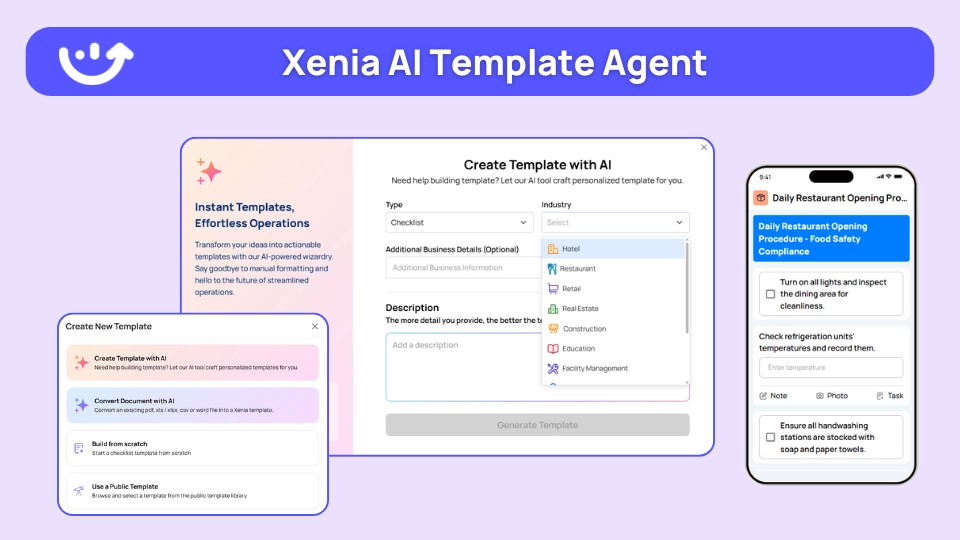
Inspections and brand standards
Weighted audit workflows score every location against brand standards and surface underperforming sites before a district visit. District and regional dashboards show completion rates, flagged items, and audit scores across all locations from one screen. AI Photo Analysis verifies visual compliance on submitted checklist items so there is no checkbox without proof.
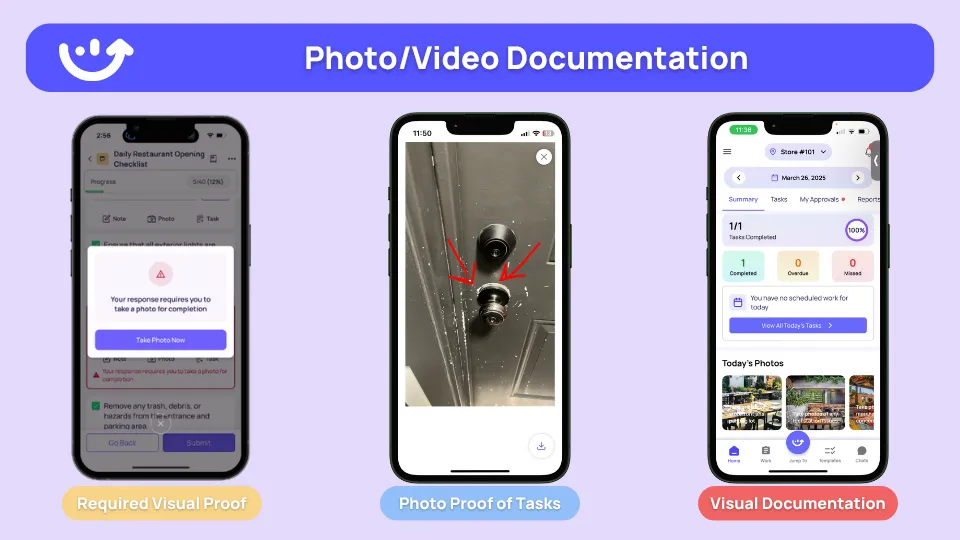
Food safety and temperature monitoring
Food safety workflows cover HACCP logs, temperature checks, and corrective action documentation in one place. Bluetooth temperature monitoring tracks fridges, freezers, and cold storage with automated alerts the moment readings go out of range. Digital incident forms replace paper records with timestamped, photo-verified documentation.
.webp)
Reporting and accountability
The frontline reporting dashboard is filterable by location, region, or concept. The AI Analytical Agent answers plain-language operational questions instantly, ask "which locations have the most overdue corrective actions this week?" and get a direct answer. Frontline communication tools replace group texts and shift binders with structured team messaging. Employee accountability tracking shows who completed what, when, and with what evidence.
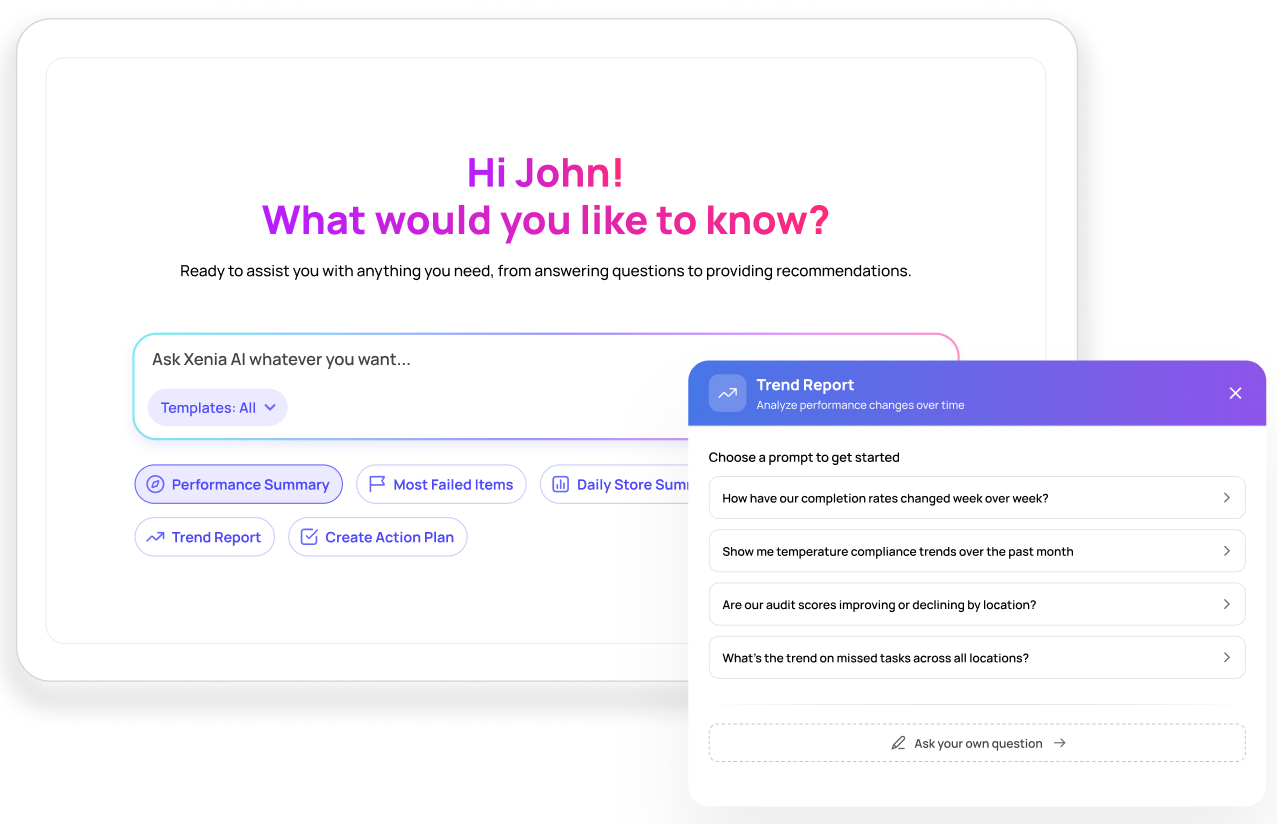
Xenia has a free plan for up to 5 users with no time limit. Paid plans scale from 15 users upward. Get started for free or book a demo.

Priced on per user or per location basis
Available on iOS, Android and Web


2. MeazureUp
MeazureUp is a digital audit and compliance platform used by multi-location food service, retail, and hospitality operators. If the primary problem is getting consistent compliance tracking across many sites, it covers that use case well.
What it does well:
- Customizable inspection and audit forms configured around brand standards, food safety requirements, or operational procedures
- Real-time monitoring with a dashboard showing task status and compliance metrics across locations
- Automated corrective action tracking that assigns issues and monitors resolution
- Automated reporting that surfaces trends, recurring problems, and site-level performance patterns
- Calendar-based task tracking showing completion progress across shifts
- Automated email alerts when tasks are due or overdue
Where it stops short: MeazureUp is primarily an auditing and checklist platform. It does not have the work order management, equipment maintenance scheduling, frontline communication tools, or food safety temperature monitoring that a full restaurant operations platform provides. Pricing is not published publicly, which makes budgeting harder for growing operators.
Pricing: Starts around $20 per month. Contact for full pricing.
Best for: Multi-location restaurant groups whose primary need is structured digital audits and brand standards compliance tracking across all sites.
3. Lumiform
.webp)
Lumiform is an AI-powered inspection and audit platform used across multi-location food service, retail, and facilities operations. Its strength is digitizing inspection workflows from start to finish, checklist completion through corrective actions through real-time compliance reporting.
What it does well:
- 12,000 pre-built templates including food safety checklists, opening and closing procedures, HACCP forms, and equipment inspection formats
- Drag-and-drop form builder for custom restaurant checklists with no technical setup required
- Conditional logic that changes the inspection flow based on prior answers
- Automated corrective action task creation when any checklist item fails
- Real-time analytics dashboard showing inspection results and resolution status across all locations
- Full offline capability with auto-sync when connectivity returns
- Multi-language support covering 60 languages
Where it stops short: Lumiform is an inspection-first tool. It does not have the shift log depth, equipment maintenance scheduling, frontline team communication, or broader multi-unit operations management that a full restaurant operations platform provides.
Pricing: Free plan available for small teams. Paid plans via contact.
Best for: Restaurant operators who want strong digital inspection workflows with automated corrective actions and cross-location reporting.
4. Bindy

Bindy is a cloud-based audit and task management platform built for retail and hospitality brands that need consistent brand standards across many locations. For multi-location restaurant groups where district managers conduct regular site visits and need a structured audit program, it fits that use case.
What it does well:
- Customizable inspection checklists and multilingual forms configured around brand standards, food safety, or operational procedures
- GPS coordinates, date stamps, and signatures verify inspection completion so nothing gets rubber-stamped remotely
- Corrective action task assignment directly from flagged inspection items, tracked through to resolution
- Centralized dashboard where supervisors assign tasks, generate custom reports, and see performance trends across all sites
- Interactive maps showing location-level compliance status at a glance
- Photo and document attachment on any inspection item for visual evidence
- SSO and API integration for connecting with existing systems
- Scheduling tools for planning and managing regular site visits across the portfolio
Where it stops short: Bindy is built for structured periodic audit programs. Daily shift checklists, food safety temperature monitoring, equipment maintenance scheduling, frontline team communication, and ongoing daily task management between inspection cycles are outside its core design. Strong for audit programs. Not a full daily operations platform.
Pricing: Contact-based. Per-usage pricing that can reduce costs for larger networks.
Best for: Multi-location restaurant and hospitality operators who need structured site visit audit programs and brand standards compliance tied to periodic inspection cycles.
5. MarketMan
MarketMan is a cloud-based inventory management platform built for restaurants. For multi-location operators where food cost control and supplier management are the biggest pain points, it is one of the stronger tools in the category.
What it does well:
- Real-time inventory tracking connected to your POS so actual vs. theoretical COGS data updates automatically
- Supplier management with scanned invoice processing, automated price change alerts, and direct ordering through the platform
- Menu engineering tools that calculate recipe costs and gross profit by menu item
- Centralized reporting across multiple locations covering cost variances, ordering trends, and inventory performance
- Waste tracking and food cost analysis that surfaces where margins are leaking
- Integration with Toast, Square, and other major POS systems
Where it stops short: MarketMan is an inventory and food cost platform. Daily operational checklists, food safety inspection workflows, equipment maintenance, frontline communication, and corrective action tracking are outside its design. It needs to sit alongside a dedicated restaurant operations app for multi-location teams.
Pricing:
**
Plan, Monthly cost
Operator, $179
Professional, $249
Ultimate, $399
**
Best for: Multi-location restaurant groups where food cost management, supplier ordering, and inventory tracking are the primary operational challenges.
6. UpKeep
UpKeep is a mobile-first CMMS, a computerized maintenance management system, used by restaurant and hospitality operators to manage equipment maintenance, work orders, and facility upkeep. For restaurant groups where aging equipment and reactive maintenance are the recurring problem, it solves that specific challenge well.
What it does well:
- Work order creation, assignment, tracking, and resolution from any device on or off site
- Preventive maintenance scheduling with automated triggers based on time or equipment usage
- Asset tracking covering full service history, costs, and maintenance records for all equipment
- Vendor and contractor management including performance tracking and cost history
- Compliance tracking for equipment inspections and safety requirements
- Reporting and analytics on maintenance patterns, recurring issues, and cost trends by location
Where it stops short: UpKeep is maintenance-first. Daily operational checklists, food safety compliance, HACCP documentation, frontline communication, and corrective action workflows beyond maintenance tickets are outside its native design. Operators who need the full daily operations layer will need to pair it with another tool.
Pricing: Free trial available. Lite at $20 per user per month. Starter at $45. Professional at $75. Business Plus via contact.
Best for: Restaurant operators whose primary challenge is equipment maintenance tracking, work order management, and reducing unplanned downtime across multiple locations.
7. FoodDocs
.webp)
FoodDocs is a food safety compliance platform built around HACCP plan creation, monitoring, and documentation. If building and maintaining a defensible food safety system is the top priority, this is one of the most specialized tools available.
What it does well:
- AI-powered HACCP plan builder that generates a customized plan based on the restaurant's menu, processes, and specific food hazards
- Customizable monitoring tasks that match each kitchen's actual food safety workflow
- In-app notifications that remind team members of scheduled food safety checks so nothing gets skipped
- Real-time dashboard giving managers visibility into food safety task completion across all locations without being on site
- Automated temperature logging with 24/7 monitoring and early alerts for any deviations
- Digital documentation that creates audit-ready records for health inspections
- Training support to build food safety compliance into daily team habits
Where it stops short: FoodDocs is purpose-built for food safety and HACCP compliance. Broader restaurant operations management including equipment maintenance, brand standard inspections, multi-location operational dashboards, and frontline task management are outside its scope. Works best alongside a broader restaurant operations platform.
Pricing: Basic plan billed annually at approximately £999 per year. Standard at £199 per month. Professional at £299 per month.
Best for: Restaurant operators who need to build, implement, and document a full HACCP-based food safety management system, particularly those preparing for health inspections or regulatory compliance reviews.
8. Trail
.webp)
Trail is a digital operations platform used by restaurant, cafe, and hospitality teams. It replaces paper-based daily operations with structured digital workflows that keep front-of-house and back-of-house teams accountable through every shift.
What it does well:
- Digital daily ops checklists covering opening procedures, service readiness, food safety checks, and closing tasks
- Real-time completion tracking so managers see exactly which tasks are done and which are outstanding at any moment in the shift
- Automated corrective action workflows when checklist items are flagged or failed
- Compliance documentation for food safety and health inspection readiness
- Intuitive mobile UX built for frontline staff with minimal training required
- Integrations with scheduling tools, POS systems, and food safety platforms
- Multi-site dashboard for above-store visibility across locations
Where it stops short: Trail's strength is daily operational checklists and shift compliance. Equipment maintenance scheduling, HACCP-specific food safety documentation, advanced analytics dashboards, and multi-concept portfolio management are more limited compared to full-stack restaurant operations platforms.
Pricing: Contact-based. No public free plan.
Best for: Restaurant and hospitality operators who want a clean, mobile-first daily operations platform to replace paper-based shift management and build consistent procedures across multiple sites.
9. HotSchedules by Fourth

HotSchedules, now part of the Fourth platform, is one of the most widely used restaurant workforce management tools. It covers employee scheduling, labor management, and back-office operations for restaurant chains and multi-unit operators.
What it does well:
- Drag-and-drop shift scheduling with demand forecasting in 15-minute intervals for smarter labor deployment
- Labor cost tracking and compliance alerts built into the scheduling workflow
- Individual and broadcast messaging for team communication across locations
- Tip pooling reports for transparent staff gratuity management
- POS integration for smooth data flow between sales and labor systems
- Fourth platform integration covering payroll, HR, and inventory for broader back-office management
Where it stops short: HotSchedules is a workforce management platform. Daily operational checklists, food safety compliance, equipment maintenance, corrective action tracking, and multi-location operational accountability are outside its scope. Strong for managing labor. Not a restaurant operations execution platform.
Pricing: Contact the vendor for current pricing.
Best for: Restaurant chains and multi-location operators who need advanced labor scheduling, workforce management, and back-office integration as the primary operational priority.
10. When I Work
When I Work is an employee scheduling and communication platform for small to mid-size restaurant operators. For front-of-house managers who need shift scheduling, time tracking, and team messaging in one affordable app, it covers those basics cleanly.
What it does well:
- Simple shift scheduling with templates that reduce time spent building weekly schedules
- Role-based shift assignment so each shift has the right mix of servers, hosts, and kitchen staff
- Employee time and attendance tracking with payroll export capability
- Team messaging and schedule updates through the app
- Time-off and availability management in one place
- Calendar integration across devices
Where it stops short: When I Work is a scheduling and communication tool. Daily operational checklists, food safety compliance, equipment maintenance, corrective action workflows, and multi-location operational dashboards are not part of its design. Operators who need more than labor management will need to pair it with a dedicated restaurant operations app.
Pricing: Essential at $2.50 per user per month. Pro at $5.00. Premium at $8.00. Free plan available for very small teams.
Best for: Small restaurant teams and independent operators who want simple, affordable shift scheduling and team communication without the complexity of a full operations platform.
How to Pick the Right Restaurant Operations App
Start with the table. Then ask yourself the three questions below it.
**
Your situation, Best fit
Multi-location team needing daily checklists-food safety-equipment maintenance-corrective actions and above-store analytics in one platform, Xenia
Multi-location operator focused on structured audits and brand standards compliance tracking, MeazureUp
Restaurant group wanting strong digital inspection workflows with automated corrective actions, Lumiform
Team needing structured site visit audit programs and brand standards compliance, Bindy
Multi-unit operator focused on food cost control and inventory management, MarketMan
Restaurant with recurring equipment downtime needing dedicated maintenance management, UpKeep
Team needing to build a full HACCP food safety management system, FoodDocs
Hospitality or restaurant team wanting clean daily operational checklists and shift compliance, Trail
Chain needing advanced labor scheduling and back-office workforce management, HotSchedules / Fourth
Small restaurant team wanting simple affordable scheduling and team communication, When I Work
**
Question 1: Are you trying to run daily operations or manage people and schedules?
These are different problems. Scheduling tools answer "who is working tonight?" Restaurant operations apps answer "did the team actually do what they were supposed to do during that shift?" Most multi-location operators need both. But buying a scheduling upgrade when what is broken is the opening checklist process does not fix anything.
Question 2: Are you managing more than one location?
If yes, the list shortens fast. You need cross-site dashboards, location-level benchmarking, and the ability to push consistent standards to every site without relying on managers to self-report.
Xenia is the only tool here that connects daily checklists, food safety, equipment maintenance, corrective actions, and above-store analytics in one platform built specifically for multi-location frontline teams.
Question 3: Do you need operations, food safety, maintenance, and communication in one place or are you fine managing multiple tools?
Most tools on this list handle one or two of those pieces well. If consolidation matters, that is the question that decides everything. Most multi-location restaurant operators running four separate apps for four different operational needs eventually consolidate. It is worth asking whether to do that now.
Book a free demo to see how Xenia works for restaurant operations.
Conclusion
Most restaurant app roundups mix everything together. POS systems, scheduling tools, inventory platforms, and reservation software all get called "restaurant management apps." That does not help when what you actually need is something that makes your team execute consistent operations across every location every single day.
Every tool in this article was chosen because it addresses the operational layer. What happens between transactions, not the transactional layer itself.
For small single-location teams, Lumiform, When I Work, and FoodDocs cover specific pieces at low cost. For food cost control, MarketMan is strong. For periodic audit programs and site visits, Bindy fits well. For equipment-heavy operations, UpKeep handles maintenance cleanly.
For multi-location restaurant operators who need daily checklists, food safety compliance, equipment maintenance scheduling, corrective action automation, and above-store visibility across every location in one platform, Xenia is built specifically for that combination.
Start for free or book a demo to see it in action.
Frequently Asked Questions
Got a question? Find our FAQs here. If your question hasn't been answered here, contact us.
What makes Xenia different from other restaurant operations software?

Most restaurant management apps stop at capturing information. Xenia is built around what happens after information gets captured. When a flagged item appears on a checklist, Xenia automatically creates an assigned corrective action task with a deadline and escalates it if unresolved.
Food safety, equipment maintenance, brand standard audits, and frontline communication all live in one mobile-first platform built for deskless teams. That is what separates it from the rest of this list.
Which app is best for restaurant district managers overseeing multiple locations?
For district managers who need real-time visibility across all locations, flagged issue tracking, audit scoring, and corrective action accountability, Xenia is the strongest fit on this list.
MeazureUp is a solid alternative if structured audits and compliance tracking are the primary requirement. Bindy works well if periodic site visit audit programs are the main use case. Most scheduling-focused tools on this list do not provide the above-store operational visibility that district managers actually need day to day.
How do multi-location restaurant teams track food safety compliance across sites?
The most reliable approach is a platform that pushes food safety tasks to each location automatically, requires photo and timestamp verification on completion, and generates corrective action tasks when anything falls out of compliance.
Xenia handles this through automated workflows built directly into the food safety checklist process. FoodDocs is a strong specialist alternative if building a full HACCP system from scratch is the primary need.
What should the best restaurant operations app include?
At minimum: digital checklists for daily procedures, food safety compliance tools, cross-location visibility for district managers, corrective action workflows that automatically assign and track flagged issues, and mobile access that works offline.
The best platforms add equipment maintenance scheduling, weighted audit scoring, and analytics dashboards that surface patterns across all locations without manual report compilation.
What is the difference between a restaurant operations app and restaurant management software?
Restaurant management software covers POS, accounting, and inventory tools that handle transactions and business data. Restaurant operations apps handle what your team actually does between those transactions: opening checklists, food safety logs, equipment checks, task management, corrective actions, and inspection tracking. Most multi-location operators need both running side by side because they solve completely different problems.


A Modern, AI-Powered Platform Built for Restaurant Operations
Xenia brings kitchen operations, food safety, audits, and team communication into one mobile-first platform. Restaurant teams execute daily work consistently, maintain compliance, and resolve issues faster, while leadership gets real-time visibility across all locations.
.webp)
Why Restaurant Operators Choose Xenia:
🤖 AI-Powered Operations, Convert paper logs instantly and verify food presentation and kitchen cleanliness automatically. Get instant answers about food safety trends without building reports.
🍽️ Food Safety & Compliance, Track line checks and temperature logs with automated alerts. Trigger corrective actions when readings exceed safe ranges. Maintain audit-ready records for health inspections.
📊 Multi-Location Control, Monitor food safety compliance and task completion across regions. Benchmark locations to identify training needs. Export reports for operational reviews.
One platform for kitchen operations, food safety, and compliance across all locations.

.svg)
.webp)
%201%20(1).webp)

.svg)
%201%20(2).webp)