
Post Summary
UpKeep works. No one's going to pretend it doesn't.
But if you're here, something is off. Maybe the mobile experience isn't cutting it for your frontline team. Maybe you're managing five locations now instead of one. Maybe you're tired of running four tools to do the job of one.
Whatever it is, you need a better UpKeep alternative. And this guide gives you exactly that.
We've researched and ranked the 7 best UpKeep alternatives in 2026. Every tool on this list gets a full breakdown of CMMS features, AI capabilities, pricing context, and an honest trade-off assessment.
No filler. Just what you need to make the right call.
What Is UpKeep?
UpKeep is a mobile-first computerized maintenance management system (CMMS) used by maintenance technicians, facility managers, and operations teams.
It covers the core CMMS workflow:
- Work order creation and tracking
- Preventive maintenance scheduling
- Asset tracking and equipment history
- Basic inventory management for parts and consumables
- Multi-site support
It's been popular in manufacturing, property management, and facilities for years.
The problem is that most growing operations need more than a maintenance tool. They need a platform that runs the full operation, not just the repair queue.
Why Teams Are Looking for UpKeep Alternatives
These are the real reasons teams start the search.
1. The mobile experience wasn't built for frontline staff
UpKeep works well for technicians handling maintenance requests. But if your frontline staff needs daily checklists, opening and closing procedures, food safety logs, and shift communications, the app falls short. It was never designed for that workflow.
2. There's no real audit or compliance layer
Work order management and inspections are two different things. UpKeep doesn't have inspection tools with weighted scoring, conditional logic, or automatic corrective action triggers. Teams end up paying for a second tool just to cover this gap.
3. Reporting doesn't scale at multi-location level
Basic dashboards work fine for one site. But operations directors tracking completion rates, compliance trends, and facility costs across 20 or 30 locations find that UpKeep's reporting runs out fast.
4. AI features are not there
In 2026, maintenance software needs to do more than store records. Teams expect platforms that auto-generate reports, verify compliance from submitted photos, and answer operational questions instantly. UpKeep hasn't built that.
5. The tool stack keeps growing
One tool for maintenance. One for checklists. One for audits. One for communications. Teams that started with UpKeep often end up running four platforms to do the job of one. That creates data fragmentation, higher costs, and slower decisions across locations.
Want to understand CMMS best practices before switching? Read our CMMS best practices guide.
The 7 Best UpKeep Alternatives in 2026
.svg)
.webp)
.webp)
Here's the full list at a glance.
**
Tool, Best For, Multi-Site, AI Features, Pricing Model
Xenia, Multi-location restaurants-retail-C-stores, Strong, Advanced (4 live modules), Custom per location
Coast, Small facilities-hospitality-real estate, Strong, Minimal, Per user per month
Fiix, Manufacturing-Rockwell Automation users, Strong, Moderate, Custom enterprise
Tractian, Industrial plants-critical rotating equipment, Good, Strong (anomaly detection), Subscription + hardware
SuperCMMS, Budget-conscious SMBs, Limited, None, Free up to 5 users
eWorkOrders, SMBs needing custom forms, Good, None, Per user per month
Maintainly, Small to mid-size maintenance teams, Good, None, Per user per month
**
Now let's go deep on each one.
1. Xenia
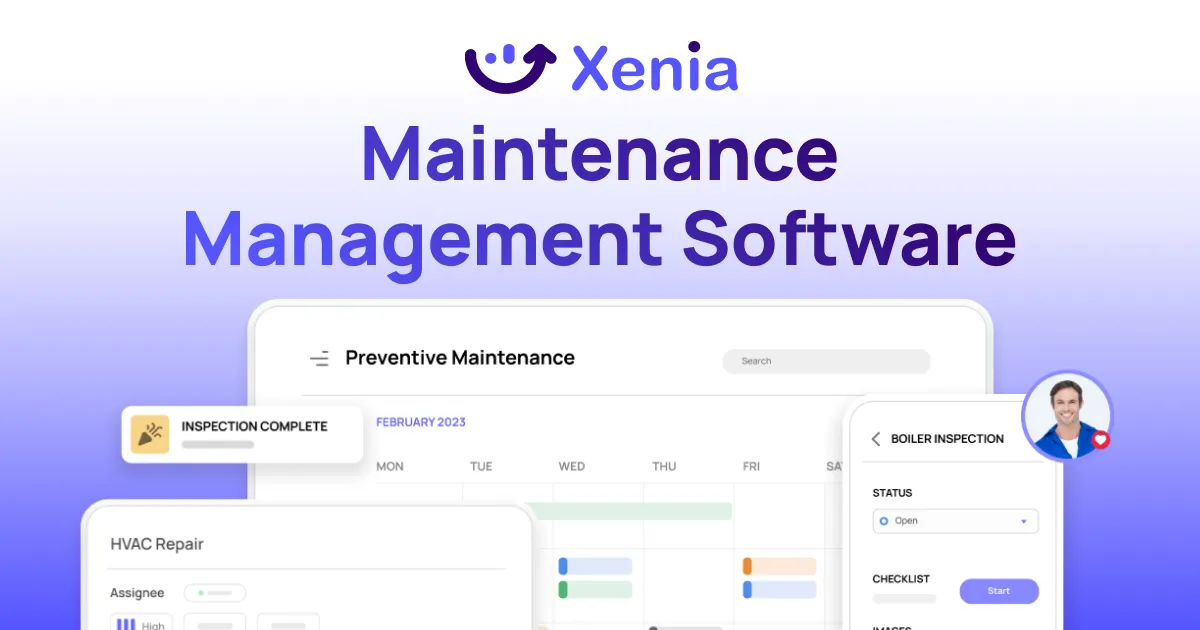
Best for: Multi-location operators in restaurants, retail, and convenience stores who need CMMS, audits, compliance, and frontline communications in one place.
Xenia is in a different category than every other UpKeep alternative on this list.
UpKeep is a maintenance platform. Xenia is a mobile-first operations execution platform with a facilities and maintenance module built into it. For teams currently running UpKeep alongside three other tools, Xenia replaces all of them.
That's the short version. Here's the full picture.
CMMS and Maintenance Features
**
Feature, What It Does
Work Order Management, Create-assign and track work orders with photos-priority levels-status tracking-vendor routing and full history
Preventive Maintenance Scheduling, Role-based recurring tasks that reassign automatically when staff changes-no manual updates needed
Equipment Management, QR code identification with full maintenance history and per-asset service logs accessible from any phone
IoT Temperature Monitoring, Real-time Bluetooth sensor alerts for refrigeration and holding equipment-24/7
Vendor Management, Assign work orders to vendors-require photo proof at completion-collect digital sign-off
Multi-Location Hierarchy, Role-based visibility at the store-district and regional level
Inventory Management, Track parts-consumables and stock levels across all locations
**
Where Xenia Goes Beyond UpKeep
This is what separates Xenia completely.
- Digital checklists and SOPs with conditional logic. A failed step automatically triggers a corrective action, nobody needs to catch it manually.
- Audit and inspection workflows with weighted scoring, compliance tracking, and auto-generated corrective actions across every location.
- Brand standards compliance tools that let district managers run consistent evaluations across all sites.
- Frontline communications with mandatory read and sign-off for policy updates and procedure changes.
- Analytics and reporting dashboards that pull real-time completion data from every location automatically.
- Document and records management for SOPs, training materials, and compliance documentation.
- Food safety management tools including HACCP logs, temperature tracking, and food handling checklists.
- HR workflows for onboarding, incidents, and personnel processes.
- Task management that connects your entire multi-unit operation with transparent accountability from field to store.
AI Features
Xenia has four live AI capabilities. No pure CMMS alternative on this list comes anywhere close.
Analytical Agent - Ask a plain-language question about your operations and get instant answers with visualizations from your live data. Ask which location had the most failed inspections last month. Get the answer in seconds. No report needed.
AI Summaries - Auto-generates executive dashboards and performance reports from your live data. Surfaces trends and gaps without anyone building a report manually.
AI Photo Rollouts - Analyzes submitted photos across all locations to verify compliance automatically. Product presentation, equipment condition, cleanliness standards, brand execution. It checks all of it without manual review.
Template Agent - Converts paper SOPs and PDF forms into structured digital checklists in seconds. Or build a new template from a plain text prompt. You can also use the standalone AI-powered SOP writer to generate complete procedures instantly.
Explore the full Xenia AI suite to see all four capabilities live.
Industries Xenia Serves
Xenia was built specifically for multi-unit operators. The platform has dedicated solutions for:
- Restaurants - daily checklists, food safety, maintenance, and audits in one place
- Retail - store visits, brand standards, task management, and communications
- Convenience stores - daily operations, incident reporting, compliance, and temperature monitoring
- Hotels and hospitality - preventive maintenance, housekeeping workflows, and guest-ready standards
Honest Trade-Off
Xenia is built for multi-unit frontline operations. If your environment is a single industrial plant with complex SCADA requirements, a dedicated industrial CMMS may also be needed. For restaurants, retail chains, and convenience store operators, Xenia covers more ground than anything else on this list.
See how Xenia customers like Newk's Eatery, Power Market, and TempStop use the platform in their day-to-day operations.
Pricing and Deployment
- Custom per-location and per-user pricing
- 14-day free trial available
- Implementation, setup, and onboarding included at no extra cost
- Most teams are fully operational within two weeks
Book a demo to get started.

Priced on per user or per location basis
Available on iOS, Android and Web


2. Coast
.webp)
Best for: Small to mid-size facilities teams, hospitality operators, and property managers who want simple, mobile-first maintenance management without heavy configuration.
Coast sits on the lighter end of the mobile CMMS spectrum. It's closer to a task management tool that handles maintenance than a full work order management system. For some teams, that's the right fit. For others, it runs out fast.
CMMS Features
- Multi-site organization across portfolios, buildings, floors, and areas
- Work orders with photo attachments, status tracking, comments, and assignee management
- Recurring task templates for preventive maintenance and inspections
- Location-based templates reusable across sites
- Mobile-first interface for field teams
AI Features
Minimal. Coast has basic automation for task assignment and reminders. There's no predictive scheduling, photo compliance verification, or AI reporting. If AI-driven operational insights matter to your decision, Coast is not the platform.
Key Limitations
**
Limitation, Impact
Very light asset management, Can't track lifecycle data or maintenance cost per asset
No audit or compliance layer, Requires a second tool for brand standards inspections
Reporting doesn't scale, Limited cross-location visibility for larger operations
No real inventory management, Parts and consumables tracking not available
No AI features, Manual reporting and compliance reviews only
**
Honest Trade-Off
Coast is genuinely easy to get started with. The trade-off is a clear ceiling. Teams managing more than 10 or 15 locations, or anyone who needs compliance tracking and AI reporting, will need something more capable.
Pricing
Per user per month with transparent public pricing. Deployment typically runs one to two weeks.
3. Fiix (by Rockwell Automation)
Best for: Mid to large manufacturing and plant operations in the Rockwell Automation ecosystem that need strong ERP and SCADA integrations.
Fiix is a more mature CMMS than UpKeep, aimed squarely at industrial and manufacturing environments. Rockwell Automation acquired it in 2021, and the integration capabilities with industrial control systems are its clearest advantage.
CMMS Features
- Centralized asset registry across unlimited locations
- Time-based and meter-based preventive maintenance scheduling
- Work orders with parts, labor, cost, and full history tracking
- Spare parts inventory with stockroom management and min/max ordering rules
- API integrations with ERP, SCADA, and accounting platforms
- KPI dashboards for MTTR, PM compliance, and maintenance backlog
- Mobile access through a responsive web app (no native mobile application)
AI Features
Fiix uses AI to suggest PM intervals from actual failure history rather than manufacturer defaults. More developed than basic CMMS tools for industrial scheduling. Narrowly focused on maintenance scheduling rather than broader operational intelligence.
Key Limitations
**
Limitation, Impact
Web-based mobile only, Less optimized for field technicians than UpKeep or Xenia
No frontline operations layer, Only covers maintenance-not audits or communications
Enterprise pricing, Higher cost than SMB-focused tools
Wrong context for retail or restaurant, Built specifically for manufacturing environments
Long deployment, Two to four weeks minimum-longer with ERP integration
**
Honest Trade-Off
Fiix is the right call for manufacturing teams that need deep ERP integration and meter-based PM scheduling. For multi-location retail, restaurant, or C-store operations, it was built for a completely different use case.
Pricing
Custom enterprise quote per user and per site. Deployment typically runs two to four weeks for multi-site rollout, longer with ERP integration.
4. Tractian
Best for: Industrial plants and manufacturing facilities with critical rotating equipment that want sensor-driven predictive maintenance alongside standard CMMS workflows.
Tractian takes a completely different approach to maintenance management software.
Instead of starting from work orders, it starts from hardware. Vibration and temperature sensors attach directly to motors, pumps, compressors, and fans. The CMMS layer sits on top of continuous sensor data.
CMMS Features
- Vibration and temperature sensors for industrial equipment
- Automatic alerts when readings fall outside learned baselines
- Work orders generated automatically before equipment fails
- Multi-site support for plants and distribution centers
- Mobile app for technicians to receive alerts and log responses
- Asset tree linking equipment to its sensor, maintenance history, and reliability metrics
- Combined preventive and predictive maintenance in one platform
AI Features
Tractian's AI learns each machine's normal operating signature and flags deviations early enough to prevent unplanned downtime. The model improves over time as operating history accumulates. The strongest predictive capability on this list. Also the most narrow in application.
Key Limitations
**
Limitation, Impact
Requires hardware investment, Significant upfront cost before software value is realized
Industrial use cases only, Not relevant for facilities-restaurants or retail environments
No operational execution layer, No checklists-audits or communications tools
Long deployment, One to three months including sensor installation and calibration
High total cost, Subscription plus per-sensor hardware pricing
**
Honest Trade-Off
For industrial sites with critical rotating equipment, Tractian solves a real problem. For any other operational context, the hardware investment doesn't make financial sense and the platform doesn't fit.
Pricing
Subscription plus per-sensor hardware cost. Deployment runs one to three months.
5. SuperCMMS

Best for: Small businesses and solo facility managers who need core CMMS functionality without per-user SaaS pricing.
SuperCMMS markets itself as the free UpKeep alternative. Up to five users get full access at no cost, which is a genuine starting point for very small teams. That said, "free" comes with real trade-offs.
CMMS Features
- Work order creation, assignment, status tracking, and history logging
- Preventive maintenance on calendar-based intervals
- Asset tracking with basic location tags and lifecycle fields
- Parts and consumables inventory
- Basic multi-site support for small footprints
- Responsive web app for mobile access (not a native mobile application)
AI Features
None. Reporting covers MTTR, PM compliance, and work order backlog at a basic level. No predictive capabilities, no photo analysis, and no AI-generated insights of any kind.
Key Limitations
**
Limitation, Impact
No native mobile app, Less optimized for field technicians
Limited multi-site reporting, Hard to manage more than a few locations effectively
No audit or compliance tools, Need separate tools for inspections
Low ceiling, Teams outgrow it quickly as operations scale
No AI features, Fully manual reporting at every level
**
Honest Trade-Off
The free tier delivers what it promises. If budget is the primary constraint and your team has fewer than five users, SuperCMMS gets the basics done. The moment you scale past that, you'll be shopping again.
Pricing
Free for up to five users. Paid tiers for additional users and advanced features. Deployment typically runs one to two weeks.
6. eWorkOrders
Best for: SMBs in facilities, education, and light industrial environments that need customizable inspection forms alongside standard work order management.
eWorkOrders is a cloud-based CMMS that puts more emphasis on configurable forms and workflows than most alternatives at its price point. Teams with specific regulatory documentation requirements or non-standard inspection processes will find more flexibility here.
CMMS Features
- Work orders with status workflow, attachments, notes, and history
- Preventive maintenance at asset and location level
- Asset register with location, category, and lifecycle data
- Parts and consumables inventory
- Custom form builder for inspections, compliance checklists, and maintenance documentation
- Multi-site and multi-organization support
- Reports by site, asset class, or technician
The custom form builder is the standout feature. Teams build inspection templates and compliance checklists without touching a line of code.
AI Features
No AI capabilities at a level worth highlighting. Reporting is functional but fully manual. No conversational analytics, predictive scheduling, or photo verification.
Key Limitations
**
Limitation, Impact
Mobile not optimized for field teams, Adoption can lag with frontline technicians
Multi-site reporting has limits, Not built for large-scale location benchmarking
No AI or advanced analytics, Manual reporting gets time-consuming at scale
Limited integrations, Harder to connect with ERP or HR systems
No operational execution layer, Only covers maintenance and forms-not full ops
**
Honest Trade-Off
For SMBs that need more form customization than UpKeep provides and don't need sensor integration or AI, eWorkOrders is a solid fit. The ceiling becomes visible quickly as complexity and location count grow.
Pricing
Per user per month with tiered pricing. Deployment typically runs one to two weeks.
7. Maintainly
Best for: Small to mid-size maintenance teams that want a clean, well-built CMMS with strong mobile UX and no complicated configuration.
Maintainly was built for teams that found legacy CMMS tools too heavy and entry-level tools too thin. It sits in the middle. Enough CMMS depth for real maintenance management, simple enough that technicians actually use it.
CMMS Features
- Multi-site support across locations, departments, and asset groups
- Work orders with creation, assignment, tracking, and closure workflows
- Preventive maintenance on recurring calendar-based schedules
- Asset management with location tags, categories, and lifecycle fields
- Reports covering MTTR, backlog, PM compliance, and technician workload per site
- Clean mobile interface optimized for field technicians
The mobile experience is Maintainly's strongest feature. Technicians create, update, and close work orders from their phones without friction. Most small teams are operational within a week of signing up.
AI Features
None currently. Reporting is solid for the price tier but requires manual effort to generate and interpret. No predictive scheduling, AI summaries, or photo analysis on the roadmap.
Key Limitations
**
Limitation, Impact
No operational execution layer, Only covers maintenance-not full ops management
No audit or compliance tools, Need separate tools for inspections
No AI features, Manual reporting at scale becomes a bottleneck
Better for smaller footprints, Gets harder to manage as location count grows
No frontline communications, Team messaging requires a separate tool
**
Honest Trade-Off
Maintainly works well for small manufacturing sites, facilities teams, and service businesses that want a clean CMMS without a long implementation process. For multi-location operators who need full operations execution alongside maintenance, it doesn't go far enough.
Pricing
Per user per month with tiered plans. Deployment typically runs one to two weeks for multi-site rollout.
How to Pick the Right UpKeep Alternative
Use this table to match your situation to the right tool.
**
Your Situation, Best Alternative
Multi-location ops team needing maintenance-audits-AI and compliance in one place, Xenia
Small facilities or hospitality team wanting simple mobile task management, Coast
Manufacturing team in the Rockwell Automation ecosystem, Fiix
Industrial plant with critical rotating equipment and a sensor budget, Tractian
Very small operation on a tight budget, SuperCMMS
SMB needing custom inspection forms alongside work orders, eWorkOrders
Small to mid-size maintenance team wanting clean-simple CMMS, Maintainly
**
Still not sure? Ask yourself these three questions.
Question 1: Do you need more than work orders and preventive maintenance? If yes, most pure CMMS tools on this list will fall short within six months.
Question 2: Are you managing more than five locations? If yes, you need multi-unit operations tools and reporting that actually scales across all of them.
Question 3: Does your frontline staff need to execute daily operations through the same platform? If yes, Xenia is the only tool on this list built specifically for that use case.
Why Xenia Is the Best UpKeep Alternative for Multi-Location Teams
Every tool on this list does one thing well.
UpKeep does maintenance. Coast does task management. Fiix handles industrial CMMS. Tractian does predictive maintenance with sensors.
None of them give multi-location operations teams what they actually need: maintenance management, operational execution, audits, compliance, frontline communications, and AI in one platform.
That's what Xenia was built for.
Here's what the switch looks like in practice.
**
What You Have Now, What Xenia Replaces
UpKeep for work orders, Xenia work order and PM module
Separate checklist app, Xenia digital checklists and SOPs
Separate audit tool, Xenia inspections and audit workflows
Group chats and email threads, Xenia frontline communications
Manual reporting and spreadsheets, Xenia analytics and reporting
Manual photo reviews, Xenia AI Photo Rollouts
Paper SOPs and PDFs, Xenia Template Agent
Reactive maintenance only, Xenia preventive maintenance scheduling
Separate food safety tools, Xenia food safety management
**
One platform. Every location. No stacked tools. No data fragmentation.
You can also browse how Xenia customers use the platform across restaurants, retail chains, convenience stores, and hospitality groups.
Book a demo and see what your operation looks like when it all runs from one place.
The Bottom Line
UpKeep is a capable maintenance management tool. But capable and right for your operation are two different things.
If your mobile experience is holding your team back, if you're stacking tools to cover gaps, or if you need a full operations platform rather than a pure CMMS, there are better options in 2026.
For multi-location operators in restaurants, retail, and convenience stores, Xenia handles everything UpKeep does and everything UpKeep can't. Maintenance management, audits, compliance tracking, digital checklists, frontline communications, and AI in one platform built for multi-unit operations.
Book a demo and see what your operation looks like with the right platform in place.
Frequently Asked Questions
Got a question? Find our FAQs here. If your question hasn't been answered here, contact us.
What's the difference between a CMMS and an operations execution platform?

A CMMS handles maintenance workflows: work orders, preventive maintenance, asset tracking, and inventory.
An operations execution platform covers all of that plus daily operations, audits, compliance, frontline communications, and AI reporting. Xenia is an operations execution platform. UpKeep, Fiix, and Maintainly are CMMS tools.
What should I look for in a UpKeep alternative?
Start with these six criteria:
- Mobile-first design that field teams will actually use
- Multi-site support with real cross-location reporting
- Preventive maintenance scheduling with flexible trigger options
- Photo documentation for work orders and inspections
- AI features for reporting, compliance, and operational insights
- A platform that covers more than just maintenance so you're not adding tools every six months
How does UpKeep compare to Xenia?
UpKeep is a maintenance platform. Xenia is an operations execution platform with a full CMMS module inside it. UpKeep handles work orders and preventive maintenance scheduling. Xenia handles those plus digital checklists, brand compliance audits, IoT temperature monitoring, frontline communications, and four AI features that UpKeep doesn't offer.
What are the best UpKeep alternatives in 2026?
Xenia is the strongest option for multi-location operations teams that need maintenance alongside audits, compliance, communications, and AI reporting.
For basic maintenance management only, Fiix handles manufacturing environments well and Coast works for light facilities teams. For small businesses on a budget, SuperCMMS offers core CMMS features free for teams of five or fewer.


A Modern, AI-Powered Platform Built Specifically for Frontline Operations
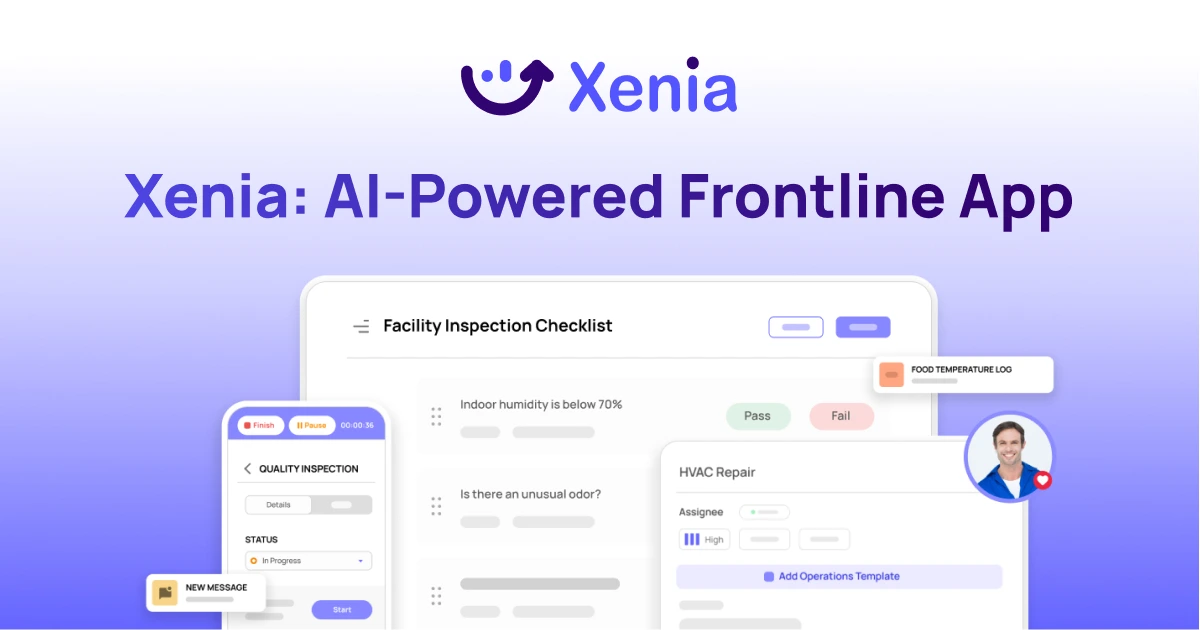
Xenia brings daily operations, maintenance, audits, and compliance into one mobile-first platform. Frontline teams execute work consistently across locations while leadership gets real-time visibility.
Why Multi-Location Operators Choose Xenia:
🤖 AI-Powered Operations, Create digital checklists instantly or convert paper forms with AI. Verify compliance automatically with photo analysis and get instant answers from your operational data.
✅ Daily Operations & Maintenance, Assign work across hundreds of locations in minutes. Report and route issues instantly. Schedule preventive maintenance to catch problems before downtime.
📊 Real-Time Visibility, Track completion, work orders, and performance across all locations through dashboards. Filter by site or asset to spot trends and take action.
Manage operations, maintenance, and compliance across all your locations from one platform

.svg)
.webp)
%201%20(1).webp)

.svg)
%201%20(2).webp)