
.webp)
Post Summary
Running a central kitchen is complicated.
You're producing food for multiple outlets. Each location needs consistent recipes, accurate inventory, and reliable delivery schedules. One batch mistake affects every restaurant.
Manual production planning doesn't work. Paper recipes create inconsistencies. Spreadsheet inventory is always outdated. By the time you spot waste, money is already lost.
The best central kitchen management software does three things: standardizes recipes with precise scaling for any batch size, tracks ingredients across all locations automatically, and schedules production to meet outlet demand without waste.
This guide breaks down the 7 best kitchen management software.

7 Best Central Kitchen Management Software
**
Rank, Platform, Focus, Key Strength, Best For
#1, Xenia, Operations Integration, Production scheduling - recipe standardization - inventory tracking, Multi-location chains (5-500+ outlets)
#2, Apicbase, Recipe & Traceability, Dynamic recipe scaling - allergen tracking, High-volume production kitchens
#3, GoFrugal, India/Asia Markets, Auto stock replenishment - franchise management, Asian restaurant chains
#4, Supy, Internal Ordering, Branch-to-kitchen ordering - demand consolidation, Kitchens supplying internal/external outlets
#5, Melba, Recipe Centralization, Production scheduling - ingredient costing, Catering and restaurant groups
#6, HashMicro, Customizable ERP, Tailored central kitchen ERP, Singapore/SE Asia chains
#7, Restroworks, POS-Integrated, Goods transfer - cost control, Multi-outlet chains with POS integration
**
.svg)
.webp)
1. Xenia - Best Central Kitchen Management Software
- What it's for: Complete central kitchen management system with production scheduling, recipe standardization, and inventory tracking integrated into restaurant operations
- G2 rating: 4.9/5
- Who uses it: Demos Restaurants, Prince Street Pizza, Hillstone Restaurant Group, multi-unit restaurant operations
- What makes it different: Only platform combining central kitchen production with complete operations management, recipes, inventory, tasks, maintenance, and compliance in one system
.webp)
Most kitchen management software handles recipes or inventory. But someone still has to coordinate production, assign tasks, track equipment, and maintain food safety manually.
Xenia central kitchen management software automates the whole operation.
Recipes standardized across all outlets. Inventory tracked in real-time. Production scheduled automatically. Tasks assigned to the right people. Everything connected.
How Xenia's Central Kitchen Management Works
Production Scheduling & Work Orders: Production schedules run automatically based on outlet demand and inventory levels.
Work orders created for each batch with exact recipes, quantities, and deadlines. Staff sees what to produce, when to start, and where it goes. Everything tracked until delivery.
.webp)
Recipe Standardization Across Outlets: Digital recipe guides with portion control verification ensure every outlet produces food identically.
Upload your recipes once. System scales them automatically for any batch size. Photos show proper plating and presentation. Staff follows step-by-step procedures with photo verification.
Real-Time Inventory Tracking: Inventory tracking across the central kitchen and all outlet locations in real-time.
Ingredients auto-deduct as production batches complete. Low stock triggers purchase orders automatically. Waste logged with photo documentation. Everything synced across locations.
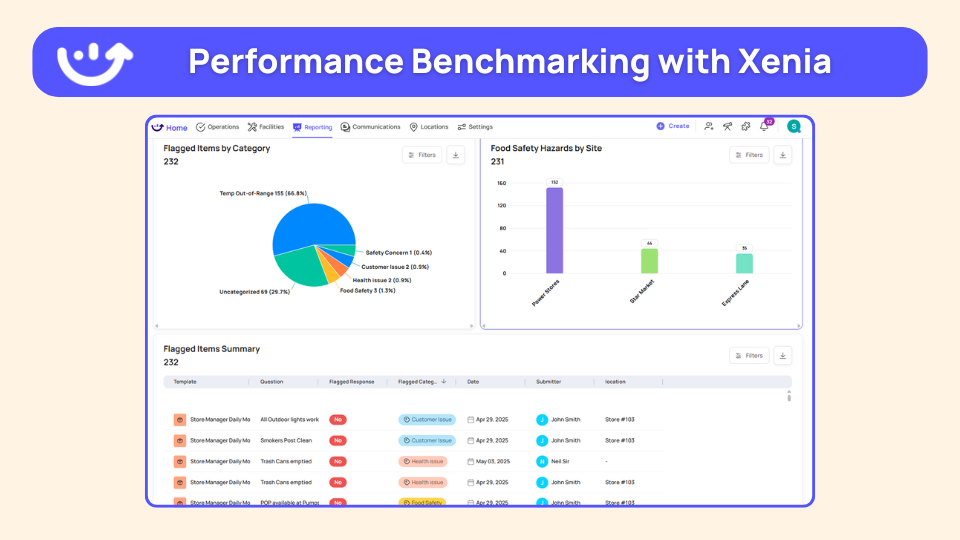
Multi-Location Oversight: District managers see production status, inventory levels, and task completion across all locations instantly.
Which outlets received today's delivery? What's in production now? Where are inventory levels low? What tasks are overdue?
Everything visible in one real-time dashboard.
Task Management & Assignments: Tasks assigned automatically based on production schedules and outlet needs.
Prep tasks for morning shift. Production tasks for batch cooks. Quality checks for kitchen managers. Delivery tasks for logistics. Everything tracked with deadlines and priorities.
Staff knows exactly what to do. Managers know exactly what's done.
Equipment Maintenance Integration: Kitchen equipment tracked with preventive maintenance schedules and service history.
Production downtime minimized. Equipment runs reliably.
Food Safety & HACCP Compliance: Temperature monitoring, food safety checklists, and HACCP documentation built into production workflows.
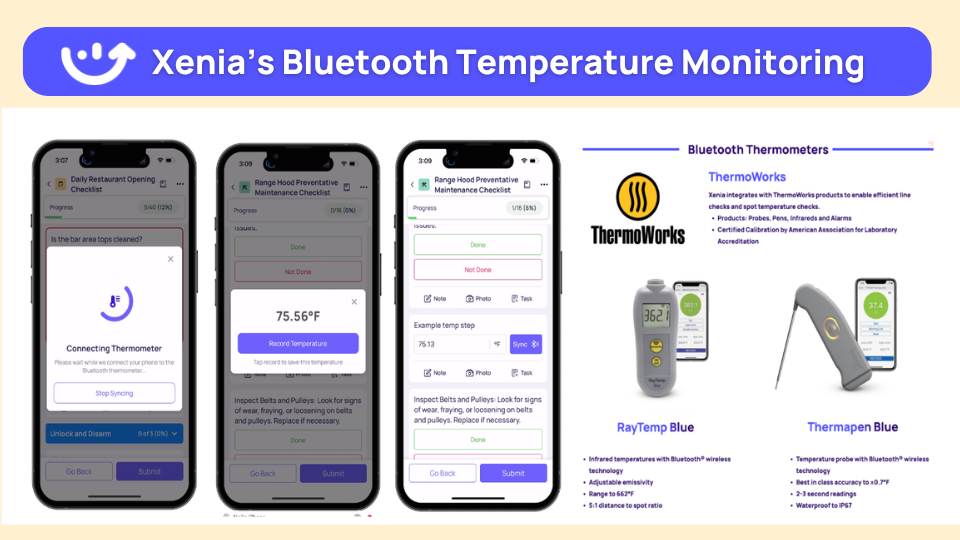
Batch temps logged automatically with Bluetooth thermometers. HACCP critical control points verified during production. Health inspection records generated automatically.
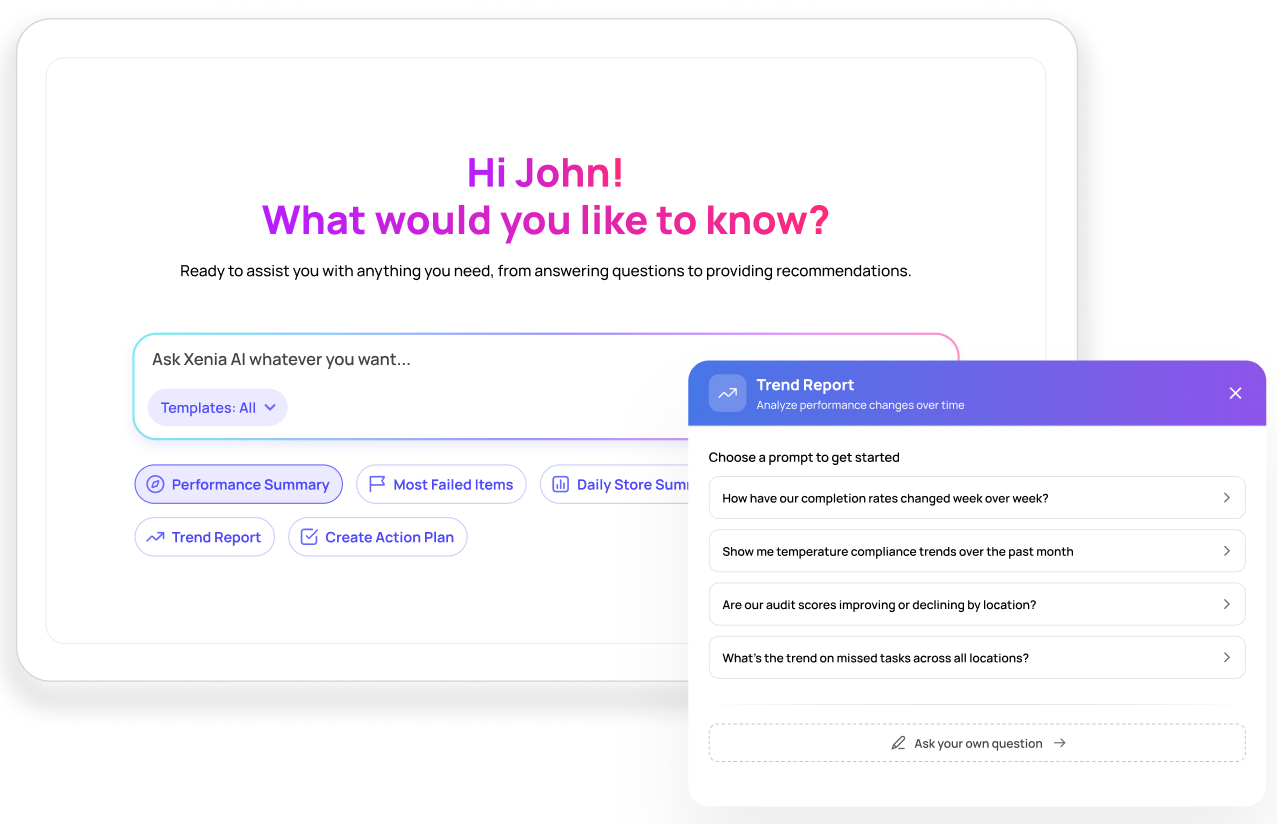
AI-Powered Reporting: AI-generated summaries highlight production trends, inventory issues, and waste patterns across all locations automatically.
Which outlets have the most waste? What recipes take longest? Where are production bottlenecks? Managers get answers without pulling reports manually.
How Xenia Compares to Standalone Kitchen Software
**
What You Need, Xenia, Standalone Kitchen Tools
Best for, Production + complete operations, Recipe management only
Production scheduling, Automated work orders with task assignment, Manual production planning
Inventory tracking, Real-time across all locations, Basic stock counts
Equipment maintenance, Integrated PM schedules and work orders, Separate system
Food safety, Built into production workflows, Separate compliance tool
Multi-location, Real-time dashboards across all outlets, Basic reporting
**
Bottom line: Use Xenia for complete central kitchen management integrated with operations. Production, inventory, tasks, maintenance, and compliance in one platform.

Priced on per user or per location basis
Available on iOS, Android and Web


2. Apicbase
.webp)
- What it's for: Recipe-centric central kitchen software with dynamic scaling and complete traceability
- G2 rating: 4.7/5
- Best for: High-volume production kitchens prioritizing recipe accuracy and allergen tracking
Apicbase excels at recipe management with precise scaling, cost calculations, and complete ingredient traceability from supplier to plate.
Key features:
- Centralized recipes with dynamic scaling
- Production planning and batch management
- Inventory and procurement automation
- Order aggregation across outlets
- HACCP tasks and traceability
- Allergen data management
- API for menus and apps
Good if: Recipe accuracy and traceability are your top priorities and you have complex menus.
Not good if: You need simple, affordable software or want operations integration beyond recipes.
3. GoFrugal
.webp)
- What it's for: Complete central kitchen management system with auto stock replenishment and franchise management
- G2 rating: 4.5/5
- Best for: Restaurant chains in India, Pakistan, and Asia
GoFrugal handles centralized procurement, production, and recipes with auto-indent stock replenishment for franchises.
Key features:
- Centralized procurement and production
- Auto-indent stock replenishment
- Consolidated master data and accounting
- Food cost reports
- Waste and vendor management
- WebSOM online ordering
Good if: You're an Asian chain needing complete central kitchen operations with franchise management.
Not good if: You need strong Western vendor integrations or are outside Asia markets.
4. Supy

- What it's for: Internal ordering from outlets to central kitchen with consolidated demand planning
- G2 rating: 4.6/5
- Best for: Central kitchens supplying internal outlets and external clients
Supy turns branch ordering into a streamlined internal ordering system with demand consolidation and production planning.
Key features:
- Internal ordering from branches to central kitchen
- Consolidated demand and purchase orders
- Production planning based on orders
- Price lists and invoicing for external clients
- Real-time tracking and audit trails
- Waste prevention through accurate forecasting
Good if: Your central kitchen supplies both internal outlets and external customers.
Not good if: You have simple production needs or don't need branch ordering functionality.
5. Melba
- What it's for: Recipe centralization and production scheduling for catering and restaurant groups
- Capterra rating: 4.5/5
- Best for: Caterers and restaurant groups standardizing production
Melba centralizes recipes across sites with production scheduling, inventory control, and order management.
Key features:
- Recipe data centralization and sharing
- Production scheduling and inventory
- Order management across locations
- Traceability and supplier management
- Multi-site dispatch
- Dynamic ingredient costing
Good if: You run catering operations or restaurant groups needing modular software.
Not good if: Module costs add up quickly or you need non-EU pricing.
6. HashMicro

- What it's for: Customizable central kitchen ERP with production, recipes, inventory, and accounting
- Regional rating: 4.6/5
- Best for: Singapore and SE Asia chains needing bespoke ERP solutions
HashMicro offers fully customizable central kitchen ERP with expert implementation support.
Key features:
- Customizable production and recipe management
- Inventory and purchasing management
- Accounting integration
- Menu engineering
- Real-time dashboards
- Expert customization and support
Good if: You're in Singapore or SE Asia and need software tailored to unique requirements.
Not good if: You want simple, out-of-the-box software without consulting fees.
7. Restroworks
- What it's for: Goods transfer and cost control with POS integration
- G2 rating: 4.6/5 (965 reviews)
- Best for: Multi-outlet chains with Restroworks POS
Restroworks handles inventory transfers, cost control, and production planning integrated with their POS system.
Key features:
- Goods transfer between central kitchen and outlets
- Inventory optimization
- Cost control and recipe management
- Indenting and production planning
- Live reports
- POS integration
Good if: You use Restroworks POS and want integrated central kitchen management.
Not good if: You use a different POS or want standalone commercial kitchen software.
What is Central Kitchen Management Software?
Central kitchen management software coordinates production, inventory, and distribution for restaurants with multiple outlets.
It handles recipe standardization so every outlet produces food identically. Tracks ingredients across all locations in real-time. Schedules batch production based on outlet demand. Manages goods transfer from central kitchen to outlets.
Who Uses Central Kitchen Management Software?
Restaurant chains with 5-500+ locations use central kitchen software to produce food centrally for consistency and cost savings.
Catering companies making meals at one facility and delivering to events and clients.
Food manufacturers producing packaged meals or ingredients for retail and food service.
Hotel groups with central kitchens supplying multiple hotel properties.
Ghost kitchens running virtual restaurant brands from central production facilities.
Any business producing food at one location for distribution to multiple outlets needs kitchen management software to handle the complexity.
Why Do Central Kitchens Need Management Software?
Manual planning leads to overproduction and waste. Kitchen management software schedules production based on real demand. This cuts waste by 20-30%.
Paper recipes vary from batch to batch. Digital recipes with photos ensure identical food at every outlet.
Spreadsheet inventory is always outdated. Real-time inventory tracking shows exactly what you have.
Manual temp logs get missed. Automated temperature monitoring keeps you inspection-ready.
Growing from 5 to 50 outlets creates chaos without software. Central kitchen systems handle everything at any size.
How to Choose the Best Central Kitchen Software
Figure out your biggest problem first. Recipe inconsistency? Focus on digital recipe management with photos. Inventory always wrong? Get real-time tracking. Production scheduling a mess? Get automated work orders.
Match software to your size. Serving 3-10 outlets? Simple recipe and inventory tools work. Serving 20-100+ outlets? You need automated scheduling, multi-location dashboards, and complete operations integration.
Must-have features:
- Digital recipes that scale automatically
- Real-time inventory across all locations
- Automated production scheduling
- Multi-location dashboards
- Food safety compliance built-in
- Equipment maintenance tracking
Don't just look at monthly cost. Calculate waste prevented (usually 20-30% less), labor hours saved on manual work, and violations avoided. Most central kitchens see ROI in 3-6 months.
Test it first. Set up your recipes. Schedule one week of production. Track inventory for a few batches. Make sure staff can use it during real production before signing contracts.
Final Thoughts
Central kitchen operations are complicated.
Manual production planning creates waste. Paper recipes create inconsistency. Spreadsheet inventory is always wrong. Equipment breaks during production runs.
The best central kitchen management software fixes all of it.
Xenia combines everything: production scheduling, recipe management, inventory tracking, task assignment, equipment maintenance, and food safety compliance in one platform.
See how it works for your central kitchen.
Frequently Asked Questions
Got a question? Find our FAQs here. If your question hasn't been answered here, contact us.
How to manage a central kitchen?

Standardize recipes across outlets. Track inventory in real-time. Schedule batch production. Monitor food safety with temp logs. Assign tasks clearly. Maintain equipment with PM schedules. Central kitchen software like Xenia automates all of this.
What is the 6T management system in the kitchen?
Which corporate dining software handles multiple locations best?
Xenia corporate dining software works best for multiple locations. You see production, inventory, and tasks across all sites in real-time. One dashboard shows everything across hundreds of locations.
What companies offer complete kitchen operations support for restaurants?
Xenia offers complete kitchen operations support with production scheduling, recipe management, inventory tracking, task management, and equipment maintenance in one platform. For most multi-location restaurants, Xenia provides everything from production planning to food safety compliance.

A Modern, AI-Powered Platform Built for Restaurant Operations
Xenia brings kitchen operations, food safety, audits, and team communication into one mobile-first platform. Restaurant teams execute daily work consistently, maintain compliance, and resolve issues faster, while leadership gets real-time visibility across all locations.
.webp)
Why Restaurant Operators Choose Xenia:
🤖 AI-Powered Operations, Convert paper logs instantly and verify food presentation and kitchen cleanliness automatically. Get instant answers about food safety trends without building reports.
🍽️ Food Safety & Compliance, Track line checks and temperature logs with automated alerts. Trigger corrective actions when readings exceed safe ranges. Maintain audit-ready records for health inspections.
📊 Multi-Location Control, Monitor food safety compliance and task completion across regions. Benchmark locations to identify training needs. Export reports for operational reviews.
One platform for kitchen operations, food safety, and compliance across all locations.

.svg)
.webp)
%201%20(1).webp)

.svg)
%201%20(2).webp)