

Summary
What goes on a shift supervisor all-shifts checklist?
A shift supervisor all-shifts checklist has six blocks that repeat on every shift regardless of daypart. The daypart changes the specific items inside each block. It does not change the blocks.
- Staffing confirmation (clock-in). Who is on, who called out, who is trained for the stations that are open, and who covers breaks. Shift supervisors "plan and allocate tasks to team members based on skills, workload and priorities" per the standard shift supervisor job description. In restaurants this block includes the pre-shift huddle.
- Floor readiness walk. The walk your format demands. Line check and hot-hold temps in a kitchen. Forecourt, pumps, and cooler temps at a c-store. Front of store, fixtures, and promo pricing in retail. Lobby, room status, and turn progress at a hotel.
- Safety and temperature exceptions. The block that turns supervisor shift duties into a legal record.
- Guest or customer issue resolution. Log it, act on it, note whether it closed.
- Maintenance routing. Decide if a broken thing is a work request, an emergency callout, or a blocker for the next shift.
- Documented handoff. Every open item gets a named owner and a due time.
Two regulatory hooks make this a role-based shift checklist rather than a chore list. Where food is served, the FDA Food Code requires a designated person in charge, the manager-level employee who must be physically present during all hours of operation, and it enumerates 16 duties for that person including monitoring handwashing, verifying receiving temperatures, and overseeing cooking, cooling, and holding temps (see the FDA Food Code 2022 and Washington's verbatim adoption at WAC 246-215-02115). The role rotates with each operating period, so the shift supervisor checklist is effectively the person-in-charge duty list. Separately, OSHA's Field Operations Manual states that "the actual or constructive knowledge of a supervisor who is aware of a violative condition or practice can usually be imputed to the employer," and that constructive knowledge attaches when the employer "failed to regularly inspect the workplace for readily identifiable hazards." Your supervisor's walk is either your evidence of diligence or the source of imputed knowledge. Documentation decides which.
The cash-control decision points carry real numbers, which is what makes a checklist item conditional instead of binary. Convenience-store practice puts a mid-shift cash-out on the supervisor, with one person counting and one witnessing, and published variance thresholds treat a $1 to $3 gap on a high-volume shift as arithmetic error, a $15-plus gap as a transaction-log review, and a $40-plus gap as a same-day manager conversation (NRS end-of-shift cash reconciliation). Retail's version of the same stakes: NRF put average shrink at 1.6% of sales in FY 2022, or $112.1 billion, up from 1.4% in FY 2021 (NRF National Retail Security Survey 2023). Write your thresholds into the retail cash handling procedures your supervisors already follow, and keep the wording aligned with your written standard operating procedure.
Sample general all-shifts supervisor checklist
Here is an 18-item shift leader daily checklist grouped into the six blocks. It runs at every shift, in every format, with the item wording swapped to match the site.
Group A: Staffing confirmation (first 15 minutes)
- Confirm every scheduled position is covered and log any call-out, including who is picking up the station.
- Name the person in charge for this shift and confirm they hold current food safety certification where food is served.
- Run the pre-shift huddle: today's priorities, promotions or limited-time offers, one safety reminder, one service focus.
Group B: Floor readiness walk (first 45 minutes)
- Complete the readiness walk for your format and photograph any area that is not to standard.
- Verify temperature-controlled equipment is in range and log the reading.
- Confirm pricing and signage accuracy against today's approved plan.
- Check restrooms and customer-facing areas, then set the recheck interval for the shift.
Group C: Safety exceptions (throughout)
- Confirm exits, aisles, and walkways are clear and unobstructed.
- Verify handwashing supplies, sanitizer concentration, and PPE availability at every station.
- Log any injury, near miss, or hazard the moment it happens, with a photo, and confirm the reporting path was followed.
Group D: Guest and customer issues (throughout)
- Record every escalated guest or customer issue with what happened, what you did, and whether it is closed.
- Approve any comp, refund, void, or markdown yourself and note the reason code.
Group E: Maintenance routing (throughout)
- Raise a work request for every broken asset, with a photo and the asset location, before end of shift.
- Flag anything that will affect the next shift's ability to open or serve, and mark it as blocking.
Group F: Mid-shift and handoff (last 45 minutes)
- Complete the mid-shift recheck: temperatures, stock and par levels, cleanliness, and staffing coverage for the next peak.
- Perform the cash count with a witness and reconcile before the outgoing team leaves.
- Confirm every open item has a named owner and a due time. Nothing carries forward as "someone should look at this."
- Submit the shift report with open exceptions attached and confirm the incoming supervisor has read it.
The same 18-item spine reads native in each format once you swap the vocabulary.
| Block | Restaurant / QSR | C-Store / Petroleum | Retail | Hotel / Hospitality |
|---|---|---|---|---|
| Readiness walk | Line check, walk-in and hot-hold temps, prep pars, FOH and BOH, drive-thru timers | Forecourt walk, pump condition, cooler temps, foodservice case, coffee bar, fuel price accuracy | Front of store presentation, planogram and fixture condition, fitting rooms, promo pricing | Lobby standards, room status and turn progress, pool and fitness readiness, meeting room setup |
| Temperature exceptions | Hot-hold at 135°F minimum, cold-hold at 41°F, line check every two hours | Cooler and hot-hold cases, coffee brew temps, walk-in | Applies only to grocery and food-adjacent departments | Banquet holding, kitchen line, pool chemistry |
| Cash control | Drawer counts, void and comp authorization | Mid-shift cash-out with witness, all open pump authorizations closed before handoff | Register counts, refund and markdown authorization | Front desk drop, folio adjustments |
| Guest or customer issue | Table recovery, allergen requests, complaint logging | Fuel dispute, age-verification refusal, incident report | Service recovery, return authorization, loss prevention flag | Walked guest, room move, DND-related service failure |
| Maintenance routing | Fryer, walk-in, dish machine, HVAC | Pump, car wash bay, cooler compressor, ice machine | Fixture, lighting, HVAC, POS terminal | Guest room AC, elevator, boiler, in-room fixtures |
| Handoff artifact | Shift change handover to next kitchen manager | Shift handover with reconciled drawer | Closing handoff with markdown and shrink notes | MOD report with property rounds documented |
Minimum hot-holding is 135°F, and food held in the danger zone beyond four cumulative hours must be discarded, per the FDA Food Code. Two-hour intervals are the operating best practice because they leave time to correct before the discard threshold. Details sit in the FDA hot and cold holding ranges. The block-level detail lives on the pages that own each moment: the restaurant mid-shift line check, the c-store shift handover, the restaurant shift change handover, the retail closing checklist, and the hotel manager on duty report, which is the hospitality name for a manager on duty checklist. For a printable starting point, use the restaurant manager checklist template, the hotel duty manager checklist template, or the shift pass-on log.
How does Xenia track supervisor checklist completion?
Xenia tracks supervisor checklist completion with per-shift assignment, timestamped item completion, required photo capture on exception items, and an above-store view that shows which supervisors finished at 100% and which stopped at 73%. The distinguishing mechanic is not the completion percentage. It is that an unresolved item becomes a routed object with an owner and a due time instead of a blank line on a clipboard.
Four mechanics do the work:
- Role-assigned daily ops checklists. Daily checklists carry photo proof, timestamps, and completion tracking. Opening, mid-shift, closing, role-based and location-based. The completion percentage becomes the store's pulse. Assign the routine to the supervisor role so it follows whoever holds the shift, not a named individual.
- Follow-up questions with required image capture. An out-of-range answer branches into "what did you find" plus a required photo. Evidence is captured at the moment of failure, not reconstructed from memory two days later.
- Corrective action workflows. A failed check becomes a task with an assignee, a deadline, and an escalation rule if the deadline passes. Most platforms collect checklist data. Few drive it to closure. That is the whole gap in corrective action tracking.
- QR-code work requests with no login required. The supervisor scans the QR on the broken asset, the form opens pre-populated with asset, location, and category, and it routes to the maintenance owner with the DM copied. No app install, no password reset at 11pm. See how QR-code work requests without a login reach the right tech.
Two honest limits. Xenia does not build the schedule or track labor cost, so the staffing block confirms coverage rather than creating it. And photos are stored as evidence, not interpreted by the platform. A supervisor still has to look at them.
| Capability | Paper or clipboard | Shared spreadsheet or group chat | Xenia role-assigned checklist |
|---|---|---|---|
| Proof a check happened | Initials, no timestamp | Message timestamp, no location proof | Timestamped item completion plus required photo |
| Exception carryover | Verbal, lost at handoff | Buried in the thread | Corrective task with owner, due time, escalation |
| Broken asset | Note on the sheet | "Someone call maintenance" | QR-code work request, pre-populated and routed |
| DM visibility before the drive | None until the store visit | Manual read of every thread | Live issues dashboard scoped by district |
| Works with no signal | Yes | No | Yes, syncs on reconnect |
| Same routine across four formats | Rebuild per format | Rebuild per format | One engine, vertical item sets |
Dashboards surface what is coming up as a problem: flagged items, open corrective actions, and locations trending toward failure, not just yesterday's completion bar. Scoped permissions decide who sees what, so a DM sees their district, a regional sees all regions, and a store manager sees one store on a single login. That is the practical shape of district and regional leader visibility.


Priced on per user or per location basis
Available on iOS, Android and Web


How to roll out an all-shifts checklist in Xenia
Roll out in six steps, and read the exceptions rather than the completion bar when you judge the pilot.
- Write the six blocks before you touch the software. Staffing, readiness, safety exceptions, guest issues, maintenance, handoff. If a proposed item does not belong to a block, it belongs on a staff task list instead.
- Decide what a supervisor may close and what must escalate. Attach a threshold to every decision item: the cash variance number, the temperature range, the injury reporting path, the dollar limit on service recovery. Escalation without a threshold gets ignored.
- Build one template, then use location attributes for format variation. A site with foodservice sees the temperature and person-in-charge items. A fuel-only site does not. Nullify scoring means the items a site does not have never drag its number down, so fuel-only stores are not marked down for missing foodservice equipment. The parent patterns live in daily ops checklists by vertical.
- Assign to the supervisor role, not to a person. The routine has to follow the shift. Set recurrence per shift, and set due times relative to shift start and end rather than to a wall-clock hour.
- Turn on required photo capture and corrective-action routing on the exception items only. Photo-requiring every item trains supervisors to rush. Photo-requiring the failures makes the evidence credible.
- Pilot at three locations across two dayparts for two weeks. The pilot question is "did the unresolved items get owners?" If yes, roll out. If no, your escalation thresholds are wrong.
When the routine itself changes, broadcast it and capture signed acknowledgment so you have proof of who saw the new standard and when. The same mechanic runs the daily pre-shift moment in step 1, covered in shift huddle broadcast. For 24-hour sites, build the overnight variant from the overnight shift checklist for 24-hour locations rather than reusing the day template unchanged.
Where do operators see results?
Operators see results in two places: the share of shift checks that actually get completed, and the share of exceptions that get closed by a named owner instead of drifting into the next shift.
Skoops achieved 100% scheduled task completion across two locations. That number matters more than it looks, because a two-location operator has nowhere to hide behind averages. Every missed check belongs to a specific shift leader on a specific day. Newk's Eatery shows the same habit at multi-unit scale, using Xenia for audits and operations across 100+ locations, where the daily ops routine is the foundation the audit program sits on.
The routine is not restaurant-only. Power Market digitized multi-store operations with Xenia across 280+ locations, and Adidas digitized visual merchandising audits and retail execution across 100+ stores. Different vocabularies, same six blocks.
Two pieces of context worth putting in front of your supervisors. Convenience foodservice now accounts for 28.5% of in-store sales and 38.9% of in-store gross profit dollars across 151,975 U.S. stores, per NACS, which means a c-store shift leader is doing person-in-charge food safety work whether anyone calls it that. And on the handoff itself, healthcare research is the clearest published evidence that structure is the intervention: Joint Commission Sentinel Event Alert 58 names insufficient information, ineffective communication methods, interruptions, and lack of a standardized handoff process as root contributors. That is hospital data, not restaurant data. The pattern still describes what happens when your 10pm supervisor tells your 6am supervisor "it's all in the notes."
Ready to make supervisor shift duties consistent across every location? Book a demo to see role-based shift checks, escalation thresholds, and exception carryover in one place, and see how the same setup drives frontline employee accountability shift after shift.
Frequently Asked Questions
Got a question? Find our FAQs here. If your question hasn't been answered here, contact us.
What is the difference between a shift supervisor checklist and a staff task list?

Should every shift use the same supervisor checklist?
How should supervisors document an unresolved exception?
Which checklist items require manager approval?
How can a district manager see missed supervisor checks across locations?

A Modern, AI-Powered Platform Built for Restaurant Operations
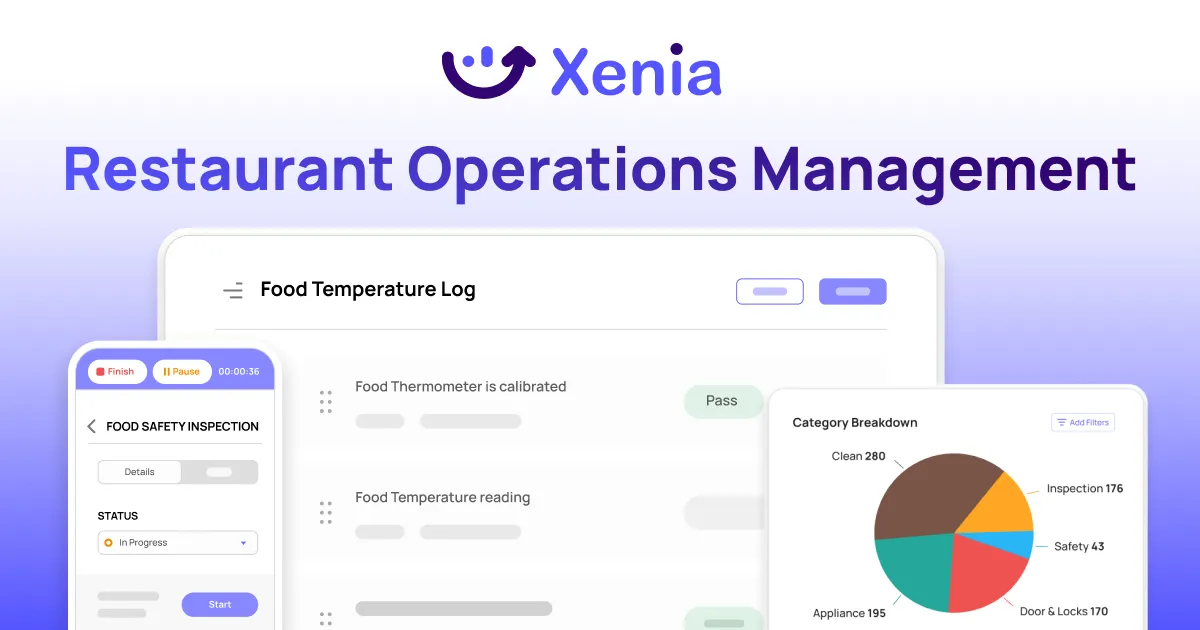
Xenia brings kitchen operations, food safety, audits, and team communication into one mobile-first platform. Restaurant teams execute daily work consistently, maintain compliance, and resolve issues faster, while leadership gets real-time visibility across all locations.
Why Restaurant Operators Choose Xenia:
🤖 AI-Powered Operations, Convert paper logs instantly and verify food presentation and kitchen cleanliness automatically. Get instant answers about food safety trends without building reports.
🍽️ Food Safety & Compliance, Track line checks and temperature logs with automated alerts. Trigger corrective actions when readings exceed safe ranges. Maintain audit-ready records for health inspections.
📊 Multi-Location Control, Monitor food safety compliance and task completion across regions. Benchmark locations to identify training needs. Export reports for operational reviews.
One platform for kitchen operations, food safety, and compliance across all locations.


