
Post Summary
Running a car wash sounds simple until you're actually doing it.
The equipment runs all day. Chemicals need constant calibration. Staff turn over. A brush wears through, and you find out at 9 am on a Saturday because a customer complained. The payment terminal goes down right when the Saturday morning rush hits.
And if you run more than one location? All of that happens at the same time, somewhere you are not.
Here is the thing. The car wash operators who have built past three or four sites share one thing in common. They stopped relying on memory, verbal handoffs, and clipboards. They built systems. They made those systems verifiable. And they gave themselves real visibility into what was happening at each site without needing to drive there.
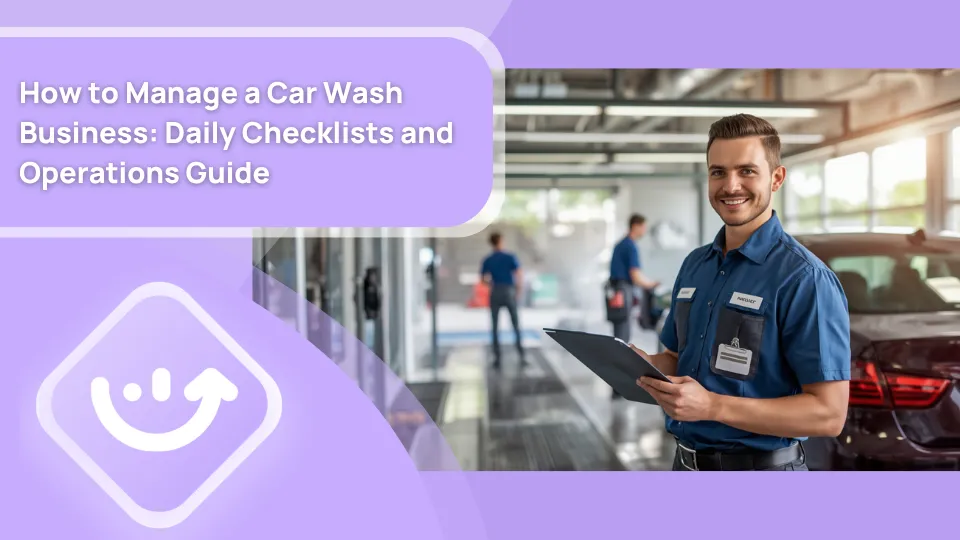
This guide is about how to manage a car wash business operationally. Daily checklists, equipment maintenance, chemical controls, staff accountability, SOPs, and the multi-location structure that actually holds up at scale.
.svg)

Priced on per user or per location basis
Available on iOS, Android and Web


Related resources
- Best mobile car wash software for frontline teams
- Different types of car washes and how to manage each
- Digital checklists: the complete guide for frontline teams
- Operations execution system: what it is and how it works
- Multi-unit operations execution guide
What managing a car wash business actually involves
Most new operators focus on the wash itself. Is the soap hitting the car? Are the brushes spinning correctly? Is the exit lane clear?
Those things matter. But they are outputs of your operational systems. They are not the systems themselves.
Car wash operations management covers six areas. Most operators handle the first two reasonably well. The last four are where the gaps usually live.
**
Area, What it covers
Daily site operations, Opening procedures-closing procedures-site cleanliness
Equipment maintenance, Preventive schedules-reactive repairs-service history
Chemical management, Inventory-injection calibration-cost per car tracking
Staff accountability, Role clarity-documented procedures-verified task completion
Customer experience, Wash quality-site presentation-feedback capture
Multi-location oversight, Cross-site visibility-standardization-performance reporting
**
Build a real system for all six, and most of the daily fire-fighting disappears.
Car wash daily opening checklist: what to check before the first car
This is the single most important document in your operation. If your opener skips it, problems show up after customers have already experienced them. If they complete it properly, you catch issues before the first car goes through.
Here is what a complete car wash opening checklist covers.
Equipment and mechanical
- Conveyor belt alignment and tension verified
- Drive rollers and pulleys checked for wear
- Mitter curtains and side brushes inspected, debris cleared
- Foam applicators and chemical injection points flushed and confirmed functional
- Dryer blowers powered on, airflow tested at each blower
- All limit switches and sensors confirmed operational
- Overhead and bay lighting working
Water systems
- Reclaim water system running, levels within normal operating range
- Spot-free rinse system pressure confirmed
- Water softener salt levels checked
- Filtration system inspected for blockage
- Hose connections and fittings free of leaks
Chemical inventory
- Presoak, soap, tire shine, and protectant tanks at correct fill levels
- Injection rates spot-checked against your wash quality benchmark
- Safety data sheets current and physically accessible on-site
- No expired or contaminated product in active use
Site and customer-facing areas
- Vacuum stations cleaned, hoses free of cracks or kinking
- Payment terminals and menu boards functional
- Entrance and exit areas clear of debris and standing water
- All signage lit and legible from the approach
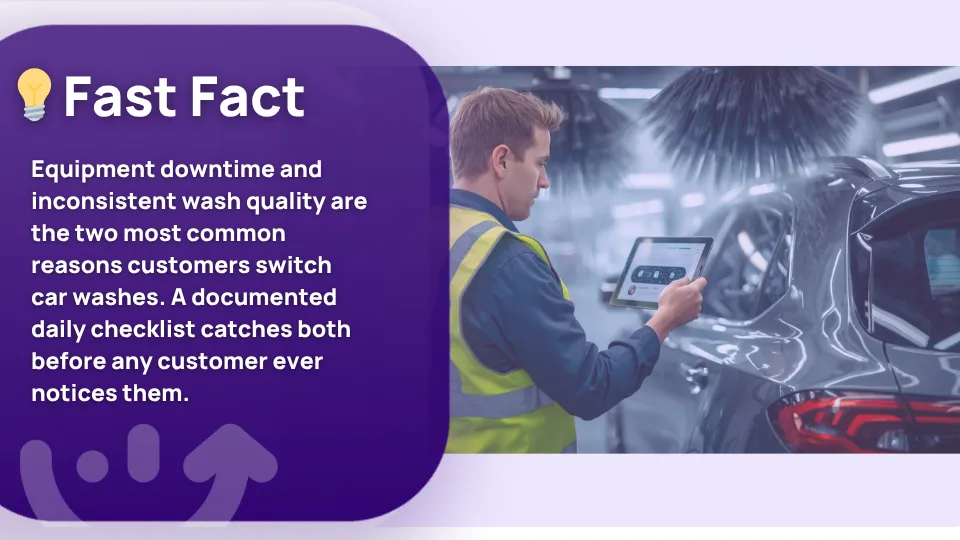
Two things are essential here. First, the checklist needs a named person assigned to it, not just a role. Second, completion needs to be verifiable. Paper checklists get initialed in batches or simply lost. Digital checklists with photo verification are what professional car wash operations use now because a photo of the brush condition is proof. A checkmark is not.
Car wash closing checklist: how to end every shift the right way
A rushed close almost always becomes a problem the next morning. The opener arrives to find water in the wrong place, a tank that ran dry overnight, or equipment that was not shut down in the right sequence.
Closing sets up tomorrow. Treat it that way.
Equipment shutdown
- All chemical systems flushed per manufacturer specification
- Brushes and mitter curtains rinsed and stored correctly
- Conveyor system walked for lodged debris before full shutdown
- Water reclaim system secured per your overnight protocol
- All blowers and pumps shut down in the correct sequence
- Equipment faults and error codes logged before leaving
Site close
- Vacuum stations cleaned, hoses hung properly
- Payment terminals secured, daily transaction reports pulled
- Cash drawer counted and reconciled where applicable
- Trash cleared across all areas including the approach lane
- Exterior lighting tested for overnight operation
- Security system armed
Chemical inventory close
- End-of-day tank levels recorded by product
- Low-stock items flagged for ordering before next open
- Any spills, leaks, or calibration issues photographed and documented
When closing and opening are documented by role and handed off properly, you stop losing information at shift change. The opener always knows what the closer left behind.
Car wash equipment maintenance schedule: weekly, monthly, and quarterly tasks
Equipment failure costs money twice. The repair bill is the obvious one. The revenue lost while you're closed or running a degraded wash cycle is usually bigger.
Most failures are not random. Bearings wear on a predictable cycle. Belts stretch over time. Chemical injectors clog from residue buildup. None of this happens overnight. It develops slowly, and if you're doing regular inspections, you catch it before it becomes an emergency.
Operators who avoid emergency service calls do it because they have a preventive maintenance schedule and they actually follow it.
Weekly maintenance tasks
**
Task, Why it matters
Lubricate all bearings-chains and sprockets, Reduces wear-extends equipment life significantly
Check belt tension on conveyor and dryers, Prevents slippage and alignment failures
Inspect brushes for wear depth and contact pattern, Catches brush issues before they damage vehicles
Clean and flush all chemical metering pumps, Prevents clog-related injection failures
Calibrate chemical concentration levels, Keeps wash quality consistent and cost per car controlled
Check water reclaim system for sediment, Prevents reclaim failures that force a shutdown
Review equipment error logs, Flags recurring faults before they become full failures
**
Monthly maintenance tasks
**
Task, Why it matters
Inspect all hydraulic and pneumatic connections, Catches pressure leaks before they cause failures
Rotate or replace high-pressure nozzles, Maintains wash quality and equipment pressure balance
Water softener performance check with hardness test, Protects equipment and ensures spot-free results
Deep clean sumps-filters and strainers, Prevents buildup that causes pump and reclaim issues
Electrical panel inspection for heat damage, Safety and long-term reliability
Fire extinguisher and safety equipment verification, Compliance and site safety readiness
**
Quarterly and annual tasks
- Motor and pump efficiency testing
- Full conveyor alignment and tension recalibration
- Chemical supplier audit comparing actual usage to expected volume
- Manufacturer service calls for equipment still under warranty
- Full safety inspection aligned with local compliance requirements
- Review of your equipment maintenance log to identify patterns in recurring failures
Tracking this properly requires more than a spreadsheet. You need a system where tasks are assigned, completed, and documented with timestamps. Work orders that link service records to specific equipment give you history you can actually use when something goes wrong.
Xenia's work orders module handles exactly this, from the request through to resolution with full photo documentation.
How to manage car wash chemicals and control costs
Chemicals are among the highest variable costs in any car wash operation. They are also among the least controlled, unless you have a system.
Two problems show up repeatedly.
Over-application. Injection rates drift. A pump calibrated three months ago is now running 15% high. You are spending more per car and nobody has noticed because nobody is tracking it.
No usage baseline. If you are not comparing chemical used to cars washed on a regular basis, you cannot tell whether a cost increase comes from waste, calibration drift, theft, or something else entirely.
A basic chemical management system tracks:
- Opening tank levels by product, recorded every day
- Closing tank levels by product, recorded every day
- Number of cars processed each shift
- Usage per car calculated weekly for each product
- Reorder triggers based on days of supply, not when a tank hits empty
If per-car chemical cost is climbing without a change in product mix or volume, check injection rates first. Then check fittings and connections for leaks. Then look at whether staff are manually supplementing product in ways that are not tracked.
Most chemical waste problems come from miscalibrated injectors or untracked manual applications. You cannot find the source if you are not measuring the inputs against the outputs.
How to hold car wash staff accountable for daily operations
The biggest operational variable in any car wash is staff consistency. Not because staff are unreliable, but because most car wash businesses do not give their team clear enough systems to execute against.
Good staff management in a car wash comes down to three things.
Clear role definitions. Every person on shift knows exactly what they own. The opener has a checklist. The closer has a checklist. The mid-shift attendant has specific tasks tied to site cleanliness, vacuum upkeep, and customer interaction. This is the starting point for anyone trying to manage training and accountability across multiple locations.
Documented procedures. The right way to do something is not stored in the head of your most experienced employee. It is written down, accessible on their phone, and updated when anything changes. This is the foundation of useful car wash SOPs and checklists.
Verifiable completion. You can confirm that a task was completed, not just submitted. Photo verification on key inspection steps and timestamped submissions give managers confirmation without requiring them to be on-site for every shift.
Most operators who implement a digital checklist system with role-based assignment find two things happen quickly. Management time drops because staff have answers in the system instead of calling a manager. Complaint-driven problem discovery drops because issues get caught at open instead of mid-shift.
How to write a car wash SOP that staff actually follow
Standard operating procedures get a bad reputation because most of them are never looked at after they're written. They are too long, stored in a binder nobody touches, and written in language that only made sense to the person who wrote them.
A useful car wash SOP answers three questions for any given task:
- What exactly are we doing?
- Who is responsible for doing it?
- How do we know it was done correctly?
Start with these five. They cover the highest-risk gaps in most car wash operations.
**
SOP, What to include
Opening by role, Step-by-step-in order-detailed enough for a new hire's first solo week
Closing by role, Same standard-includes equipment shutdown sequence and inventory recording
Equipment cleaning, Per equipment type-with photos of each step where visual reference helps
Chemical adjustment, Who approves rate changes-how changes are documented-who verifies results
Equipment failure escalation, Who gets called first-spending threshold before manager approval needed
**
After these five, add a new staff onboarding checklist. What does someone need to complete, learn, and demonstrate before they work a shift without supervision?
Once these exist, they are reusable and improvable. Every time something goes wrong, you update the relevant SOP so the same gap cannot cause the same problem again.
How car wash operations directly impact customer experience
The highest-rated car washes in any market tend to look at customer experience differently.
Most operators define it as: did the car come out clean, were staff polite, was the site clean?
The better operators define it as: every negative customer experience traces back to a specific operational failure.
A soap residue streak is a chemical calibration issue. A customer who waited eight minutes for a basic wash is a conveyor timing issue. A vacuum that dies mid-use is a maintenance issue. Fix the operations and the experience follows automatically.
Three things worth building into your regular operations to keep customer experience tight:
Site presentation audits twice a day. Morning and mid-afternoon covers your two peak windows. Check signage condition, pavement cleanliness, vacuum station state, and any equipment visible to customers approaching the site.
Wash quality logging during shifts. A quick pass/fail observation at set intervals. This catches calibration drift before customers start noticing and complaining.
Customer feedback capture at the exit. A QR code linked to a two-question form takes about an hour to set up. The signal it gives you is worth far more than the time it takes. Problems surface early, when you can still fix them quietly.
How to manage multiple car wash locations from one system
Running one car wash well is hard. Running three or more consistently is a different problem entirely.
The challenge is not finding good equipment or good people. The challenge is getting visibility into what is actually happening at each site without being there.
Here is what breaks down at scale, and it breaks down reliably.
Checklists become inconsistent across sites. One location uses a printed form on a clipboard. Another texts the manager when tasks are done. A third has a shared spreadsheet nobody has updated in weeks. You have no unified view of daily execution.
Maintenance schedules drift when key people leave. The person who knew when the brushes were last serviced left two months ago. That knowledge left with them. Now you are replacing brushes after they cause a customer complaint instead of before.
Chemical costs vary across locations with no clear cause. It might be calibration. It might be staff differences. It might be something else. Without location-level data in one place, you cannot investigate it.
Work order resolution is invisible. Equipment gets flagged, a call gets made, something gets fixed. Or maybe it does not. Without a tracked work order, you have no record of what was done, when, or by whom.
Operators managing five, ten, or twenty car wash sites who have this under control are using an operations execution system to standardize across sites. Not just for checklists but for maintenance tracking, work orders, and cross-location reporting.
If you want to understand what that looks like specifically for car wash and convenience store operations, this guide on multi-unit operations execution breaks it down further.
When evaluating mobile car wash software for multi-location management, the features that matter most are role-based task assignment, photo-verified completion, equipment maintenance scheduling with automated work order creation, and a cross-site dashboard you can actually read in under two minutes.
Car wash KPIs to track across multiple locations
Site managers track shift-level data. Multi-location operators need a layer above that.
**
Metric, What it tells you
Checklist completion rate by site, Which locations are executing daily procedures consistently
Open work orders by age, Where maintenance issues are sitting unresolved
Chemical cost per car by location, Where injection calibration or waste problems exist
Equipment failure frequency by site, Which locations have recurring maintenance problems
Preventive maintenance completion vs. schedule, Where PM is being deferred and risk is quietly building
**
A monthly review of these five metrics across all your locations will surface patterns that stay invisible when you're looking at each site in isolation. One site running 20% above benchmark on chemical spend. Two locations where monthly maintenance is consistently late. A single piece of equipment across three sites generating repeated work orders for the same fault.
The data mostly confirms what experienced operators already suspect. What it adds is the ability to have a specific, evidence-based conversation with a site manager instead of a general one based on gut feeling.
How Xenia helps you manage car wash operations
Most car wash software focuses on memberships, POS, and loyalty. That is the customer side. The operational side, which is what determines whether the wash actually runs well, is a different problem.
Xenia is built for that layer. It is used across convenience store operations with car wash bays, standalone tunnel washes, and multi-site express chains.
Here is what operators use it for:
Daily checklists with photo verification. Opening and closing checklists are assigned by role, completed on mobile, and require photos for key steps. Managers see real-time completion across all locations without calling anyone.
Preventive maintenance scheduling. Tasks are scheduled by interval and assigned automatically. When service is due, a work order is created and tracked to resolution. Full equipment history stays in the system via Xenia's equipment management module.
Work orders with photo documentation. Staff log issues on the spot with photos during their daily checks. The work order gets routed, tracked, and closed. Verbal handoffs disappear.
Multi-location dashboard. Task completion rates, open work orders, and maintenance status across all sites in one view. The analytics and reporting module shows trends over time.
AI Template Agent. Describe what you need, and it builds the checklist. Or upload your existing paper forms and convert them digitally without manual re-entry.
Task management and inventory logging. Assign daily tasks by role, record chemical tank levels at open and close, track usage per shift, and flag low stock before it causes a disruption.
If you want to see how this works for your operation, book a demo or start a free trial. No credit card needed.
.webp)
Conclusion
Managing a car wash comes down to systems. Not equipment. Not staff. Systems.
A single site can run on experience and habit for a while. Once you start growing, adding locations, or dealing with higher turnover, that approach breaks down. Problems show up after customers do. Costs drift without anyone catching them. The same failures repeat because nothing was documented the first time.
The operators running the best car wash businesses are not doing anything complicated. They have clear daily checklists by role. They have maintenance that gets done and recorded. They have visibility across sites without needing to make a phone call.
Build those three things, and most of the daily problems sort themselves out.
To see how Xenia supports this kind of structure across single or multi-location car wash operations, book a demo with the team or start a free trial today.
Frequently Asked Questions
Got a question? Find our FAQs here. If your question hasn't been answered here, contact us.
What is the biggest operational challenge in running a car wash business?

Consistency. Equipment, chemicals, and staff all introduce variability and variability is what drives complaints and unplanned costs. The fix is documented procedures, scheduled maintenance, and a way to verify that daily tasks were actually completed, not just assumed.
How do you write a car wash SOP?
Start with your five riskiest procedures: opening, closing, equipment cleaning, chemical adjustment, and breakdown escalation. For each one, write what is being done, who owns it, and how you verify it was completed. Number the steps. Add photos where it helps. Put it on mobile so staff can actually use it during their shift.
What software do car wash businesses use to manage daily operations?
Most use a POS or membership tool for the customer side. For operations, checklists, maintenance, and work orders, operators are moving to purpose-built mobile car wash software instead of generic tools that were never designed for this environment.
How do you manage a car wash business with multiple locations?
You need one system across all sites. Standardized checklists, maintenance tracking, and a single dashboard showing completion rates and open work orders by location. Without that, you are managing by phone call and finding out about problems after they have already happened.


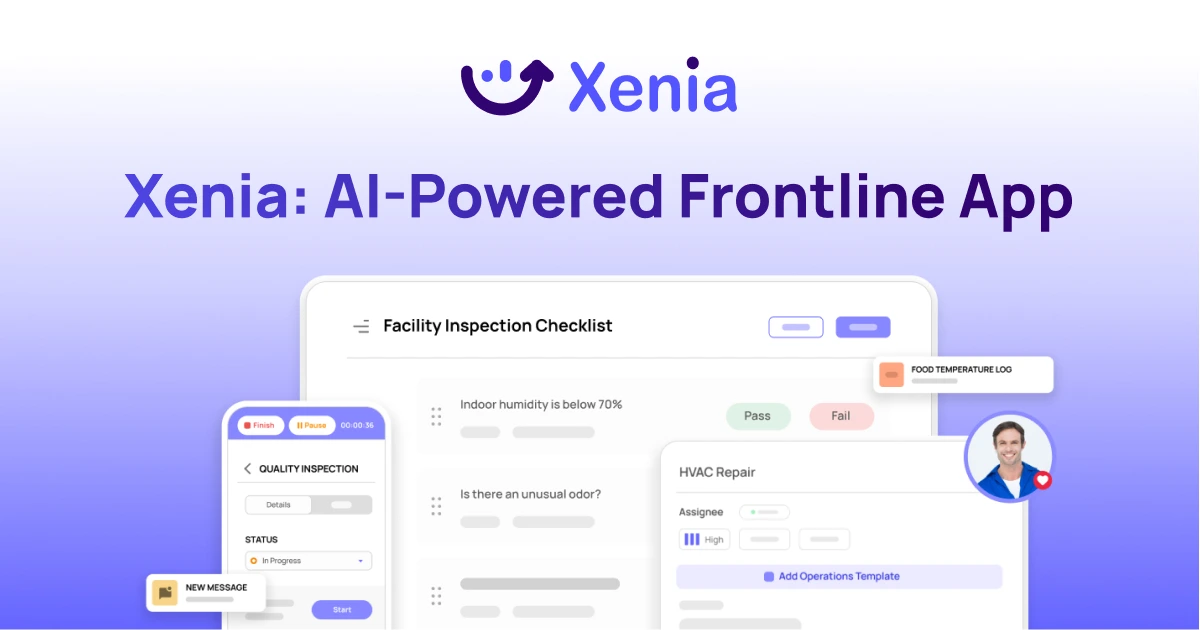
A Modern, AI-Powered Platform Built Specifically for Frontline Operations
Xenia brings daily operations, maintenance, audits, and compliance into one mobile-first platform. Frontline teams execute work consistently across locations while leadership gets real-time visibility.
Why Multi-Location Operators Choose Xenia:
🤖 AI-Powered Operations, Create digital checklists instantly or convert paper forms with AI. Verify compliance automatically with photo analysis and get instant answers from your operational data.
✅ Daily Operations & Maintenance, Assign work across hundreds of locations in minutes. Report and route issues instantly. Schedule preventive maintenance to catch problems before downtime.
📊 Real-Time Visibility, Track completion, work orders, and performance across all locations through dashboards. Filter by site or asset to spot trends and take action.
Manage operations, maintenance, and compliance across all your locations from one platform

.svg)
.webp)
%201%20(1).webp)

.svg)
%201%20(2).webp)