
.webp)
Post Summary
Imagine a facilities manager in charge of 30 stores.
She manages a team of maintenance technicians who drive from store to store every day to fix equipment, do regular maintenance, and handle inspections.
Some mornings are messy: technicians get their jobs over text, one doesn’t reply until late, two go to the same store by mistake, and another store waits days for a repair that was never assigned.
This isn’t the workers’ fault, it’s a problem with the scheduling system.
Scheduling mobile teams like field technicians, delivery drivers, contractors, or event staff is very different from scheduling a team that stays in one place.
Tools made for fixed-location teams usually don’t work well when workers move between sites.
This guide explains what makes mobile scheduling different and how to organize mobile teams in a simple and effective way.
.svg)

Priced on per user or per location basis
Available on iOS, Android and Web


What Makes Mobile Workforce Scheduling Different
Most scheduling tools were built for a team that shows up to the same place every day. Mobile operations break almost every assumption those tools make.
Here are the three structural differences that matter most.
Workers Are Not at a Fixed Location
In fixed-location scheduling, you assign someone to a shift at a known worksite. Simple. In mobile scheduling, you are answering a completely different set of questions:
- Who goes where?
- In what order?
- Carrying what equipment?
- How long does travel take between each stop?
A technician assigned to three jobs on opposite ends of a city will spend half her shift in the car. That is not bad luck. That is a scheduling decision someone made without thinking through the geography.
Route and geography are part of the schedule. They are not afterthoughts.
Schedule Changes Happen Mid-Day, Not Just Before the Shift
Fixed-location scheduling is mostly stable once the week starts. Someone calls out sick, you find coverage. That is about it.
Mobile operations are different. Things change constantly, all day long:
**
What changes, When it happens
New repair request comes in, Mid-morning
A job runs longer than estimated, Anytime
Parts delay pushes back an appointment, No warning
Traffic reroutes the whole afternoon, Daily
**
Every one of those changes needs to reach a worker who is already in the field, between jobs, probably driving. If your communication system is text messages and phone calls, good luck keeping everyone updated in real time.
Verification of Work Is Remote by Default
When your team works in one location, you can walk the floor. You can see what got done.
In mobile operations, you are not there. You find out work is complete when the worker tells you it is complete. That gap between "worker says it's done" and "it's actually done" is where quality problems and compliance issues hide. Without a structured verification process, you find out when a complaint arrives.
The Core Components of Mobile Workforce Scheduling
Whether you are running a digital system or still on spreadsheets, five things need to work. Get these right and the whole operation gets easier.
Job Assignment and Skill Matching
Every job has requirements. The worker you assign needs to meet them before they drive to the site. A technician certified for HVAC cannot complete an electrical compliance inspection. Sending the wrong person wastes a trip, delays the work, and frustrates the site manager waiting for the repair.
The fix is simple: match qualifications to job requirements before you assign, not after the worker arrives and figures out they cannot do the work.
Route and Territory Optimization
Routing in mobile operations is not a separate decision from scheduling. It is the same decision. Two approaches work well depending on your operation:
**
Approach, Best for, How it works
Territory assignments, Technicians-auditors-supervisors, Each worker owns a geographic zone
Route sequencing, Delivery drivers, Stops are ordered by geography and time windows
**
Territory assignments reduce travel overhead and build site familiarity over time. Route sequencing determines both efficiency and on-time performance for delivery operations.
A scheduling tool that assigns workers without accounting for geography is not finished. It is halfway done.
Appointment Windows and Customer Expectations
Most mobile operations require giving someone, a customer, a site manager, or a receiving team, an estimated arrival window. Here is where a lot of schedules fall apart:
- Job A takes longer than expected
- Travel to Job B eats into the buffer
- The arrival window for Job B gets missed
- Someone calls to ask where the technician is
Scheduling that does not build in realistic job duration and travel time produces missed windows. Missed windows produce complaints. For multi-site operators, this is a brand standard issue, not just a logistical one.
Build the windows in honestly. If a job typically takes 90 minutes and travel adds 20, the block in the schedule should be 110 minutes. Not 90.
Work Order Creation and Documentation
Every job needs a paper trail: what was assigned, what got done, what parts were used, whether follow-up is needed. Paper work orders create lag. By the time a form gets back to the office, processed, and entered somewhere, the manager has no real-time visibility and billing is already delayed.
**
Aspect, Paper work orders, Digital work orders
Manager visibility, After forms return to office, Real time
Billing speed, Delayed, On completion
Compliance records, Incomplete-manual, Timestamped-complete
Lost forms, Common, Eliminated
**
Verification and Completion Confirmation
A job is not done when a worker says it is done. It is done when there is evidence. What good verification looks like depends on the work type:
- Photo evidence with a timestamp
- GPS confirmation the worker was physically at the location
- Completed checklist with mandatory steps that cannot be skipped
- Digital signature from the site manager or customer
For compliance-sensitive work like food safety inspections, safety equipment checks, and regulatory audits, this is non-negotiable. Accountability built into the completion process is what separates a documented job from an assumed one.
Scheduling Approaches by Mobile Workforce Type
Not all mobile workforces have the same scheduling problems. Here is how the challenges break down by workforce type and what actually helps.
Field Service and Maintenance Technicians
The core tension in maintenance scheduling: reactive work and planned maintenance compete for the same hours. When reactive call volume spikes, planned maintenance gets pushed. Push it long enough and equipment that was supposed to be maintained quarterly has not been touched in eight months. The result is more reactive calls, which pushes planned maintenance further. It is a cycle.
The way out is reserving capacity for reactive work upfront, not filling every hour with planned jobs and hoping reactive calls do not come. They will come. A maintenance schedule program that treats reactive capacity as a built-in budget keeps both tracks moving.
Delivery Drivers and Route-Based Workers
Assigning a driver to a territory is not a complete schedule. It is a starting point. The real work is sequencing the stops within that territory. Delivery scheduling needs to account for:
- Customer time windows at each stop
- Receiving schedules at each location
- Vehicle capacity and load order
- Same-day exceptions: closed location, refused delivery, access issues
A driver who hits a closed location with no clear exception protocol either parks and calls dispatch or skips the stop and hopes someone notices. Neither is good. Build the exception process into the schedule, not as an afterthought.
Contractors and Trade Workers
Contractor scheduling has a complication that most other mobile workforce types do not: jobs have to happen in a specific order. Rough electrical before drywall. Drywall before painting. Inspections after rough-ins. A schedule that ignores those dependencies creates rework. Rework always costs more than getting the sequence right the first time.
For multi-unit operators managing renovations or upgrades across a portfolio, this becomes a project management problem. Permit sequencing, crew coordination across sites, subcontractor timing. None of it holds together without job-level documentation that informal assignment methods cannot provide.
Event Staff and Temporary Workers
Temporary event staffing has a problem permanent workforces mostly do not face: the person you assigned to the shift may not show. No-show rates for part-time and gig workers are real enough that double-coverage planning for critical roles is a standard practice, not an overreaction.
Two other things that get missed in event staff scheduling:
- Workers may have never been to this venue before. Location briefing is part of the schedule, not optional.
- Confirmation is a separate step from assignment. Assigning is not enough.
Multi-Site Supervisors and Auditors
Supervisor and auditor scheduling is partly a travel optimization problem and partly an accountability tool. Locations that get visited infrequently develop execution gaps. The gaps do not go away on their own, they grow. Scheduled visits surface them. Unannounced visits confirm whether standards hold when nobody is watching.
Operators who treat supervisor scheduling as a compliance and accountability tool see better location-level performance than those who treat it as a calendar exercise.
What Breaks Down in Mobile Workforce Scheduling and How to Fix It
Most mobile scheduling failures trace back to four specific problems.
Problem 1: Job Assignments Made by Text or Verbal Communication
**
Aspect, Text/verbal assignment, Written work order
Documentation trail, None, Full
Confirmation of receipt, Assumed, Required
Dispute resolution, Worker's word vs manager's word, Written record
Accountability, Zero, Clear
**
The fix is not complicated. Every assignment generates a written work order. The worker acknowledges it. The record exists. A paper work order beats a text message. A digital one beats paper.
Problem 2: No Real-Time Visibility Into Job Status
If you have to call a worker to find out whether a job is done, you are not managing. You are checking. That is a full-time job on its own, and it still does not catch problems until after they have happened.
The fix is mobile-accessible job status updates that workers complete in the field. Minimal works fine:
- Job marked in progress when work starts
- Job marked complete with a photo attached
That alone gives the manager enough visibility to catch delays before they become missed windows or complaints.
Problem 3: Not Allowing Extra Time for Travel
A schedule that starts the next job as soon as the previous one ends doesn’t work in real life. Things often take longer than planned, and travel between sites takes time.
For example, if a job takes 90 minutes and the next site is 20 minutes away, the schedule should include:
- 90 minutes for the job
- 20 minutes for travel
- 10 minutes extra in case the job runs late
Don’t just schedule jobs back-to-back with no buffer.
Problem 4: No Escalation Process for Incomplete or Failed Work
A worker arrives at a site. Missing access. Wrong parts. Problem is outside their skill set. They cannot complete the job. In most operations without a defined escalation process, the work goes undone, the site does not get notified, and the manager finds out through a complaint.
The fix is an escalation workflow that fires the moment a job cannot be completed:
- Worker flags the job as incomplete with a reason
- Manager is notified immediately
- Site manager is notified immediately
- Job is rescheduled with a documented reason
- The gap is tracked, not lost
How Xenia Helps

Xenia is made for businesses managing teams that work in the field across many locations.
With Xenia, managers can:
- Create and assign jobs digitally
- Make sure the right worker goes to the right place with the right skills
- Track job progress in real time
- Collect proof of work with photos and checklists
Workers get job details on their Xenia mobile app, and completion is recorded with timestamps, photos, and required steps. Managers can see what’s happening at all locations without making phone calls.
For maintenance, Xenia handles recurring schedules for every location. For compliance work, it keeps geo-stamped records and checklists for a full audit trail.
In short, Xenia replaces messy texts, spreadsheets, and calls, giving clear visibility and control over your mobile workforce. See how.
Conclusion
Mobile workforce scheduling fails when jobs are assigned without a clear plan, routes are not organized, and managers cannot see what is happening in the field.
The solution is simple. Make sure every job is clearly assigned, plan travel and timing realistically, update changes as they happen, and check work with proof. When these basics are done, teams stop chasing updates and work more smoothly.
Tools like Xenia put all of this in one place, helping teams manage jobs, track progress, and stay organized across every location, without relying on calls, texts, or spreadsheets.
Frequently Asked Questions
Got a question? Find our FAQs here. If your question hasn't been answered here, contact us.
How do you manage communication between field workers and dispatch?

Use one platform where all job updates, notes, and changes are recorded in one place. This cuts down on calls and messages and makes sure everyone sees the same information instantly.
How do you ensure accountability for remote workers?
Make accountability part of the workflow using checklists, photos, timestamps, and location info. A job should only be marked complete when proof is submitted, not just when the worker says it’s done.
What tools are needed for effective mobile workforce scheduling?
At minimum, you need digital work orders, mobile access for workers, real-time updates, GPS tracking, and a central dashboard for managers. Without these, managing the team depends too much on calls, texts, and manual communication.
What is the best way to track field worker productivity?
Track productivity by looking at how many jobs are finished, how long each takes, travel time compared to work time, and how often tasks are fixed on the first visit. The goal is not just speed, but doing the job right without needing extra visits.
How do you handle last-minute schedule changes in the field?
Use a system that can send updates to workers’ phones instantly. When a job changes, it should automatically adjust their route, notify them, and record the change. Avoid using calls or texts, because they are easy to miss and hard to track.


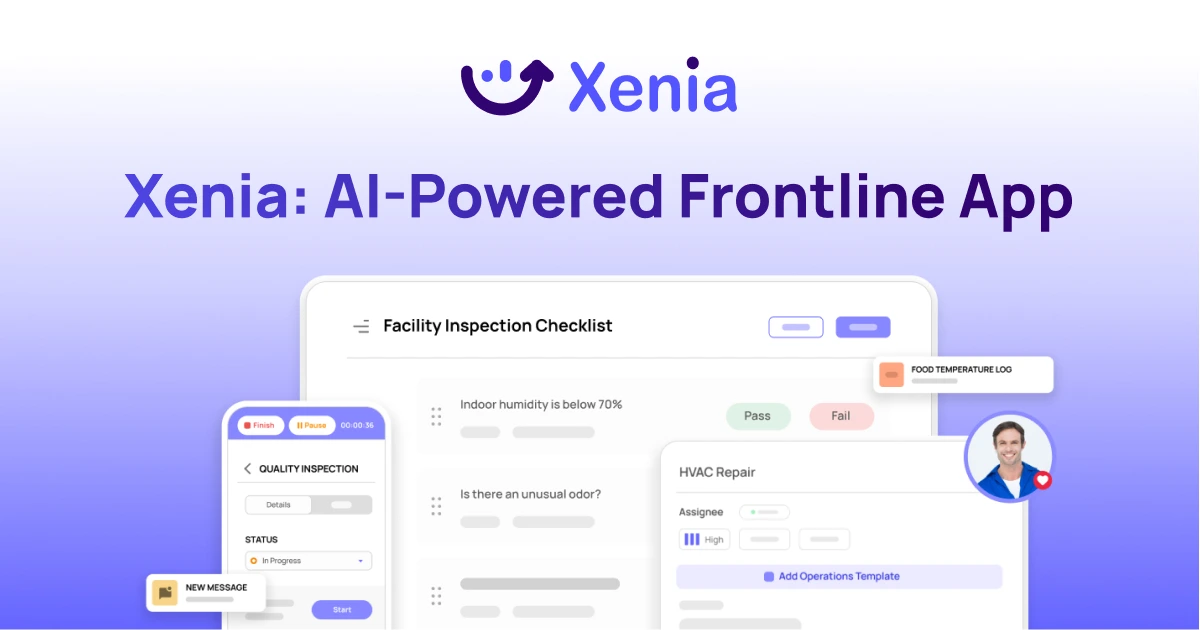
A Modern, AI-Powered Platform Built Specifically for Frontline Operations
Xenia brings daily operations, maintenance, audits, and compliance into one mobile-first platform. Frontline teams execute work consistently across locations while leadership gets real-time visibility.
Why Multi-Location Operators Choose Xenia:
🤖 AI-Powered Operations, Create digital checklists instantly or convert paper forms with AI. Verify compliance automatically with photo analysis and get instant answers from your operational data.
✅ Daily Operations & Maintenance, Assign work across hundreds of locations in minutes. Report and route issues instantly. Schedule preventive maintenance to catch problems before downtime.
📊 Real-Time Visibility, Track completion, work orders, and performance across all locations through dashboards. Filter by site or asset to spot trends and take action.
Manage operations, maintenance, and compliance across all your locations from one platform

.svg)
.webp)
%201%20(1).webp)

.svg)
%201%20(2).webp)