
Post Summary
Seven Zipline competitors, compared side by side. Pricing verified, features checked, and matched to the operator type each tool actually works for.
If you're a retail operator who's outgrown what Zipline offers, this is where you find what comes next.
This guide covers seven Zipline app alternatives worth considering. We've looked at the pricing, the features, and who each tool is actually built for, so you can make the right call faster.
Quick comparison: top Zipline software alternatives
The seven Zipline competitors below cover everything from lightweight task management to full frontline operations. Pick what fits your team.
**
Tool, Best for, Built for store teams, Multi-location support, Starting price
Xenia, Multi-unit operators (retail-restaurants-c-stores), Yes, Yes, Free trial; Starter-Pro-Enterprise
Planview AdaptiveWork, Enterprise PMO and portfolio teams, No, Partial, Contact vendor
Todoist, Individual and small team task management, No, No, Free; Pro at $5/user/month
Hive, Marketing and creative teams, No, Limited, Free; Starter at $5/user/month
MeisterTask, Agile teams-Kanban-based workflows, No, No, Free; Pro at $8.25/user/month
Confluence, Documentation and knowledge management, No, No, Free; Standard at $5/user/month
Smartsheet, Structured project tracking-enterprise teams, No, Limited, Pro at $9/user/month
**
What does Zipline Software do?
Zipline is a back-of-house retail operations platform. It lets store teams receive directives from HQ, manage tasks, push communications, and track execution across locations. Managers can build custom pages and widgets, run surveys, and segment content by role, region, or store type.
It works well for centralized retail communication. Where it struggles is flexibility. Users commonly flag limited survey and tasking customization, remote access issues when away from the store, and minimal control over user list management. For operators with non-standard workflows or multi-unit scale, it tends to feel more rigid than expected.
If any of that resonates, here are the alternatives worth a proper look.
Top 7 Zipline app alternatives
.svg)


1. Xenia
Xenia is a mobile-first retail operations execution platform built for multi-unit operators, district managers, and operations leads who need visibility and accountability across every location they manage.

Zipline is good at getting information from HQ to stores. The gap shows up after that. Did the task get done? Was the failed inspection followed up on? Were brand standards actually met? Zipline doesn't close that loop. Xenia does.
Operators switch to Xenia when they're done managing operations through WhatsApp follow-ups and spreadsheets that nobody updates. Xenia tracks execution across every location in real time, flags issues automatically, and keeps a timestamped record of everything. District managers see what's done and what isn't without making a single call.
Xenia's key features
These are the areas where Xenia goes further than Zipline:
- Corrective action workflows: Zipline lets you assign tasks manually after an issue. Xenia lets you schedule tasks and triggers follow-up tasks automatically the moment an inspection fails, assigned to the right person with a deadline already set.

- Geo-stamps and digital signatures: Every submission is logged with location, time, and a digital signature. Your audit records hold up when it matters. Zipline doesn't offer this.
- Maintenance and equipment tracking: With Xenia, you can log repair requests, track work order history, and keep records per asset. Everything lives in one place. Zipline has no maintenance management.
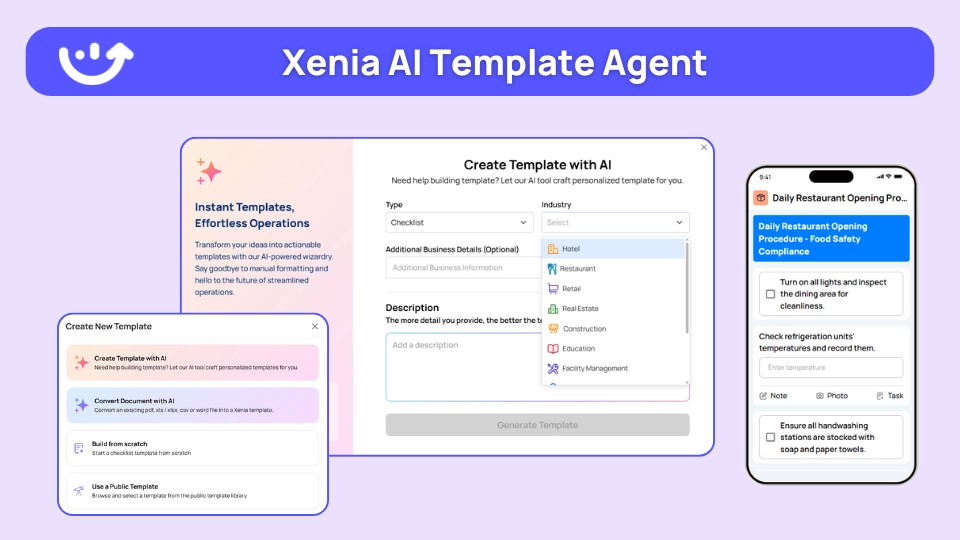
- AI Template Agent: Already have SOPs, store procedures, or audit forms on paper or in PDFs? Xenia converts them into ready-to-use digital checklists in seconds. No rebuilding, no manual data entry.
- AI Photo Analysis: Verify planogram compliance, shelf standards, and store conditions from photos with Xenia’s built-in AI image recognition. Zipline has no visual verification capability.
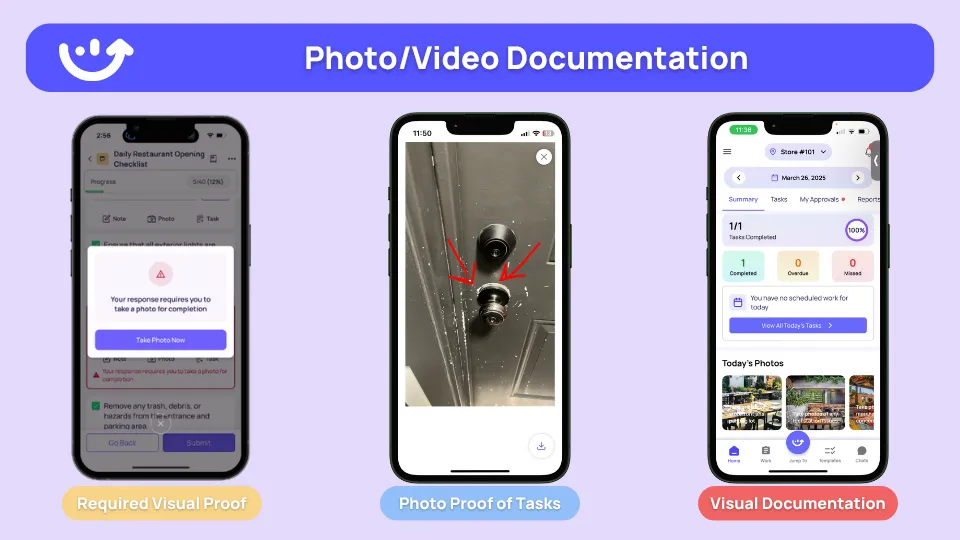
- Team communication: In Zipline, communications and operations are separate. In Xenia, they're connected. Chat, announcements, and task conversations all live in the same place as the work. Send an update, assign a task, and track completion without switching apps.
.png)
When to choose Xenia
**
Aspect, Zipline, Xenia
Store communications and directives, Yes, Yes
Task management and tracking, Yes, Yes
Corrective action workflows, Manual, Automated
Offline mode, Yes, Yes
Geo-stamped audit trail, No, Yes
Maintenance and equipment tracking, No, Yes
AI features, No, Yes
**
Zipline works for retail communication. Xenia works for retail execution. If your team is still chasing completion over the phone, dealing with compliance gaps during audits, or finding out about equipment failures too late, Xenia is the switch worth making.
Xenia's pricing
Xenia has three plans: Starter, Pro, and Enterprise. You can pay per user or per location, whichever makes more sense for your operation.
Starter is for smaller teams getting started with digital operations. Pro adds AI features and stronger multi-location controls. Enterprise is custom-priced for larger operations with more complex needs.
Pro and Enterprise both come with full setup, training, and a dedicated customer success manager. No setup fees, no surprise charges.
Start with a free trial on the Starter plan or book a demo for Pro and Enterprise.

Priced on per user or per location basis
Available on iOS, Android and Web


2. Planview AdaptiveWork

If your reason for leaving Zipline is that you need enterprise-level project portfolio management across large teams, Planview AdaptiveWork is worth looking at. For retail store operations, it isn't the right fit.
Planview AdaptiveWork, formerly Clarizen, is a project management platform built for large enterprise teams. It helps PMO and professional services teams keep track of big project portfolios across the organization. Covers resource planning, project prioritization, risk management, and reporting.
Key features
- Manage workloads and resources across multiple projects.
- Review, prioritize, and approve incoming project requests.
- Store and organize files in one place with version tracking.
- Build dashboards and reports to see how projects are performing.
- Keep teams updated via email and mobile in real time.
Pricing: Contact vendor. Pricing is negotiated based on organization size and scope with no publicly listed standard tiers.
3. Todoist

If the only thing you need from Zipline is basic task assignment and your team doesn't require audit trails or multi-location tracking, Todoist does that at a fraction of the cost.
Todoist is a personal and small-team task manager built for individuals and small teams who need to stay organized. Clean interface, fast to set up, and good at managing tasks and priorities. No audit capabilities, location hierarchies, or compliance workflows. It's a task list. A very good one.
Key features
- Recurring tasks with flexible scheduling options.
- Priority levels and due date management.
- Team workspaces with shared projects and commenting.
- Integrations across hundreds of apps and platforms.
- Calendar, board, and list views for task organization.
Pricing: Free plan available. Pro at $5/user/month (billed annually). Business at $8/user/month (billed annually).
4. Hive

If you're moving away from Zipline because your team needs stronger project collaboration and workflow management rather than store execution, Hive is a solid option to consider.
Hive is a project management tool for marketing, creative, and software teams. It covers task management, time tracking, resource management, and workflow automation from one platform.
Key features
- View your work as a Gantt chart, Kanban board, calendar, portfolio, or table.
- Track time and manage team workloads without leaving the platform.
- Automate repetitive tasks with Hive Automate.
- Connect directly with email and Salesforce.
- Use Buzz, Hive's AI assistant, to automate tasks and summarize workspace activity.
Pricing: Free plan for up to 10 workspace members. Starter at $5/user/month (billed annually). Teams at $12/user/month (billed annually). Enterprise pricing on request.
5. MeisterTask
If your team uses Zipline mainly to assign and track simple tasks and you want something lighter and cheaper, MeisterTask is worth a look. It won't replace store execution, but it handles basic task management well.
MeisterTask is a simple Kanban tool for small to mid-sized teams who want to manage tasks without a complicated setup. Clean boards, easy to use, and straightforward to get started with. Covers task automation, recurring tasks, time tracking, and custom fields.
However, no audit tools, location management, or compliance features.
Key features
- Kanban boards with drag-and-drop tasks.
- Task automation and recurring task support.
- Time tracking per task and project.
- Roles and permissions for team access.
- Custom fields and file attachments up to 200MB.
Pricing: Free basic plan. Pro at approximately $8.25/user/month (billed annually). Business at approximately $20.75/user/month (billed annually). Enterprise on request.
6. Confluence

If your main frustration with Zipline is around documentation, storing SOPs, and keeping your team aligned on processes rather than task execution, Confluence solves that specific problem well.
Confluence is Atlassian's documentation platform built for teams that need one place to write, store, and organize information. Product specs, meeting notes, internal processes, and wikis all live here. Deep Jira integration makes it a natural fit for software development teams. Not a task management or operations execution tool.
Key features
- Real-time collaborative editing with continuous autosave.
- Space and page-level permission controls.
- Template library for documentation, project pages, and whiteboards.
- Page watching with change notifications.
- Deep integration with Jira and other Atlassian products.
Pricing: Free plan for up to 10 users. Standard at approximately $5/user/month (billed annually). Premium at approximately $9/user/month (billed annually). Enterprise available.
7. Smartsheet

If you're leaving Zipline because you need stronger reporting, structured workflows, and a tool your operations team can build custom processes in, Smartsheet gives you that flexibility in a familiar spreadsheet-style format.
Smartsheet is a work management tool that works like a spreadsheet. It adds project tracking, automated workflows, dashboards, and reporting on top of a familiar grid layout. Works best for project managers and enterprise teams. Not built for frontline or store operations. Costs go up fast as your team grows.
Key features
- Grid, Gantt, card, and calendar views.
- Workflow automation with conditional triggers.
- Resource management and team workload tracking.
- Customizable dashboards and data collection forms.
- Enterprise security, SSO, and directory integrations.
Pricing: Free plan (1 licensed user, 2 editors). Pro at $9/user/month (billed annually, up to 10 members). Business at $19/user/month (billed annually, 3+ members). Enterprise and Advanced Work Management plans at custom pricing.
Which Zipline alternative is right for you?
Most tools on this list are built for office teams managing projects. If that's what you need, Todoist, Hive, MeisterTask, Confluence, and Smartsheet will all serve you well.
But if you're a retail operator managing multiple locations, the problem isn't project management. It's execution. Did the store complete the task? Was the planogram set correctly? Was the failed inspection followed up on? Those questions don't get answered by a task list or a wiki.
Zipline gets you part of the way there. It moves information from HQ to stores. What it doesn't do is verify that stores acted on it, document that it happened, or automatically follow up when something goes wrong.
That's the gap Xenia fills. Built specifically for retail operators managing multiple locations, it closes the loop between what gets assigned and what actually gets done.
Still have questions? Here's what operators ask most.
Conclusion
If you're still on Zipline, you already know what it does well. Communications, directives, basic task management. That's a solid foundation.
The question is whether that's enough. For retail operators dealing with compliance gaps, missed follow-ups, and no clear audit trail, it usually isn't.
The tools on this list cover a range of needs. Pick the one that matches where your operation actually is right now, not just where you want it to be.
If execution across multiple locations is the gap, Xenia is the right pick. Start with a free trial or book a demo.
Frequently Asked Questions
Got a question? Find our FAQs here. If your question hasn't been answered here, contact us.
What is the best Zipline competitor for multi-unit retail?

Xenia. Real-time task tracking, audit workflows, and automated corrective actions across every location, all from one platform.
Which Zipline alternatives work offline?
Xenia. It works fully offline and syncs automatically when connectivity returns. Useful for field teams in stores where internet access isn't reliable.
What are the main limitations of Zipline?
Limited customization in surveys and tasking, difficulty accessing the app remotely, and little control over user list management. For operators with complex or non-standard workflows, it tends to feel restrictive.
What are the best Zipline alternatives in 2026?
Xenia, Planview AdaptiveWork, Todoist, Hive, MeisterTask, Confluence, and Smartsheet.
For multi-unit retail operators, Xenia is the strongest pick. It's the only one on this list built specifically for frontline operations execution across multiple locations.


A Modern, AI-Powered Platform Built Specifically for Frontline Operations
Xenia brings daily operations, maintenance, audits, and compliance into one mobile-first platform. Frontline teams execute work consistently across locations while leadership gets real-time visibility.
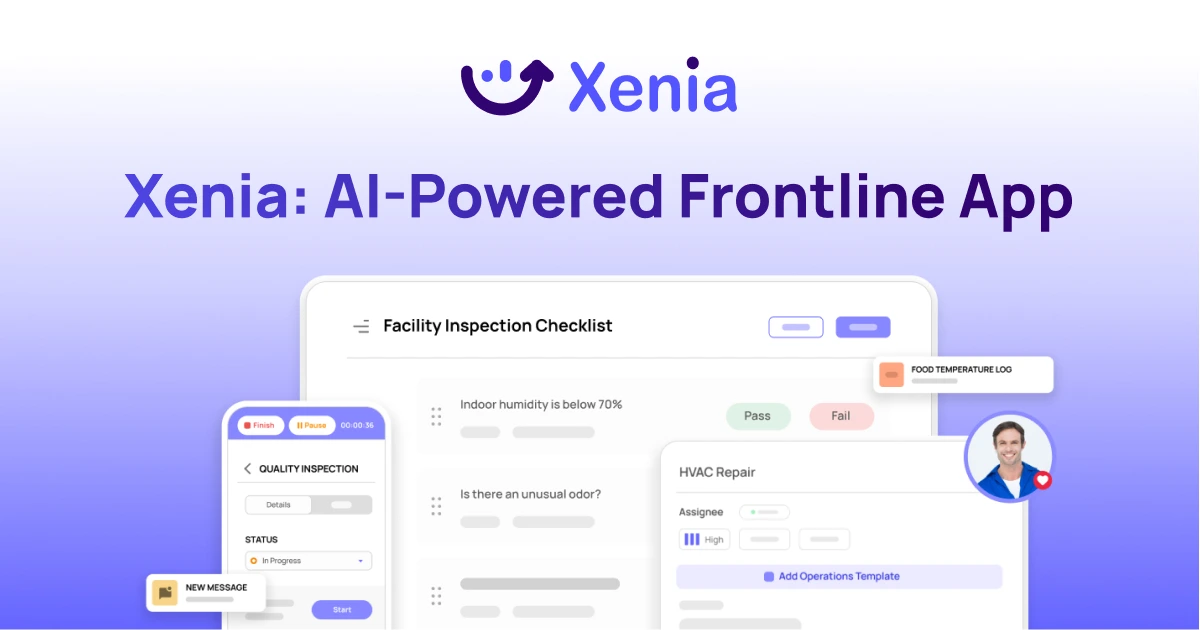
Why Multi-Location Operators Choose Xenia:
🤖 AI-Powered Operations, Create digital checklists instantly or convert paper forms with AI. Verify compliance automatically with photo analysis and get instant answers from your operational data.
✅ Daily Operations & Maintenance, Assign work across hundreds of locations in minutes. Report and route issues instantly. Schedule preventive maintenance to catch problems before downtime.
📊 Real-Time Visibility, Track completion, work orders, and performance across all locations through dashboards. Filter by site or asset to spot trends and take action.
Manage operations, maintenance, and compliance across all your locations from one platform

.svg)
.webp)
%201%20(1).webp)

.svg)
%201%20(2).webp)