

Summary
What is food safety audit scoring?
Food safety audit scoring converts the findings on a food safety inspection into a single number that signals risk. Weighted scoring assigns higher point values to items that can cause foodborne illness (temperature, cross-contamination, handwashing) and lower values to cosmetic items. The result is a score that reflects danger, not item count.
The problem most operators have is that unweighted scoring lies. In an unweighted audit, every item is worth the same. A 50-item audit where a store misses 5 items scores 90% whether those 5 misses are cosmetic flags or temperature violations. The number is identical. The risk is not. A walk-in cooler holding cold food at 48°F and a scuffed baseboard subtract the same point. The ops director reading the dashboard cannot tell a food safety emergency from a paint touch-up.
This is the "always 87%" trap. Unweighted scoring compresses the signal until the number means nothing. Weighted scoring fixes it by tiering items by severity. The structure most audit programs use:
**
Dimension, Unweighted scoring, Weighted scoring
Point value per item, Every item worth the same, Critical 10-important 5-minor 1
What an 87% means, Could be all critical or all cosmetic-no way to tell, A 10-point critical failure reads differently than thirteen 1-point flags
Maps to FDA Food Code, No-flattens Priority and Core into one number, Yes-mirrors the Priority-Priority Foundation-Core hierarchy
Where the DM walk goes, Guesswork, Straight to the critical failures
Corrective action trigger, All-or-nothing, A critical-item failure can auto-fire a corrective task
**
Two terms matter on first read. TCS food (time and temperature control for safety food) is any food that needs temperature control to limit pathogen growth, covered in the TCS food handling guide. HACCP (Hazard Analysis and Critical Control Points) is the food safety management framework, explained in the HACCP principles reference. Both feed directly into how you weight an audit.
Regulatory framework
The FDA Food Code does not use the words "critical" and "minor." It classifies every provision as a Priority item (P), a Priority Foundation item (Pf), or a Core item. Weighted audit scoring is the operator's way of mirroring that exact hierarchy. Priority items get the heaviest weight. Core items get the lightest.
The 2022 FDA Food Code (the current edition) defines three risk tiers. Operators should cite them by their official names. The audit's 10/5/1 tiers are a direct parallel.
**
FDA Food Code class, Definition, Audit-weight parallel, Examples
Priority (P), Provisions that contribute directly to eliminating-preventing or reducing foodborne illness hazards to an acceptable level, Critical-10 points, Cooking temps-holding temps-handwashing-cross-contamination-approved source-allergen control
Priority Foundation (Pf), Provisions that support the successful execution of Priority items-typically record-keeping and training certifications, Important-5 points, Date-marking-sanitizer test kits-thermometer calibration records-food-handler certification on file
Core, General sanitation-facility maintenance-equipment design-no P or Pf designation, Minor or cosmetic-1 point, General cleaning-light bulbs-floor and wall maintenance-signage
**
These definitions come straight from the FDA Food Code 2022 full text and LegalClarity's breakdown of FDA Food Code priority violations. The FDA's summary of changes to the 2022 Food Code confirms that thawing moved from a Core item to a Priority Foundation item in 2022. That reclassification is proof the FDA actively tiers risk, and that your audit weighting should track those changes.
The correction clock is why weighting matters. Priority (P) violations must be corrected at the time of inspection. When immediate correction is not feasible, an inspector may grant up to 72 hours. Many jurisdictions set a hard cap on critical-violation correction, commonly within 5 calendar days for documented follow-up, per StateFoodSafety's guide to common food safety violations.
A critical-item failure is on a 72-hour to 5-day regulatory clock the moment it is found. That is why weighted scoring must drive a corrective action workflow with a deadline, not just a report.
The CDC names five foodborne-illness risk factors that map directly to Priority items: food from unsafe sources, inadequate cooking temperatures, improper holding temperatures, cross-contamination, and poor personal hygiene. Those five are the basis for what counts as "critical." On TCS food, the danger zone runs 41°F to 135°F. Keep cold-held food below 41°F and hot-held food above 135°F, per FDA Food Code section 3-501.16.
HACCP Principle 3, Establish Critical Limits, is the conceptual root of all of this. A critical limit is the maximum or minimum value a parameter must hold at a critical control point to keep a hazard in check. A walk-in must hold below 41°F. That HACCP critical limit becomes a critical audit item worth 10 points, and a breach of it is the textbook trigger for a corrective action.
The FDA HACCP principles and application guidelines lay out the full framework. For scale: the CDC estimates 48 million people get sick, 128,000 are hospitalized, and 3,000 die from foodborne disease in the US each year, per the CDC facts about food poisoning.
How does Xenia handle food safety audit scoring?
.webp)
Xenia handles food safety audit scoring with three stacked features: weighted scoring with color-coded pass thresholds, nullify (N/A) scoring so a store is never penalized for equipment it does not have, and end-to-end corrective action workflows that turn a critical-item failure into an assigned task with a deadline and escalation.
When Dave's Hot Chicken left RizePoint, this was the first thing they fixed. RizePoint scored a missing patio chair the same as a temperature violation in the walk-in. The food safety score was effectively always 87%, so it told the DM nothing. After moving to Xenia, Dave's rebuilt every audit with weighted scoring, paired the audits with Bluetooth thermometers across all 321 locations, and connected critical failures straight to corrective action.
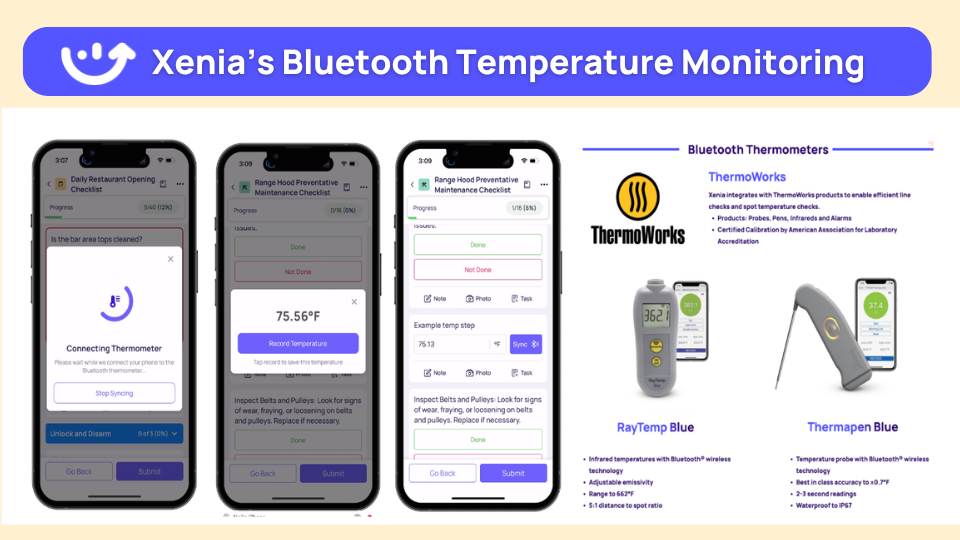
Temps log automatically at logged intervals (every 15 minutes), and an out-of-range reading triggers a follow-up question, requires a photo of the fix, and assigns a task to the kitchen manager with a deadline.
Weighted scoring + color-coded thresholds let you set critical items at 10 points (temp failures, food safety) and minor items at 1 point. A misaligned menu board is cosmetic. A walk-in temp out of range is critical. Dave's Hot Chicken replaced RizePoint for this exact feature.
Three Xenia features solve the scoring problem:
The incumbents are not bad tools. They have gaps.
**
Platform, Strength, Scoring and corrective-action gap, Xenia counter
RizePoint, Pioneered mobile auditing-deep food-safety tenure, Conditional logic is an expensive add-on-penalty-based scoring can let N/A items hurt the score-corrective action closes manually in another tool, Native conditional visibility-nullify scoring and corrective action to closure. Dave's switched at 321 locations
SafetyCulture (iAuditor), Owns food safety audit search at scale-supports weighted sections and skip logic, Lighter on corrective-action closure depth-generic horizontal platform not built for the franchise and DM layer, Franchise-specific corrective action that closes to evidence and signature-built for multi-unit operators
EcoSure (third-party audit), Recognized QSR brand-standards audit-clear pass tiers, Third-party visit cadence-the score is a snapshot-not a daily operating system, Continuous self-audit plus Bluetooth temp logging between third-party visits
**
RizePoint pioneered mobile auditing. But the conditional logic costs extra and corrective actions close in a separate tool. If you are weighing those incumbents, the Zenput alternatives breakdown and the SafetyCulture alternatives comparison map the trade-offs. One honest limitation: Xenia supports HACCP-aligned audits, it does not certify HACCP compliance or issue certificates, and photo capture stores evidence without auto-interpreting what is in the image.
.svg)

Priced on per user or per location basis
Available on iOS, Android and Web


How to set up weighted food safety audits in Xenia
Setting up weighted food safety audits takes five moves: assign point values by risk tier, mark N/A-eligible items, set a color-coded pass threshold, connect critical failures to corrective action, and decide your hard-stop rule. Here is the sequence.
On the threshold itself, most QSR brand-standards audit programs set the passing line at 85 to 90% or higher, with the mid-to-high 90s considered excellent. A single critical violation can push a location below passing even when everything else is in order. You have two threshold approaches. A percentage threshold passes at 90%+, which is simple, but a single critical item may not visibly move a high score.
A hard-stop critical rule (recommended) auto-fails the audit on any unresolved 10-point critical item regardless of percentage. That mirrors the FDA's logic that a single Priority violation is correctable on the spot or it becomes an enforcement issue.
Color bands let a regional VP scan a dashboard and triage without reading every line. That pairs with what the 50-location ops director actually wants: a view of what is coming up as an issue, not a completion percentage. For the logging side of the same audit, the HACCP temperature logs guide covers automated temp capture, and the Bluetooth thermometer setup walkthrough covers pairing.
Where do operators see results?
Operators see results from weighted food safety audit scoring in three places. The audit score range finally spreads out, so DM walks target the right stores. Critical failures close inside the regulatory correction window instead of lingering in a report. And the corrective action trail and the audit trail become one record, ready when the health inspector arrives.
Here is what changes after weighted scoring goes live:
A few verified outcomes are worth naming. Dave's Hot Chicken runs 321 locations on Bluetooth thermometers after migrating from RizePoint for weighted scoring and corrective-action depth. Cook Out runs a weekly price-change process plus line-check temperature capture across 335 locations.
On the C-store side, H&S Energy runs a fuel price form with more than 4,000 submissions and 360-plus stores on continuous Bluetooth and LoRaWAN sensors, and Power Market posts 40% faster task resolution across 360 locations. Mezeh reports a 60% reduction in manager phone calls. The restaurant operations playbook for multi-unit teams shows how these pieces fit together across a chain.
For a C-store area manager, the same scoring logic applies to cooler temps, hot-hold, and fuel-price execution. Cooler #3 trending out of range across four locations is a critical-tier signal the dashboard surfaces before a customer complaint does. Audit failure leads to an automatic corrective task, tracked to resolution, with escalation if not addressed by the deadline. Most platforms collect audit data. Few drive it to closure. To tune how often these audits run, the food safety audit frequency guide sets the cadence, the regulatory frameworks for food safety overview maps FDA and FSMA requirements, and the full food safety operations hub ties the cluster together.
Frequently Asked Questions
Got a question? Find our FAQs here. If your question hasn't been answered here, contact us.
What counts as a critical food safety violation?

What is the difference between weighted and unweighted audit scoring?
How should a restaurant set audit pass thresholds?
Why does scoring a missing patio chair like a temp violation hurt the audit?
Does the FDA Food Code define critical items?
How does weighted scoring drive corrective action workflows?


A Modern, AI-Powered Platform Built for Restaurant Operations
Xenia brings kitchen operations, food safety, audits, and team communication into one mobile-first platform. Restaurant teams execute daily work consistently, maintain compliance, and resolve issues faster, while leadership gets real-time visibility across all locations.
.webp)
Why Restaurant Operators Choose Xenia:
🤖 AI-Powered Operations, Convert paper logs instantly and verify food presentation and kitchen cleanliness automatically. Get instant answers about food safety trends without building reports.
🍽️ Food Safety & Compliance, Track line checks and temperature logs with automated alerts. Trigger corrective actions when readings exceed safe ranges. Maintain audit-ready records for health inspections.
📊 Multi-Location Control, Monitor food safety compliance and task completion across regions. Benchmark locations to identify training needs. Export reports for operational reviews.
One platform for kitchen operations, food safety, and compliance across all locations.

.svg)
.webp)
%201%20(1).webp)

.svg)
%201%20(2).webp)


