
Post Summary
Food waste is costing your restaurant money every single day.
Not in a vague, theoretical way. A mid-size restaurant spending $1 million annually on food can lose $80,000 to $120,000 a year in avoidable waste alone. That is not a sustainability problem. That is a profit problem.
The good news: food waste management software makes waste visible, measurable, and reducible. The right tool tells you where waste is happening, what it is costing you, and what to do about it.
The bad news: most restaurants are still tracking waste on paper logs or spreadsheets, if they are tracking it at all.
This guide covers 7 food waste management software tools worth evaluating in 2026, with honest detail on what each one does, what it costs, and who it is actually built for.
What is food waste management software?
Food waste management software is a digital system that helps restaurants track, measure, analyze, and reduce food waste across kitchen operations.
At its core, it does four things:
- Captures waste data: staff log waste events by type, quantity, reason, and station
- Calculates cost: converts waste volume into dollar figures tied to your food cost
- Surfaces patterns: shows where waste is happening and why, by location, daypart, menu item, and shift
- Drives action: alerts managers, triggers SOPs, and tracks reduction progress over time
More advanced systems add AI predictions, smart scale hardware, automated waste identification, and integration with inventory and POS systems.
For multi-location operators, the critical requirement is centralized visibility: one dashboard showing waste performance across all sites, not just one kitchen at a time.
The four types of food waste every restaurant needs to track
Before evaluating any software, understand what you are actually tracking.
**
Waste type, What it means, Where it typically happens
Prep waste, Trimmings-over-cutting-mis-portioning, Kitchen prep stations
Overproduction waste, Too much food made-not sold, Production planning failures
Plate waste, Food returned or left uneaten, Front of house-portion sizing
Spoilage waste, Expired or improperly stored food, Storage-walk-in coolers
**
Most restaurants have blind spots in at least two of these categories. Software makes all four visible.
What to look for in a food waste tracking system
Not every tool fits every operation. Match the tool to your actual need.
Ease of logging. If logging waste takes more than 30 seconds per event, your kitchen staff will not do it consistently. The best food waste apps minimize steps: select category, enter quantity, add reason, done.
Cost calculation. Tracking weight alone is not enough. You need the system to convert waste into dollar values tied to your current food cost data. That is what tells you whether a problem is actually worth fixing.
Multi-location reporting. For restaurant groups and chains, site-level waste data that does not roll up into a centralized dashboard is nearly useless. You need to compare location vs. location and identify which kitchens are driving the most loss.
Integration with inventory and POS. The best food waste reduction software connects waste data to stock levels and sales, so you can see theoretical vs. actual food cost variance in real time.
AI and automation level. Some teams want software only. Others want AI cameras and smart scales that log waste automatically without any staff input. Know which end of that spectrum you need before you shop.
Sustainability and ESG reporting. If you have corporate sustainability commitments or franchise reporting requirements, check that the platform generates the reports your stakeholders need.
7 best food waste management software tools in 2026
.svg)
.webp)
.webp)
**
Tool, Waste tracking depth, AI and automation, Hardware needed, Multi-site, Mobile UX, Pricing tier, Best buyer
Xenia, High-ops-connected, Rules-alerts-AI SOP, No, High, Frontline-first, SMB to mid, Multi-site restaurants-QSR-hospitality
LeanPath, Very high, Smart scale AI, Smart scales, High, Manager-focused, Mid to enterprise, Large kitchens-hotels-institutional
Supy, High-inventory-linked, Inventory integration, No, High, Manager-focused, Mid to enterprise, Restaurant groups with inventory focus
Winnow, Very high-automated, AI cameras + scales, AI cameras + scales, High, Manager-focused, Enterprise, Hotels-large kitchens-cruise lines
Altametrics, Medium, Rules-based, No, High, Kitchen-focused, Mid to enterprise, Kitchen ops teams
SmartKitchen, Medium, Basic, No, Medium, Kitchen-focused, SMB to mid, Simple waste tracking-no hardware
Olio, Low-donation focus, Donation routing, No, Medium, Simple, SMB to mid, Donation and redistribution focus
**
1. Xenia
.webp)
- What it's for: Multi-location food waste tracking, food safety compliance, and kitchen ops execution built to work alongside your existing inventory and POS tools
- G2 rating: 4.9/5
- Capterra rating: 4.9/5
- Who uses it: Multi-unit restaurant operators, QSR chains, hospitality groups, and food service operations managing 10 or more locations who want waste tracking inside the same platform their teams use every day
Xenia is the only tool on this list that combines food waste tracking with the full operational layer your kitchen teams use every day. That means waste logging lives inside the same platform as your food safety checklists, temperature monitoring, corrective action workflows, and daily ops tasks. Nothing is siloed.
Here is why that matters.
In most operations, waste gets logged in one system and acted on in another. Or not acted on at all. Xenia closes that loop. When waste crosses a threshold, a manager gets an alert. If it is tied to a food safety issue, a corrective action work order fires automatically. If it points to a training gap, an SOP gets assigned. The data does not just sit in a dashboard. It triggers a response.
What Xenia covers:
- Food waste logging with auto-cost calculation: Staff log waste in under 30 seconds on iOS or Android. Each entry captures waste type, quantity, reason, category, station, shift, and optional photo evidence.
Pre-built categories cover prep waste, spoilage, plate waste, overproduction, and expired goods. When connected to your food cost data, Xenia automatically calculates the dollar value of each waste event so you are tracking cost, not just volume.
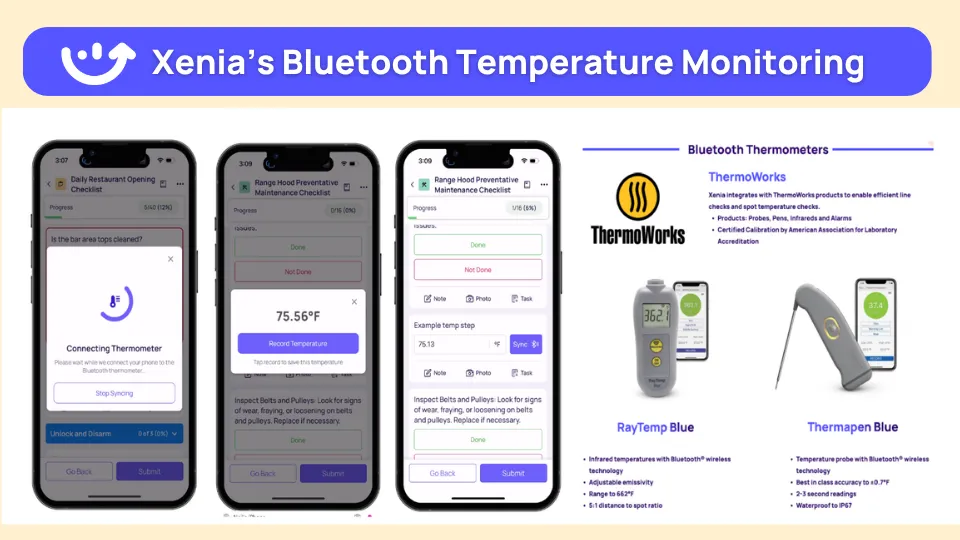
- Temperature monitoring via Bluetooth and LoRaWAN sensors: Spoilage waste is often a temperature problem before it is a waste problem. Xenia connects directly to Bluetooth thermometers and LoRaWAN sensors for 24/7 automated monitoring across refrigeration units and hot holding equipment.
Alerts fire the moment readings enter the danger zone. The audit log builds itself continuously. You catch the walk-in cooler issue before it becomes a waste event, not after.
- Multi-site waste dashboards: For restaurant groups and chains, site-level waste data that does not roll up is nearly useless. Xenia compares waste by location, region, and chain simultaneously.
You see which kitchens are driving the most loss, which shifts are the worst offenders, and which categories are out of control, all on one dashboard. No spreadsheets. No manual data pulls.
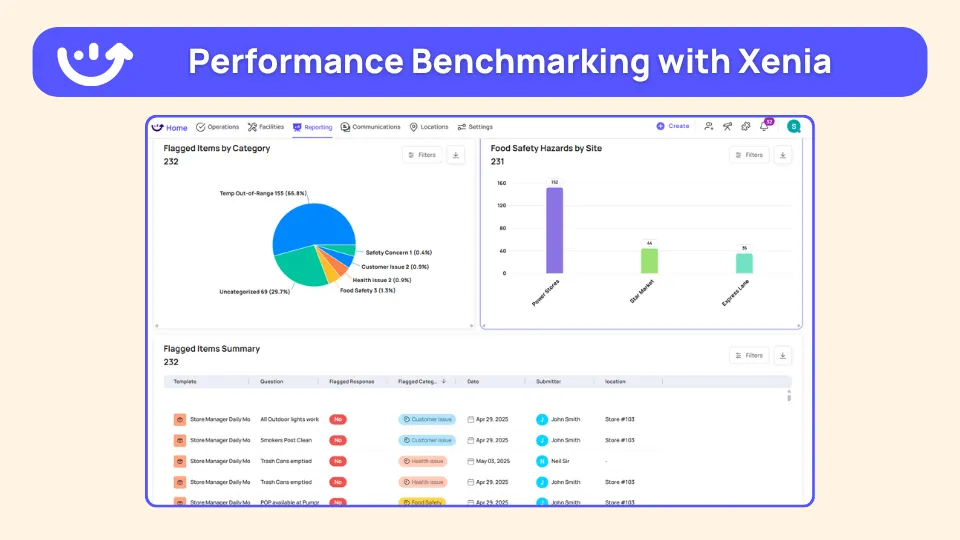
- Corrective action workflows connected to waste: When waste crosses a threshold you set, Xenia fires an alert and can automatically generate a corrective action task routed to the right person.
That task requires evidence on completion and closes with a full audit trail. The waste event does not just get recorded. It gets resolved and documented.
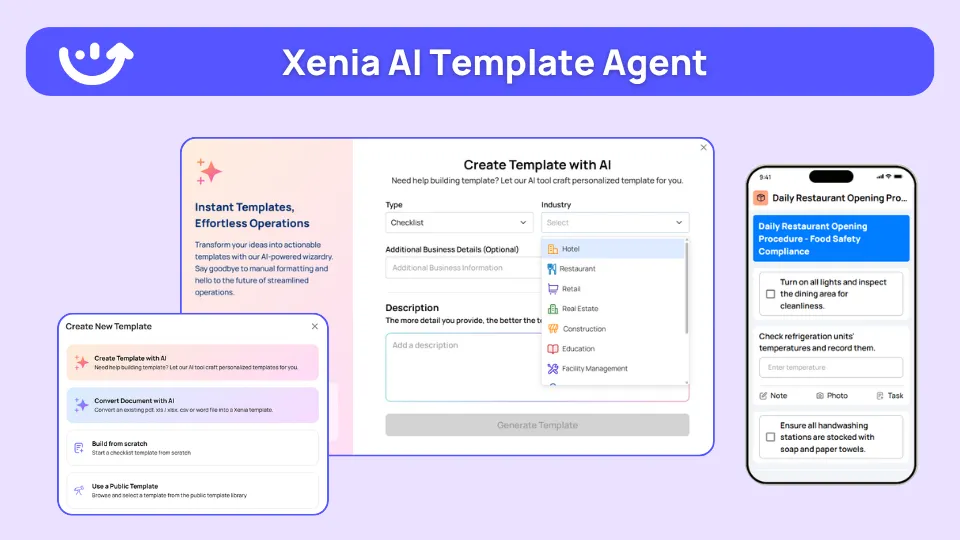
- AI template builder for waste prevention SOPs: Most kitchens do not have documented procedures for waste prevention. They should.
Xenia's AI builds SOP templates and waste prevention checklists from plain language descriptions or uploaded PDF documents in minutes. You can push those templates to all locations at once or target specific sites with local gaps.
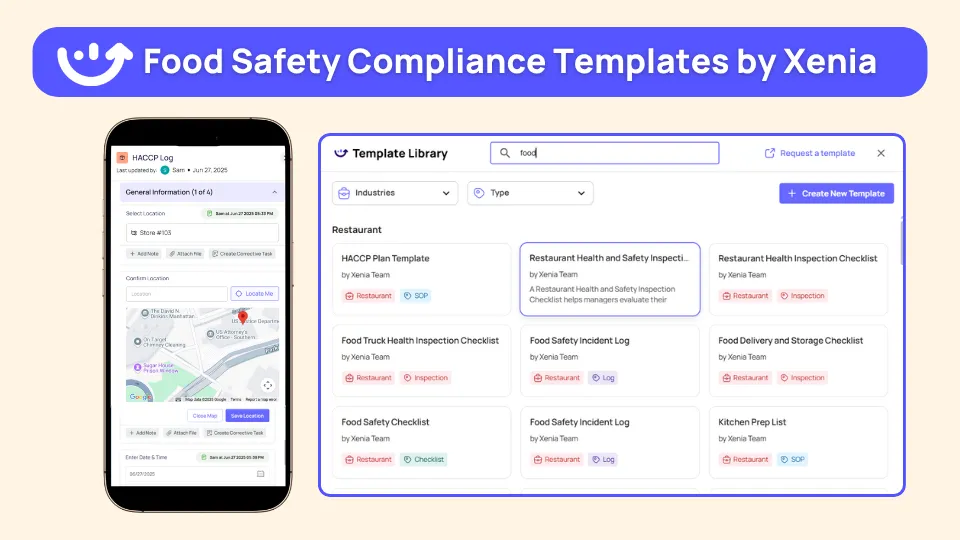
- Food safety compliance and HACCP-aligned checklists: Waste and food safety are connected. Improper storage, temperature violations, and FIFO failures all generate waste before they generate health code violations.
Xenia's digital food safety checklists and HACCP-aligned templates run alongside your waste logging in the same app. Failed items trigger corrective tasks automatically. Documentation is timestamped and geo-tagged for every submission.
- Integrations with your existing stack: Xenia does not replace your inventory system, POS, or HR tools. It connects to them. Employee data syncs automatically from Workday, ADP, UKG, and 7shifts.
Waste data can be linked to inventory and food cost data via API. New hires provisioned in your HRIS get immediate access to Xenia without manual setup. It is an addition to your current stack, not a disruption of it.
Pricing: Xenia has a free plan for up to 5 users with no credit card required. Paid plans cover larger teams and multi-location rollouts with full access to waste tracking, dashboards, temperature monitoring, and all core features.

Priced on per user or per location basis
Available on iOS, Android and Web


2. LeanPath
.webp)
Best for: Large restaurants, hotel groups, institutional kitchens, and multi-site food service operations focused on measurement-first waste reduction
LeanPath is an established dedicated food waste tracking platform. It takes a hardware-first approach: smart scales with built-in cameras sit on prep stations and automatically capture weight and waste type when kitchen staff place food on them.
The combination of automated data capture and rich analytics has made LeanPath the go-to for large commercial kitchens that need precise, auditable waste data.
The gap: LeanPath requires hardware investment. Smart scales start at around $5,000 to $6,000 per unit plus monthly SaaS fees. Deployment typically runs 4 to 8 weeks and includes hardware setup. For a single restaurant or small chain, the cost-benefit calculation may not work. For a 50-location hotel group or a hospital system trying to hit ESG targets, it often does.
Key features:
- Smart scale hardware with AI-assisted waste identification
- Auto-capture of weight and waste type per event
- Rich analytics by category, station, shift, daypart, and menu item
- Benchmarking against industry and portfolio averages
- ESG and sustainability reporting with SDG 12.3 alignment
- ROI tracking on waste reduction efforts
- Coaching support from culinary and food service experts
- Multi-site centralized dashboards
Pricing: Enterprise custom-quote. Hardware starts at $5,000+ per site. Contact LeanPath for current rates.
Deployment: 4 to 8 weeks including hardware setup.
3. Supy
.webp)
Best for: Multi-site restaurant groups and QSR operations that want food waste tracking connected to inventory and food cost variance
Supy is an inventory intelligence platform for restaurant groups that includes food waste tracking as a core module. The key differentiator: waste does not live in isolation. Every waste event you log immediately affects your inventory levels and updates your food cost variance calculation. You see the direct impact of waste on your theoretical vs actual food cost in real time.
That connection is genuinely useful for restaurant operators who are trying to understand why their food cost numbers do not match their purchasing. Supy helps you trace the gap. Was it over-prep on protein? Plate waste on a new menu item? Spoilage from a refrigeration issue? The data tells the story.
The gap: Supy does not have the operational layer that Xenia provides. No corrective action workflows, no food safety checklists, no temperature monitoring integration, no task management. If your primary need is inventory-connected waste tracking, Supy is strong. If you need waste tracking inside a broader ops platform, it stops short.
Key features:
- Food waste logging connected to live inventory levels
- Automatic food cost variance update on each waste event
- Theoretical vs. actual food cost tracking
- Multi-site waste dashboards with location comparison
- Menu item waste analysis for recipe and portion optimization
- Mobile app for floor-level waste logging
- POS and ERP integrations
Pricing: Custom quote, mid-SMB to enterprise. Contact Supy for current rates.
Deployment: 2 to 6 weeks.
4. Winnow Solutions

Best for: Hotels, large restaurants, institutional kitchens, and cruise lines wanting fully automated waste tracking without manual staff input
Winnow is an automated food waste tracking solution. AI cameras mounted above waste bins identify food automatically using computer vision trained on 500 million+ images. The system recognizes hundreds of food types, weighs them via smart scale, and logs the waste event automatically. Kitchen staff throw food away. Winnow does the rest.
The gap: Winnow requires significant hardware investment. AI cameras and smart scales typically cost $5,000+ per site with monthly SaaS fees of $200 to $500. Deployment runs 4 to 8 weeks including hardware installation. For a single restaurant, the economics are hard. For a large hotel group or institutional operation with many kitchens and real ESG reporting obligations, Winnow delivers measurable ROI.
Key features:
- AI cameras with computer vision trained on 500M+ food images
- Automated waste identification, categorization, and weighing
- Zero manual staff input required for most waste events
- Rich analytics by category, station, shift, and daypart
- Industry benchmarking and portfolio comparison
- ESG and sustainability reporting
- ROI tracking showing food cost savings
- Multi-site centralized dashboards
Pricing: Enterprise custom pricing. Hardware starts at $5,000+ per site. Contact Winnow for current rates.
Deployment: 4 to 8 weeks including hardware setup.
5. Altametrics

Best for: Restaurant and QSR operations that want food waste tracking inside a kitchen operations platform
Altametrics is a kitchen operations platform that includes food waste tracking as part of a broader suite covering production planning, scheduling, and kitchen management. The key value is integration: waste data lives alongside the kitchen workflows that drive it, which makes it easier to connect waste events to operational root causes.
The gap: Altametrics is a kitchen operations tool. It does not have the broader ops execution layer, food safety inspection workflows, or corrective action management that Xenia provides. For teams that want waste tracking inside kitchen operations specifically, it is worth evaluating.
Key features:
- Food waste logging by category, reason, station, and shift
- Multi-site dashboards with location comparison
- Production planning integration showing how kitchen ops drive waste
- POS and inventory integrations
- Mobile app for kitchen floor logging
- Analytics connecting waste to operational factors
Pricing: Custom quote, mid-SMB to enterprise. Contact Altametrics for current rates.
Deployment: 2 to 6 weeks.
6. SmartKitchen

Best for: Restaurants and QSR operations wanting simple food waste tracking without heavy AI or hardware investment
SmartKitchen is a straightforward food waste tracking system. Staff log waste by category, reason, quantity, and menu item. Reports show waste by location, category, and time period. Multi-site dashboards allow portfolio comparison. The platform connects to production planning systems to pull current menu data directly into waste logging screens.
The gap: SmartKitchen is a lightweight waste tracker. No corrective action workflows, no food safety integration, no temperature monitoring, and limited analytics depth compared to LeanPath or Winnow. For teams that need straightforward digital waste logging and reporting, it works. For teams that need the data to connect to broader operational workflows, it falls short.
Key features:
- Simple waste logging with minimal steps
- Pre-built and custom waste categories
- Menu item integration from production planning systems
- Multi-site dashboards and location comparison
- Trend analysis and waste reduction tracking
- Mobile app for kitchen teams
Pricing: Mid-SMB custom quote. Contact SmartKitchen for current rates.
Deployment: 1 to 4 weeks
7. Olio for Business
.webp)
Best for: Restaurants, retailers, and food service operations focused on reducing waste through donation tracking
Olio takes a fundamentally different approach to food waste management. Rather than primarily focusing on tracking and reducing waste in the kitchen, Olio focuses on redistributing surplus food to charity before it becomes waste. The platform connects businesses with local community organizations and tracks the food donated rather than the food discarded.
The gap: Olio is a donation and redistribution platform, not a kitchen waste tracking system. It does not track prep waste, overproduction, spoilage, or plate waste in the operational detail that the other tools on this list provide. For a complete food waste management approach, most operations would use Olio alongside a dedicated tracking platform rather than instead of one.
Key features:
- Food donation logging by recipient, type, quantity, and date
- Community organization network for surplus food redistribution
- ESG reporting: CO2 saved, water conserved, meals donated
- Sustainability reporting for internal and external stakeholders
- Mobile app for easy donation logging
- Food safety guidelines built into donation workflow
Pricing: Mid-SMB custom quote. Contact Olio for current rates.
Deployment: 1 to 4 weeks.
How food waste software actually saves you money
This is the question that matters most. Here is what it looks like in practice.
It makes invisible costs visible. Most restaurants do not know what their waste actually costs in dollar terms. They know they throw food away. They do not know it is costing them $8,000 per month. Once you see the number, you act on it.
It identifies the root cause. Not all waste comes from the same place. High protein prep waste points to a knife skills or portioning problem. High spoilage waste points to a storage or ordering problem. High overproduction waste points to a production planning problem. Software tells you which one you have. Guessing wastes money fixing the wrong thing.
It creates accountability. When staff know waste is being measured and logged, behavior changes. That alone reduces waste in most kitchens without changing any processes.
It drives production accuracy. Waste trend data informs your purchasing and production planning. If Sunday brunch consistently generates high plate waste on a specific dish, you adjust portion sizes or prep quantities. That is food cost savings you can calculate.
It supports compliance and ESG. Food waste regulations are expanding. Sustainability reporting requirements from franchisors and corporate parents are growing. Having documented waste data makes compliance faster and cheaper.
What causes food waste in restaurants?
Understanding the causes helps you choose the right software to address them.
**
Cause, What drives it, Software fix
Over-prepping, Poor production planning-no demand forecasting, Waste logging + trend analysis-AI prediction
Poor portioning, Inconsistent training-no portion controls, SOP checklists-template-based procedures
Improper storage, Temperature violations-FIFO failures, Temperature monitoring-food safety checklists
Menu item performance, Low-selling items generating plate waste, Waste-by-menu-item reporting
Equipment failures, Refrigeration breakdowns causing spoilage, Preventive maintenance-temperature alerts
**
Conclusion
Food waste is not a sustainability problem. It is a profitability problem.
Every pound of food thrown out is money that never made it to your bottom line.
The restaurants winning on margins in 2026 are not the ones with the best menus. They are the ones with the tightest operations: measured waste, root causes identified, corrective actions taken.
The right food waste management software depends on your operation.
Large hotel group with a dedicated kitchen team and ESG obligations? LeanPath or Winnow.
Multi-site restaurant group that wants waste connected to inventory and food cost variance? Supy.
Multi-location operator that wants waste tracking inside the same platform your team uses for inspections, food safety, and daily ops? Xenia.
For most multi-unit operators, Xenia covers the most ground. It connects waste logging to the operational workflows that drive waste in the first place. Get started for free or book a demo.
Frequently Asked Questions
Got a question? Find our FAQs here. If your question hasn't been answered here, contact us.
How does food waste software connect to food safety?

The connection is direct. Spoilage waste is often caused by temperature violations, improper storage, or FIFO failures. A platform like Xenia connects food waste logging to temperature monitoring, food safety checklists, and corrective action workflows so waste events trigger the right operational response automatically.
What is the best free food waste management software?
Xenia offers a free plan for up to 5 users that includes food waste logging, food safety checklists, temperature monitoring, and corrective action workflows. It is one of the only tools in this category with a usable free tier rather than a short trial window.
What types of food waste should restaurants track?
The four main categories are prep waste, overproduction waste, plate waste, and spoilage. Most restaurants have blind spots in at least two of these. Food waste tracking software makes all four visible and quantifiable.
How much does food waste actually cost a restaurant?
A mid-size restaurant with $1 million in annual food spend can lose $80,000 to $120,000 per year in avoidable waste. Food costs typically represent 28 to 35 percent of restaurant sales, so even a 5 percent reduction in waste has a meaningful impact on profitability.
What is food waste management software?
Food waste management software is a digital system that helps restaurants and food service operations track, measure, analyze, and reduce food waste. It replaces paper waste logs with structured digital data that calculates waste cost, surfaces patterns, and drives action to reduce waste at the source.


A Modern, AI-Powered Platform Built for Restaurant Operations
Xenia brings kitchen operations, food safety, audits, and team communication into one mobile-first platform. Restaurant teams execute daily work consistently, maintain compliance, and resolve issues faster, while leadership gets real-time visibility across all locations.
.webp)
Why Restaurant Operators Choose Xenia:
🤖 AI-Powered Operations, Convert paper logs instantly and verify food presentation and kitchen cleanliness automatically. Get instant answers about food safety trends without building reports.
🍽️ Food Safety & Compliance, Track line checks and temperature logs with automated alerts. Trigger corrective actions when readings exceed safe ranges. Maintain audit-ready records for health inspections.
📊 Multi-Location Control, Monitor food safety compliance and task completion across regions. Benchmark locations to identify training needs. Export reports for operational reviews.
One platform for kitchen operations, food safety, and compliance across all locations.

.svg)
.webp)
%201%20(1).webp)

.svg)
%201%20(2).webp)