

Summary
What are food safety regulatory frameworks?
A food safety regulatory framework is a structured rule set, published by a regulator or standards body, that defines how a food business must identify hazards, control them at specific points, document the controls, and respond when something goes out of spec. For a multi-unit US operator, three frameworks dominate.
Two definitions worth nailing down before going further. TCS food is Time/Temperature Control for Safety food. Items that require time and temperature control to keep pathogens from multiplying. Meat, poultry, dairy, cooked rice, cut tomatoes, cut leafy greens. Per FDA Food Code §3-501.16, TCS foods must be held cold at 41°F or below, hot at 135°F or above.
CCP stands for Critical Control Point. A step in the food process where a control measure can prevent, eliminate, or reduce a hazard to an acceptable level. Cooking, cooling, hot-holding, and cold-holding are the four most common CCPs in a restaurant kitchen.
The frameworks are not redundant. They serve different layers of the same problem. A 200-unit QSR has to follow the Food Code edition adopted by each state where it operates, maintain HACCP-style hazard plans for hot-held, cooled, and reheated TCS items, and keep FSMA-compliant traceability records for any tomato, leafy green, or sprout it touches. One inspection visit can cite all three.
Regulatory framework
The three frameworks compress into a side-by-side that answers the question operators actually search.
**
Framework, What it is, Who enforces, What it covers, Recordkeeping demand
FDA Food Code, Model regulation for retail food and food-service, State and local health departments (FDA writes-states adopt), Cold/hot holding temps-employee health-equipment-cleaning-allergens-date-marking, Temp logs-employee health attestations- date-marking-cleaning logs
FSMA, Federal law (2011) with multiple implementing rules, FDA directly, Preventive controls (21 CFR Part 117)-supplier verification-sanitary transport-traceability (FSMA 204), Hazard analysis-preventive controls-monitoring-corrective actions- verification-retained 2+ years per 21 CFR 117 Subpart F
HACCP, Seven-principle hazard-analysis methodology (NACMCF-1997), Voluntary for retail food. Mandatory in USDA meat/poultry-FDA juice and seafood, Biological-chemical-physical hazards at critical control points, Monitoring logs-deviation records-corrective action records-verification
**
The seven HACCP principles, in the order FDA publishes them:
Where the frameworks overlap and confuse operators. FSMA's preventive controls rule (21 CFR Part 117) is broader than HACCP. It covers biological, chemical, physical, radiological hazards, and food defense. HARPC (Hazard Analysis and Risk-Based Preventive Controls) is the FSMA term.
In practice multi-unit retail operators rarely have to satisfy HARPC directly because retail food establishments and restaurants are exempt from the full PCHF rule, per Penn State Extension's FSMA explainer. Operators with a central kitchen or commissary that distributes to multiple branded units can be pulled into FSMA's full scope.
State adoption reality is the operator's day-to-day pain. As of 2024, 11 state agencies in seven states had adopted the 2022 Food Code (Colorado, Connecticut, Illinois, Mississippi, Ohio, Pennsylvania, Utah). That represents 16.06% of the US population. Another 24 states use the 2017 edition. Fourteen states are still on the 2013 edition.
Six states plus Washington D.C. are on the 2009 edition. Fifteen years out of date. A chain running stores in California (stricter bare-hand contact rule) and Texas (2017 edition, allows Alternative Highly Effective Measures) trains two different glove protocols on the same line.
FSMA 204 timeline shift (operationally relevant for 2026). The Food Traceability Rule's compliance date was moved from January 20, 2026 to July 20, 2028 by the Continuing Appropriations Act of 2026, per Food Safety Magazine.
Operators with central kitchens or commissaries handling Food Traceability List items (leafy greens, herbs, tomatoes, cucumbers, melons, peppers, sprouts, tropical fruits, finfish, smoked finfish, crustaceans, mollusks, shell eggs, nut butters, ready-to-eat deli salads, cheeses) get an extra 2.5 years to build Traceability Lot Code and Critical Tracking Event recordkeeping. The work didn't go away. The deadline did.
How does Xenia handle multiple regulatory frameworks?
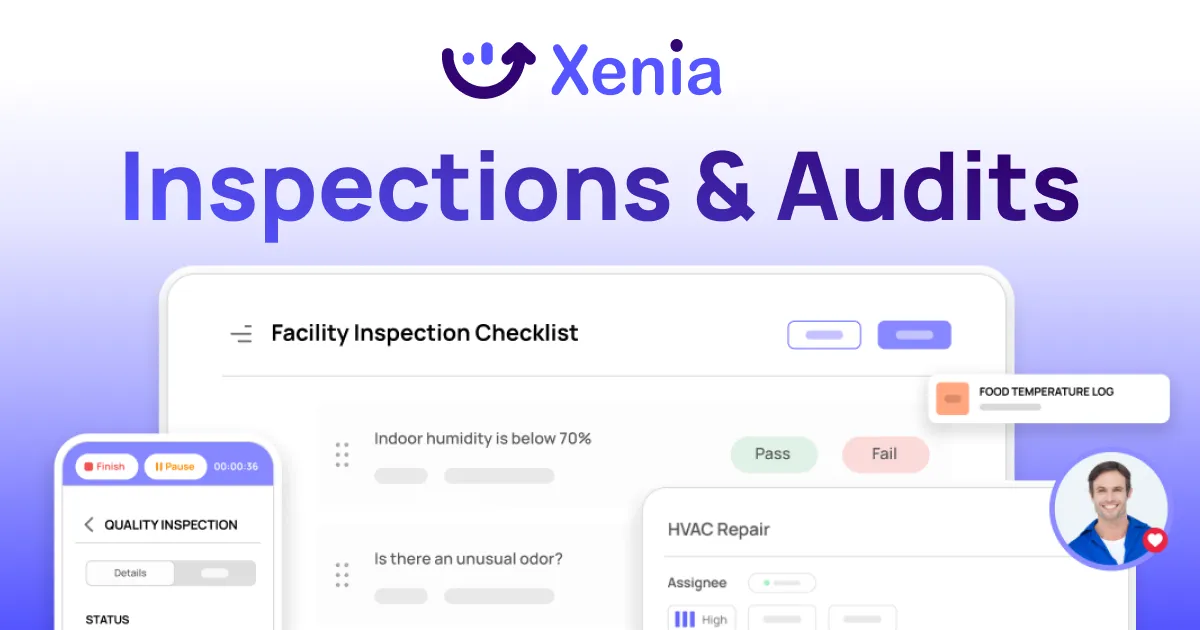
Xenia sits underneath the three frameworks as the digital audit trail that satisfies their common denominator. The operator can show, on demand, who did what check, when, what they found, and what they did about it. Xenia is not a HACCP-certification platform. It does not auto-file reports with state health authorities. It does not replace ServSafe certification. It is the audit-and-corrective-action layer that produces the evidence inspectors ask for.
The mapping from framework requirement to Xenia capability:
**
Framework requirement, Where Xenia covers it
FDA Food Code §3-501.16 cold/hot-holding (41°F / 135°F), Bluetooth thermometer integration auto-logs walk-in-hot-hold and line-station temps. Out-of-range readings trigger a follow-up question and required photo
FDA Food Code employee health attestations, Daily ops checklists capture shift-start health attestations with timestamp and digital acknowledgment
FDA Food Code allergen disclosure (9 major allergens including sesame-added 2023), Audit templates include allergen-handling questions with conditional visibility for menu items containing sesame-tree nuts-dairy
HACCP Principle 4 (Monitoring), Scheduled audits at CCP cadences (line check-walk-in temp-cooling logs) with assigned owner and tablet capture-linked to HACCP-aligned temperature logs
HACCP Principle 5 (Corrective Actions), Audit failure auto-creates a corrective task with assignee-deadline and escalation rule. The audit trail and the closure trail are the same record. See food-safety corrective action workflow
HACCP Principle 7 (Recordkeeping), All audits-photos-signatures and corrective actions stored with timestamps. Retrievable by location-date-item or owner
21 CFR Part 117 Subpart F (recordkeeping), Digital records satisfy FDA's electronic records provisions: audit trail-controlled corrections-retention period-fast retrieval
State-by-state Food Code variation, Conditional visibility shows the right questions per state. California units see the bare-hand-contact prompts. Texas units see the AHEM documentation prompts. One template-no manual duplication
**
Weighted scoring is what makes the score mean something. Food safety violations are critical (10 points). A misaligned menu board is cosmetic (1 point). Cooler temp out of range is critical. Dave's Hot Chicken replaced RizePoint for exactly this feature, and you can read the long version in our weighted audit scoring breakdown.
Bluetooth thermometers turn the line check into automatic compliance evidence. Pair Bluetooth thermometers with Xenia and walk-in temps log automatically every 15 minutes. Out-of-range readings auto-alert. No manual data entry. Dave's Hot Chicken's top driver across 321 locations. The detailed pairing process is in our Bluetooth thermometer setup guide.
The Dave's Hot Chicken anchor. Dave's Hot Chicken migrated from RizePoint at 321 locations because their old audit platform treated a missing patio chair the same as a temp violation in the walk-in. The food safety score was always 87%. Always. With Xenia, weighted scoring let food safety items count for 10 points and cosmetic items count for 1.
Bluetooth thermometers log temps every 15 minutes automatically. An out-of-range reading triggers a follow-up question on the audit, requires a photo of the corrective action, and assigns a corrective task to the kitchen manager with a deadline. If it isn't closed in 24 hours, the DM gets the escalation. The food safety score finally tracked what mattered.
A note on what Xenia does not do. It does not certify HACCP compliance. It supports HACCP-aligned audits and corrective action workflows. It does not auto-file with health authorities. The audit trail is available, submission is operator-driven. It does not stream temperatures in real time. Bluetooth thermometers log at intervals (15-minute cadence in the Dave's case). And it does not replace ServSafe certification. The platform tracks acknowledgment of training. Certification itself is a separate process administered by the National Restaurant Association.
.svg)

Priced on per user or per location basis
Available on iOS, Android and Web


Where do operators see results?
Operators see results when the audit cadence and the corrective-action loop close on the same record. Five live examples worth naming.
The patterns operators ask about, with the honest answer.
A common mistake worth flagging. Operators assume "we follow the Food Code" means they are FSMA-compliant. They are not necessarily. If you run a central kitchen or commissary that distributes to multiple units, FSMA preventive controls and traceability rules can apply on top of the Food Code. The frameworks stack. They do not substitute.
For the broader operator playbook, see the food safety operations hub and the cross-cluster audit management hub. Vertical context for QSR and full-service teams lives in the restaurant task management hub. For the c-store reading, the convenience store operations software hub covers the forecourt and cooler side of the same problem.
Frequently Asked Questions
Got a question? Find our FAQs here. If your question hasn't been answered here, contact us.
What is the FDA Food Code?

How does FSMA differ from the FDA Food Code?
What are the seven HACCP principles?
Does my state follow the FDA Food Code or its own version?
Do digital audit trails satisfy FSMA recordkeeping?
Which framework should I align my internal audits to?


A Modern, AI-Powered Platform Built for Restaurant Operations
Xenia brings kitchen operations, food safety, audits, and team communication into one mobile-first platform. Restaurant teams execute daily work consistently, maintain compliance, and resolve issues faster, while leadership gets real-time visibility across all locations.
.webp)
Why Restaurant Operators Choose Xenia:
🤖 AI-Powered Operations, Convert paper logs instantly and verify food presentation and kitchen cleanliness automatically. Get instant answers about food safety trends without building reports.
🍽️ Food Safety & Compliance, Track line checks and temperature logs with automated alerts. Trigger corrective actions when readings exceed safe ranges. Maintain audit-ready records for health inspections.
📊 Multi-Location Control, Monitor food safety compliance and task completion across regions. Benchmark locations to identify training needs. Export reports for operational reviews.
One platform for kitchen operations, food safety, and compliance across all locations.

.svg)
.webp)
%201%20(1).webp)

.svg)
%201%20(2).webp)


