

Summary
What is food date labeling and FIFO rotation?
Food date labeling marks prepped or opened ready-to-eat TCS food with a use-by date. FIFO rotation is the shelf discipline of using the oldest-dated item first. They are not the same thing. The label is the data. FIFO is the behavior.
A few definitions land first so the rest of the page reads clean:
Most training pages treat date marking and FIFO as one topic. They are sequential, not identical.
**
Concept, What it is, What it answers, Failure mode
Date labeling, A label on the container, When must this be used by?, Unlabeled-illegible or wrong date
FIFO rotation, A shelf-stocking and pull behavior, Which one do I grab first?, New stock placed in front of old-old stock buried and expires
**
FIFO itself is four simple shelf rules the prep team runs every shift:
This page is anchored in the restaurant walk-in and prep cooler. The same rule reaches into a c-store food-service cooler too. Grab-and-go items prepped on-site fall under date marking the moment a team member makes them.
Regulatory framework
FDA Food Code 3-501.17 requires that refrigerated ready-to-eat TCS food held more than 24 hours be marked with a use-by date no more than 7 calendar days out, with the day of preparation counted as day 1, when the food is held at 41°F or below. That is the rule a health inspector reads on your prep shelf.
FDA Food Code 3-501.17, the date-marking rule
The verified facts to run your audit against, per the FDA Food Code:
- Refrigerated, ready-to-eat TCS food prepared and held more than 24 hours must be clearly date marked.
- The maximum holding period is 7 calendar days when held at 41°F or below.
- The day of preparation, or the day a commercial container is opened, counts as day 1.
- Either the prep date or the discard date may be marked. The system just has to stay consistent and readable to staff and inspectors.
- Food held 24 hours or less is exempt.
A short list of foods is exempt from date marking because a federally inspected plant already processed and packaged them: deli salads packaged off-site, hard cheeses like cheddar and parmesan, semi-soft cheeses like gouda, cultured dairy like yogurt and sour cream, preserved acidified fish, and shelf-stable fermented sausages. They still need temperature control.
One honest note on temperature tiers. The 2022 model code states 7 calendar days at 41°F or below. Date marking is state-adopted, so check your adopted state code for any local variation before you set your number. The Minnesota rule adopting 3-501.17 and the Wisconsin DATCP date-marking fact sheet both mirror the 7-calendar-day language.
USDA product dating is a different system
The labels on a manufacturer's package are not the same as the in-house date a kitchen applies. Per USDA FSIS Food Product Dating, product dates are not required by federal law except on infant formula, and they are not safety indicators. "Best if Used By" is a quality date. A package "Use-By" date marks peak quality, not safety.
The operator takeaway is clean. A "best by" date on a sealed product is about quality. The moment a kitchen opens that product or preps a TCS item from it, the FDA Food Code 7-day in-house clock starts. The kitchen rule is the one inspectors enforce.
Why the rule exists comes down to pathogens and policy. Per CDC date-marking guidance, Listeria monocytogenes grows at refrigeration temperatures, which is why deli meats and refrigerated salads are the date-marking targets. A CDC EHS-Net study found almost 1 in 4 restaurants did not date mark food as recommended, and restaurants with a formal written date-marking policy were 5 times more likely to date mark correctly. Date marking and FIFO sit under HACCP Principle 7, record-keeping, and pair naturally with your broader HACCP checklist template for daily, weekly, and monthly checks.
How does Xenia handle date-labeling and FIFO checks?
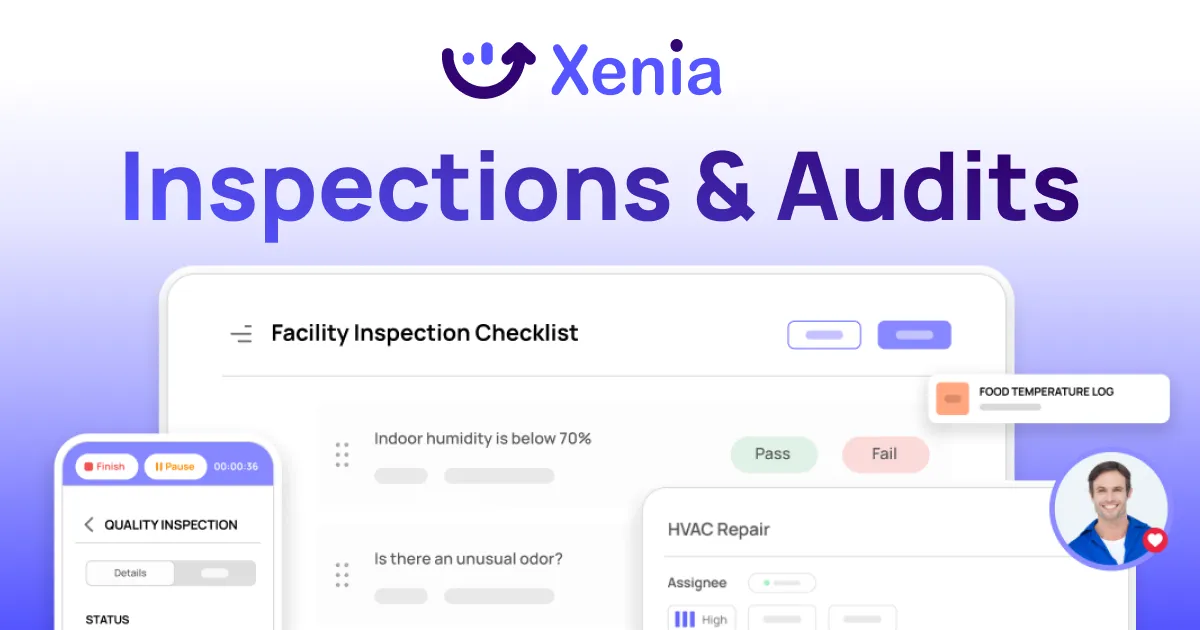
Xenia is the verification layer, not the label printer. It confirms the labels are present, legible, and in-date, and that the shelf is rotated FIFO, with photo proof and an automatic corrective action when something is wrong. Label-printing hardware generates the prep label. Xenia is the recurring check that proves the kitchen actually applied and followed it.
Here is how the workflow maps in Xenia:
A single-store FIFO blog post cannot answer the real multi-unit question: how do I verify FIFO rotation across 40 walk-ins I never personally see? Xenia's answer is that the same date-labeling audit runs at every location on a schedule, with photo proof per cooler, and the dashboard surfaces the units where labels are going missing before the health inspector finds them.
**
Attribute, Static paper checklist, Xenia date-labeling audit
Proof a label was checked, Initials on a sheet-no evidence, Photo per cooler-timestamped
Unlabeled item found, Noted-maybe, Auto corrective task plus deadline and escalation
FIFO order verified, Eyeballed-not recorded, Pass or fail per shelf-photo-backed
Score reflects real risk, All items weighted the same, Expired item critical-smudge minor
**
Dave's Hot Chicken anchors this verify-prove-route pattern. After leaving RizePoint, Dave's rebuilt its food-safety program on weighted scoring and corrective action workflows across 321 locations. Dave's also pairs Bluetooth thermometers for temp logs, though that is a separate layer from shelf labeling.
.svg)

Priced on per user or per location basis
Available on iOS, Android and Web


How to set up a date-labeling audit in Xenia
A date-labeling audit is a short recurring check that confirms every prepped TCS item is labeled, legible, and in-date, and that the shelf is rotated FIFO. It takes about 15 minutes to build and runs daily.
- Create a recurring daily check named "Date Labeling and FIFO" and assign it to the prep lead or opening manager.
- Add a checklist item per storage area: walk-in cooler, prep cooler, reach-ins, and any food-service cooler.
- For each area, ask three pass or fail questions. Are all prepped items labeled? Are labels legible with item, prep date, use-by date, and initials? Is the shelf rotated oldest-to-front?
- Set a "no" answer to trigger a follow-up question and a required photo of the offending item.
- Set a "no" answer to auto-create a corrective task to discard or relabel, assigned with a deadline, escalating to the DM if not closed.
- Weight an expired-item finding as critical and a cosmetic label issue as minor, so the score tracks real risk.
- Roll the template out to every location through the location hierarchy. The DM sees their district. Corporate sees all.
A compliant prep label carries four fields: item name, prep date, use-by or discard date (prep day counts as day 1, 7 days max at 41°F or below), and staff initials. Many kitchens add color-coded day-of-week dot labels so staff read rotation at a glance. The dot is a fast visual aid. It does not replace the written use-by date the inspector reads. The audit verifies both the dot and the written date are present. For the temperature side of the same shelf, pair this with your walk-in cooler temperature log to catch cold-holding drift.
Where do operators see results?
Operators see results in two places. Fewer date-marking and FIFO citations on the health inspection, and a dashboard that flags the units where labels are slipping before an inspector ever walks in.
Date-marking and FIFO failures (unlabeled containers, expired stock mixed with fresh, undated prep) are among the most commonly cited non-critical violations and are described as the easiest to prevent. A recurring audit is the formal written policy that, per CDC, makes a kitchen 5 times more likely to date mark correctly. The photo trail is the inspection answer. When the inspector asks to see your date-marking system, the audit history is already there with timestamps and photos.
Real customer outcomes that show the pattern, cited by name and not extrapolated:
This is the formal-policy and closure layer that generic FIFO content skips. Jolt covers restaurant date-code labeling on the checklist side. Xenia adds the corrective action closure, the weighted scoring, and the dashboard that works across restaurants, c-stores, and other multi-unit formats. For c-store operators running food-service coolers alongside fuel, the same logic carries over to a tap-system versus fuel-only audit that hides irrelevant questions per store format.
**
Attribute, Paper clipboard or log book, Xenia date-labeling audit
Proof a label was checked, Initials on a sheet-no evidence, Photo per cooler-timestamped
Unlabeled item found, Noted-maybe, Auto corrective task plus deadline and escalation
FIFO order verified, Eyeballed-not recorded, Pass or fail per shelf-photo-backed
Multi-unit visibility, Binder in each store, Dashboard across all locations
Inspector asks for the record, Hunt for the binder, Pull the audit history on a tablet
Score reflects real risk, All items weighted the same, Expired item critical-smudge minor
**
You can see the broader picture across the food safety operations hub and how labeling discipline fits multi-unit kitchens through Xenia's restaurant task management platform.
Frequently Asked Questions
Got a question? Find our FAQs here. If your question hasn't been answered here, contact us.
How many days can prepped food be held with a use-by date?

What information should a prep label include?
What is the difference between FIFO and date labeling?
Does the FDA Food Code require date marking?
How do you verify FIFO rotation across multiple coolers?
How long does it take to set up a date-labeling audit?


A Modern, AI-Powered Platform Built for Restaurant Operations
Xenia brings kitchen operations, food safety, audits, and team communication into one mobile-first platform. Restaurant teams execute daily work consistently, maintain compliance, and resolve issues faster, while leadership gets real-time visibility across all locations.
.webp)
Why Restaurant Operators Choose Xenia:
🤖 AI-Powered Operations, Convert paper logs instantly and verify food presentation and kitchen cleanliness automatically. Get instant answers about food safety trends without building reports.
🍽️ Food Safety & Compliance, Track line checks and temperature logs with automated alerts. Trigger corrective actions when readings exceed safe ranges. Maintain audit-ready records for health inspections.
📊 Multi-Location Control, Monitor food safety compliance and task completion across regions. Benchmark locations to identify training needs. Export reports for operational reviews.
One platform for kitchen operations, food safety, and compliance across all locations.

.svg)
.webp)
%201%20(1).webp)

.svg)
%201%20(2).webp)


